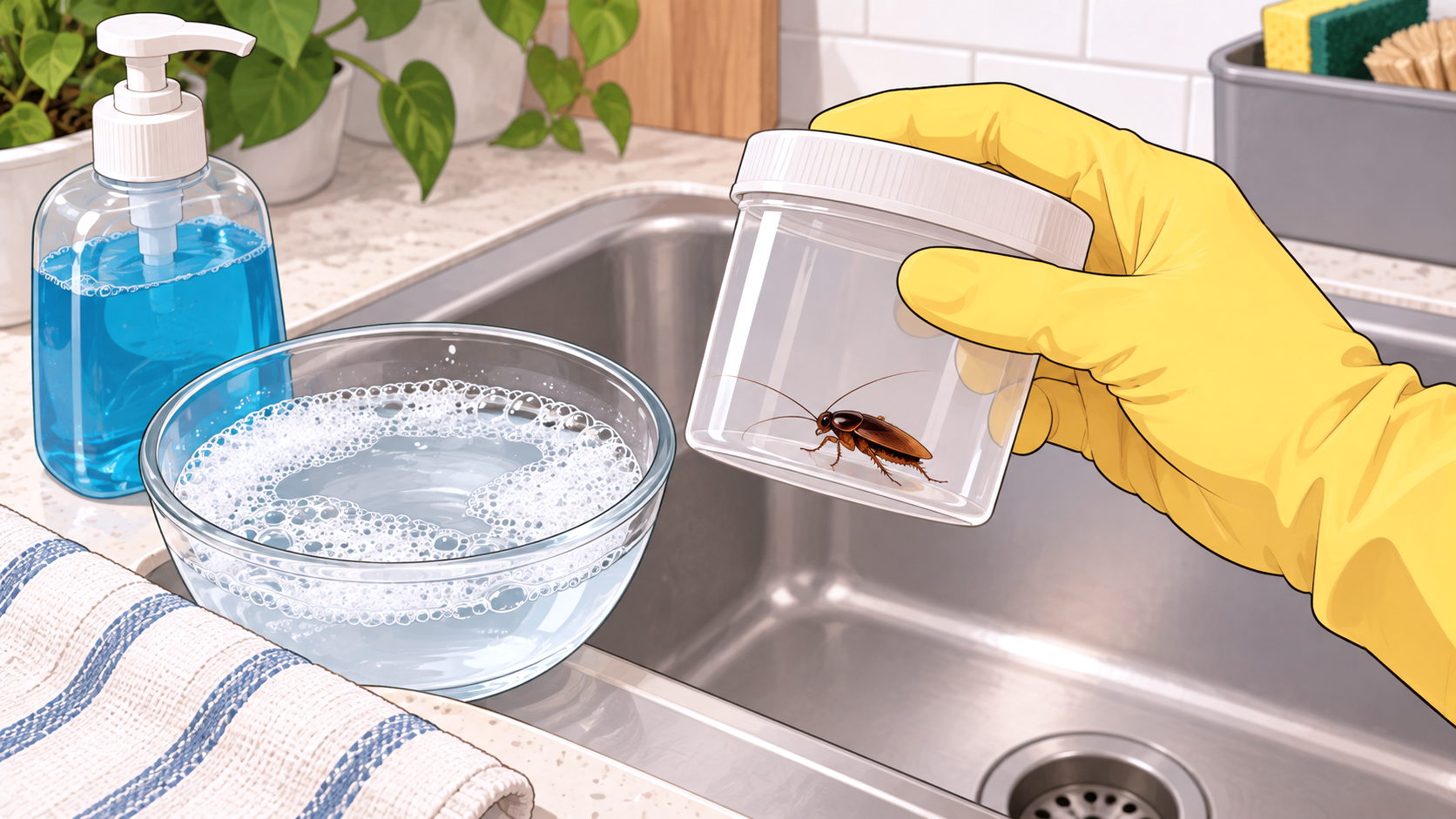
A cockroach sprayed with soapy water may flip onto its back, struggle briefly, and stop moving. This reaction is not simply a household myth. Dishwashing liquid has demonstrated insecticidal effects against cockroaches in laboratory experiments, although the results depend heavily on how much solution reaches the insect.
Yes, dish soap can kill cockroaches when a sufficiently concentrated solution thoroughly wets their bodies. Research has demonstrated high mortality in German cockroaches exposed to dishwashing liquid, but brief contact, incomplete coverage, or excessive dilution can allow some insects to recover. Dish soap also provides no dependable residual protection once the solution has dried.
It may be useful against an exposed insect, but its contact-dependent action makes it unsuitable as the primary treatment for an established infestation.
What Research Says About Dish Soap and Cockroach Mortality
One of the most relevant experiments was published in the Journal of Economic Entomology in 2002. Researchers exposed German cockroaches (Blattella germanica) to dishwashing liquid diluted in water at concentrations ranging from 0.05% to 5%.
The study of German cockroach responses to dishwashing liquid found that solutions containing 3% or more detergent caused all treated cockroaches to become unresponsive within three minutes. All treated insects at those concentrations eventually died within 72 hours. Adult females were generally more difficult to kill than younger cockroaches.
The researchers also observed that some insects recovered after initially becoming motionless, particularly at lower concentrations. A cockroach lying on its back immediately after being sprayed therefore cannot automatically be considered dead.
A separate study of commercial household cleaners and cockroaches examined German and American cockroaches exposed through spraying and immersion. Immersion in dishwashing liquid produced substantial mortality, while contact sprays were ineffective against adult American cockroaches in the tested conditions.
These findings establish that dish soap can be lethal, but they do not support a universal claim that any diluted household detergent will kill every cockroach it touches.
How Does Dish Soap Kill a Cockroach?
Dishwashing liquids contain surfactants, compounds that reduce surface tension and help water spread across surfaces. These properties can interfere with the protective barriers and respiratory structures of insects.
Cockroaches breathe through openings called spiracles, which connect to a network of internal air passages. The 2002 dishwashing-liquid study found evidence consistent with the solution entering or obstructing these respiratory passages, potentially causing asphyxiation.
The researchers observed that applying concentrated detergent to the upper surface of a cockroach did not immediately produce the same effects as wetting the underside of its body. This suggests that where the liquid reaches the insect is important, not simply whether a few drops land on its shell.
The University of Colorado’s guidance on insecticidal soaps explains that soap-based insecticides generally require direct contact and offer little continuing activity after drying. However, commercial insecticidal soaps differ in formulation from household dishwashing detergents.
An insect exposed only briefly may therefore remain alive, especially if the liquid never reaches its more vulnerable body surfaces.
Does Dawn Dish Soap Work Better Than Other Brands?
Dawn is frequently recommended online for killing cockroaches, partly because it was the detergent used in the 2002 German cockroach experiment. However, that study did not establish that Dawn is more effective than every competing product.
Commercial dishwashing liquids differ in surfactant composition, viscosity, fragrances, preservatives, and other additives. Even products sold under the same brand can have multiple formulations.
The 2007 comparison of household cleaners against cockroaches investigated several dishwashing liquids and cleaning products, including Dawn, Palmolive, and Joy. Its findings demonstrate that more than one household detergent can affect cockroaches, but mortality depends on the product and exposure method.
There is no dependable evidence that a specific fragrance, color, or marketing description makes a dish soap particularly effective against cockroaches.
Likewise, antibacterial dish soap should not be assumed more lethal than ordinary detergent. Ingredients intended to reduce bacteria are not necessarily responsible for the effects observed in cockroaches.
How Much Dish Soap Is Needed to Kill Cockroaches?
The laboratory results provide useful evidence about concentration, but they should not be converted into a guaranteed household recipe.
In the 2002 experiment, researchers tested carefully measured solutions and directly exposed individual German cockroaches. A concentration of 3% produced complete eventual mortality under those particular conditions, but household applications rarely provide the same control over coverage, contact duration, or insect behavior.
Simply adding more soap does not guarantee better results. A thick solution may distribute poorly through a spray nozzle, while a highly diluted mixture may cause temporary immobilization without fatal exposure.
Three practical limitations affect the result:
- Incomplete coverage: A cockroach may escape before enough liquid reaches its body.
- Uneven exposure: Soap landing on the upper shell may be less effective than solution reaching respiratory openings.
- Species differences: Results involving German cockroaches cannot automatically be applied to American, Oriental, or other species.
The different cockroach species found around homes vary considerably in size and behavior, making broad claims about a single soap concentration unreliable.
If an exposed cockroach becomes immobilized after contact, collect and securely dispose of it rather than assuming that it has died.
Can Soapy Water Kill Cockroaches Hidden in Cracks?
Dish soap is poorly suited to treating concealed cockroaches because the solution must reach the insects directly.
Spraying soapy water across a baseboard does not ensure that it penetrates the protected spaces behind the wall. Once the treated surface dries, ordinary dishwashing liquid does not provide a dependable insecticidal residue that cockroaches will encounter later.
The University of California’s cockroach management guidance emphasizes locating insect activity and using targeted, established control methods rather than relying on surface treatments that miss concealed populations.
Even if a spray kills several exposed adults, insects remaining inside furniture joints or structural openings may never contact the solution. The difficulty of eliminating cockroaches occupying concealed spaces cannot be resolved simply by increasing the amount of detergent applied.
Nor should soapy water be considered a reliable way to kill cockroach egg cases. Their protective capsules and sheltered locations make thorough liquid exposure uncertain. The removal of cockroach egg cases is more dependable when the cases are physically accessible.
Is Spraying Dish Soap Around the House Safe?
Dish soap is generally intended for washing dishes and compatible household surfaces, not for widespread insecticide application. Although ordinary hand-dishwashing detergent is typically less hazardous than many concentrated cleaning chemicals, exposure and material-damage concerns still exist.
According to Poison Control’s guidance on dish soap, household formulations can irritate the eyes and cause gastrointestinal symptoms if swallowed. The organization also advises against mixing dish soap with other cleaning products because potentially dangerous chemical reactions can occur.
Spraying large quantities onto floors may create slippery surfaces, while detergent residues can affect certain furniture finishes and fabrics. Water-based solutions should not be sprayed into electrical outlets, power strips, appliances, or other energized equipment.
Dish soap can be appropriate for cleaning compatible surfaces, but that is different from using it as an insecticide. For example, washing a contaminated countertop removes debris without requiring the entire surface to remain covered in detergent.
The risks associated with putting liquids inside cockroach-infested electronics are particularly important because water and detergent can damage internal components.
Commercial insecticidal soaps should not be confused with ordinary dish soap either. The formulations are different, and products labeled for garden pests are not automatically approved for cockroach control inside homes.
Can Dish Soap Interfere With Cockroach Bait?
Yes. Spraying detergent or other household cleaners directly onto cockroach bait can contaminate the formulation and reduce its attractiveness.
An EPA training manual on cockroach management identifies contamination by household cleaners and pesticide sprays as a reason cockroach baits may perform poorly.
Consequently, washing an area containing active bait placements without regard to the product instructions can undermine treatment. Cleaning should be coordinated with the bait manufacturer’s directions rather than repeatedly soaking the same cracks and crevices.
The EPA recommends registered pest-control products used according to their labels, with treatment choices based on the intended pest and application site.
A household dishwashing detergent does not offer the tested formulation, application instructions, or residual performance of a registered cockroach product.
Is Dish Soap Worth Using Against Cockroaches?
Dish soap has credible experimental evidence of lethal contact effects, particularly against German cockroaches that receive thorough exposure. Its limitations become apparent when only part of an insect is wetted, the solution is diluted unpredictably, or cockroaches remain concealed.
For an individual insect on a washable, non-electrical surface, soapy water may immobilize or kill it. The difference between quickly incapacitating a cockroach and confirming its death is important when deciding whether the insect has been successfully removed.
Repeated sightings require a different assessment. Killing exposed cockroaches with detergent does not establish that a breeding population has disappeared, and continued activity should be evaluated through monitoring. The evidence used to determine whether cockroaches are gone is more meaningful than counting insects that briefly stopped moving after being sprayed.
Dish soap can kill cockroaches under suitable contact conditions, but its unreliability as a spray and lack of residual action make it a limited tool rather than a dependable infestation treatment.