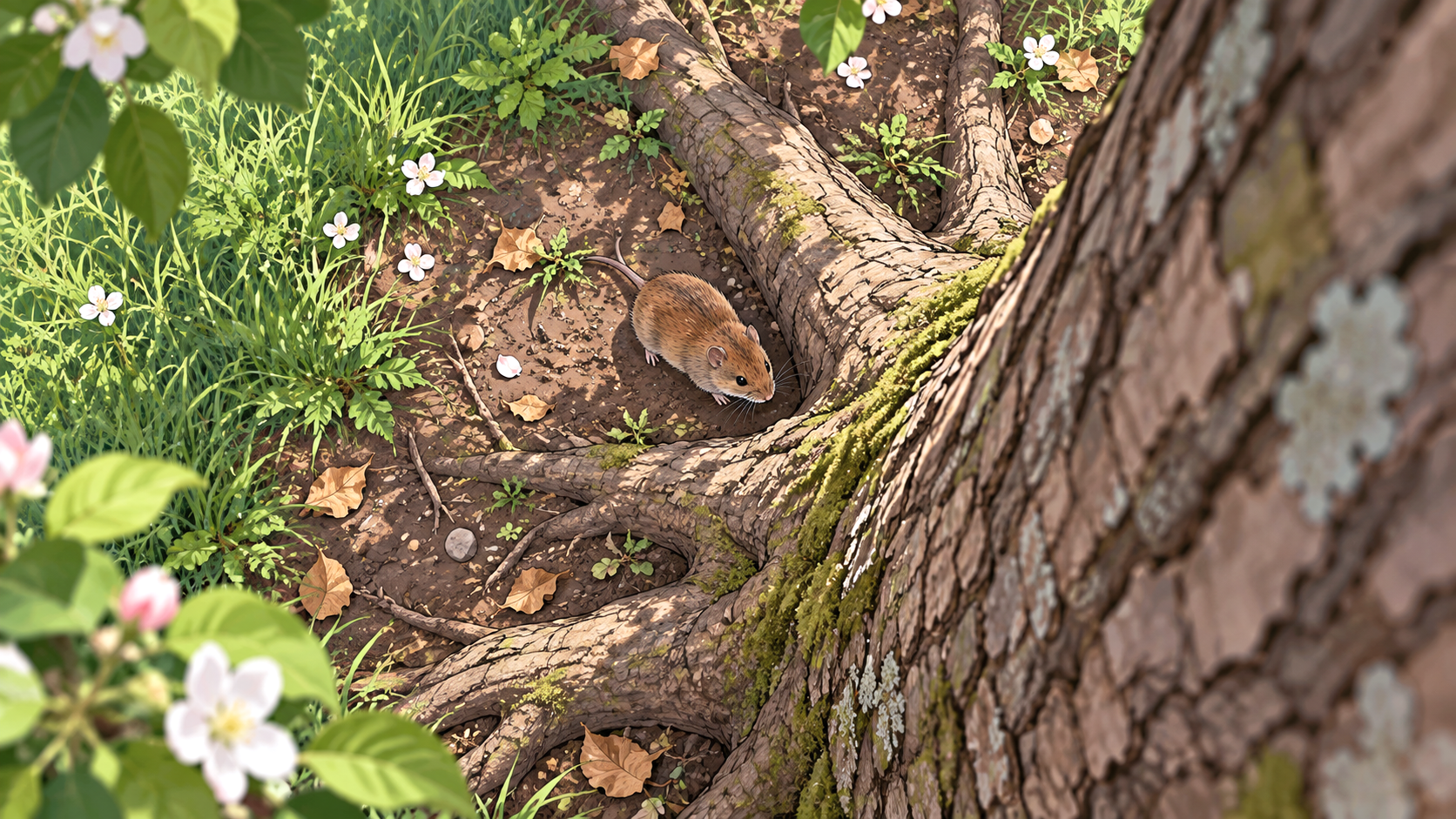
Voles can climb trees, although their climbing abilities vary considerably between species. Bank voles and red-backed voles are capable climbers that may travel along branches, forage aboveground, and descend tree trunks. Meadow voles and field voles generally spend much more time on or near the ground, using vegetation and shallow passages for movement.
Climbing is not necessarily an unusual response to danger. For some woodland species, trees provide another part of the environment in which they regularly search for food and avoid predators. Scientists have even recorded northern red-backed voles descending trunks headfirst, despite their short legs and relatively short tails.
Which Vole Species Can Climb Trees?
Bank voles (Myodes glareolus, also classified as Clethrionomys glareolus) are among the better-documented climbing species. They inhabit woodlands, hedgerows, and gardens across much of Europe, frequently moving into bushes and small trees. The People’s Trust for Endangered Species describes their ability to climb through shrubs while feeding on fruit and buds. Unlike animals that remain closely associated with grass-level runways, bank voles readily exploit vegetation above the soil surface.
Their climbing behavior has also been examined experimentally. A study of bank voles in Oxfordshire woodlands investigated how the animals used trees under different environmental conditions. Researchers placed live traps both on the ground and at heights of 30–250 centimetres, demonstrating that tree use could be studied as a regular component of their spatial behavior rather than dismissed as an accidental occurrence.
Northern red-backed voles (Myodes rutilus) provide a North American example. Although historically regarded as predominantly terrestrial, researchers in Alaska documented individuals climbing spruce trees at heights of approximately two metres. The 2015 study published in the Journal of Mammalogy established that these animals voluntarily climbed trees and exhibited coordinated movements along branches.
Other red-backed voles, including southern red-backed voles (Myodes gapperi), have also been recorded in trees. These species belong to a broader group of woodland-associated voles whose climbing abilities differ from those of many grassland species. The different types of voles therefore include both capable climbers and animals that spend most of their lives at ground level.
How High Can a Vole Climb?
The height a vole can reach depends on the species and the structure of the tree. Northern red-backed voles were captured approximately two metres aboveground during the Alaska research, while earlier observations of other red-backed vole species documented individuals several metres up trees.
These observations should not be interpreted as maximum climbing heights. Finding an animal at a particular elevation establishes that it reached that point, not that it was physically incapable of climbing higher.
Tree structure also influences accessibility. Rough bark, low branches, and interconnected shrubs provide footholds and opportunities to move between surfaces. A smooth, exposed trunk offers different climbing conditions from a densely branched spruce. Comparisons of climbing behavior therefore need to account for the vegetation available, not simply the species involved.
The University of Alaska Fairbanks’ account of northern red-backed vole research documents individuals moving up and down spruce trunks, including one that climbed along a branch using coordinated forelimb movements. The recordings challenged assumptions that voles’ compact bodies necessarily prevented them from climbing.
Voles Can Descend Trees Headfirst
Climbing upward is only part of moving through a tree. Descending safely requires an animal to maintain its grip while controlling its weight on a steep surface.
Northern red-backed voles have been recorded moving down tree trunks headfirst. The animals accomplish this partly by rotating their hind feet to maintain contact with the bark. The movement resembles an ability familiar from squirrels, although voles do not possess the same overall body proportions or specialized lifestyle.
The Alaska climbing observations established this behavior through direct sightings and subsequent research. Headfirst descent is particularly notable because some mammals that climb trees readily have difficulty coming down in the same orientation.
This does not establish that every vole species can descend a vertical trunk headfirst. The documented ability belongs to particular red-backed voles, and differences in limb coordination or available surfaces can influence how other species move.
Why Would a Vole Climb a Tree?
Food and escape opportunities are two documented reasons for climbing. Bank voles can reach fruit, berries, and buds in shrubs and trees, while northern red-backed voles have been observed collecting arboreal lichens. During the Alaska investigation, a camera recorded a vole reaching from one branch toward lichen growing on another before eating it.
Predation risk can also change how voles use trees. In an experiment involving bank voles and grey-sided voles, both species increased their use of trees when exposed to the presence of a least weasel. Bank voles spent more time in trees than grey-sided voles, demonstrating that the response differed between species even under comparable experimental conditions.
A separate field study of voles and shrews identified climbing as a recognized response of bank voles to weasels, while field voles more commonly sought refuge at or below ground level.
A vole climbing a tree is not necessarily escaping a predator, however. An animal feeding on buds or lichens may simply be exploiting food that is unavailable at ground level. The foods consumed by voles differ among species, helping explain why some climb into vegetation more frequently than others.
Do Meadow Voles Climb Trees?
Meadow voles (Microtus pennsylvanicus) are predominantly ground-associated animals. They typically move through grass, herbaceous vegetation, and shallow passages rather than regularly exploring trunks and branches. Their short legs and compact bodies do not make climbing impossible, but they lack the documented degree of tree use found in bank voles and certain red-backed voles.
European field voles (Microtus agrestis) show a similar preference for ground-level shelter. Research comparing field voles with bank voles has identified differences in their responses to predators, with field voles more likely to seek cover at or below the soil surface.
These differences are best understood as behavioral tendencies, not absolute physical restrictions. A meadow vole moving onto an inclined branch or low woody structure would not contradict its predominantly terrestrial lifestyle.
The surface pathways used by voles are particularly associated with grassland activity, while woodland habitats can provide additional opportunities for movement above the ground. Observing a vole on a branch therefore gives some ecological context, but it is not sufficient to identify its species.
Does Finding a Vole in a Tree Mean It Lives There?
A vole climbing through a tree should not automatically be assumed to nest there. Tree use may involve feeding, exploring, or escaping a predator, while the animal continues to spend most of its time elsewhere.
Bank voles and red-backed voles are regularly associated with woodland ground cover, fallen logs, and sheltered spaces near the soil. The Wildlife Trusts’ bank vole profile describes shallow burrows and nests built aboveground where digging conditions are unsuitable. An individual visiting a bird table or moving through shrub branches does not necessarily occupy a nest in the tree.
Climbing ability should also not be confused with evidence of feeding damage. A vole seen on a trunk may be traveling or collecting food from vegetation, while bark damage associated with voles requires separate examination of the injury itself. Tree presence alone cannot establish that the animal caused damage.
For a reliable observation, note the species’ visible characteristics, the height reached, the surface it climbed, and whether it was feeding or moving away from a disturbance. These details provide more useful evidence than assuming that all voles remain on the ground or that every vole found aboveground is an unusually skilled climber.