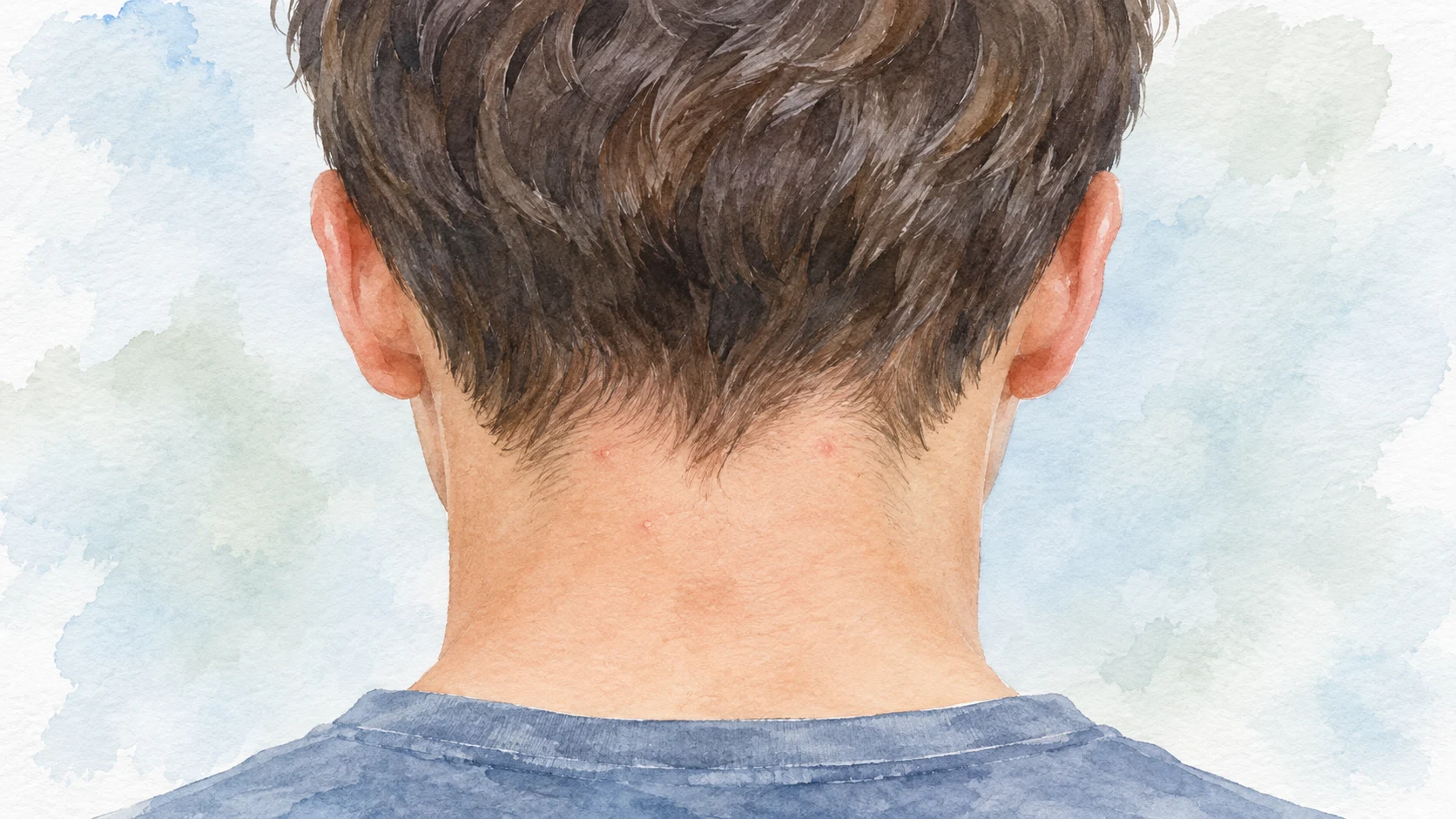
Head lice bites can appear as tiny red, pink, or darker irritated spots on the scalp, sometimes with small raised bumps. They may be difficult to see beneath the hair, and some people develop no obvious marks at all. The appearance depends partly on how the skin reacts to louse saliva and whether the person has been scratching.
Unlike insects that leave relatively conspicuous marks on exposed skin, head lice feed close to the scalp, where individual feeding sites are often hidden by hair. A person may notice persistent itching without ever finding a recognizable bite.
You cannot reliably identify head lice from bite marks alone. Small scalp bumps, redness, and scratch marks are not unique to lice. Finding a living head louse provides much stronger evidence of an active infestation than the appearance of the skin.
What Does an Individual Head Lice Bite Look Like?
An individual head lice bite is usually extremely small. The louse pierces the skin with specialized mouthparts to feed on blood, but the feeding site does not necessarily leave a clearly visible puncture mark.
When the skin reacts, the surrounding area may develop a small, itchy bump or localized discoloration. On lighter skin, this can appear pink or red. On darker skin, inflammation may look brownish, purplish, or slightly darker than the surrounding scalp rather than bright red.
Some reactions resemble tiny pimples, although they are not necessarily filled with pus. Others appear as flat irritated spots that are easier to feel than to see. The bumps may be scattered rather than forming a recognizable pattern.
Small red bumps on the scalp and around the neckline are among the recognized skin findings associated with head lice. However, their presence is not specific enough to establish that lice caused them.
A bite also does not have to produce an immediate reaction. Someone who has recently acquired head lice may have no visible bumps because their immune system has not yet developed a noticeable response.
The absence of marks is therefore just as important to understand as their presence. A normal-looking scalp does not rule out lice, and an irritated scalp does not prove that lice are responsible.
Where Are Head Lice Bite Marks Most Likely to Appear?
Head lice feed on the scalp, so any visible bite-related reactions are generally associated with the skin beneath the hair. Irritation may be particularly noticeable behind the ears and around the back of the head near the neckline.
These areas are commonly associated with head lice activity, although lice can occur elsewhere on the scalp. The typical locations where head lice are found help explain why someone might notice irritation near the ears or nape rather than across the entire head.
The back of the neck is one of the few places where small bumps may be relatively easy to see without parting much hair. A person with short hair might notice a few irritated spots along the hairline, while similar marks could remain completely hidden beneath longer hair.
Small itchy bumps around the back hairline are also described among the visible features of a head lice infestation. They may occur alongside other scalp changes, including scratches.
Location alone is not enough to identify the cause. A bump behind an ear or near the neckline is not automatically a head lice bite simply because lice commonly occupy those areas.
Head lice are primarily associated with scalp hair. A widespread eruption across the trunk or limbs is not the usual appearance of ordinary head lice feeding. The extent of lice-associated reactions on the neck or body requires separate consideration rather than assuming that every distant mark is a bite.
Are Head Lice Bites Red, Brown, or Purple?
There is no single color that identifies a head lice bite.
Fresh inflammation may look red or pink on lighter skin. On darker skin, the same response can appear less red and more brown, violet, or darker than the surrounding skin. Some marks are subtle enough that their color is difficult to distinguish without good lighting.
Scratching can change their appearance further. A small bump may develop a superficial scab, making it appear dark red or brown. Older irritated areas can also retain discoloration after the initial inflammation has settled.
Not every dark speck on a louse-infested scalp represents a bite. Head lice produce fecal material containing digested blood, and this can appear as reddish-brown or dark spots. These traces are different from the skin’s inflammatory response.
Descriptions of head lice and their associated scalp findings distinguish red-brown fecal spots from irritation caused by scratching. Confusing the two can lead someone to interpret ordinary debris or surface marks as evidence of multiple bites.
A tiny dark spot may therefore be a crust, a trace of louse waste, or an unrelated mark. Color alone cannot distinguish among these possibilities.
The appearance of head lice droppings is a separate identification issue because fecal traces are not the same thing as raised, inflamed skin.
Do Head Lice Bites Have a Visible Puncture Mark?
Most people cannot identify a definite puncture point from a head louse bite with the naked eye.
Head lice have piercing-sucking mouthparts adapted for feeding on blood. Their feeding activity can provoke irritation, but the actual skin opening is extremely small.
A person looking closely at an itchy bump might notice a darker center or tiny crust. That does not establish that the mark is a louse puncture. Scratching and other minor skin changes can produce similar appearances.
Under magnification, clinicians may observe tiny inflammatory or hemorrhagic papules associated with lice. These findings are described in dermatological accounts of pediculosis, but they are not a dependable identification feature for someone examining their own scalp.
There is no characteristic pair of punctures, large central hole, or distinctive geometric shape that reliably identifies a head lice bite.
Trying to locate a precise feeding hole in every bump is therefore unlikely to resolve whether lice are present.
Do Head Lice Bites Appear in Clusters or Lines?
Head lice bites do not have a dependable arrangement that can be used to identify them.
Several irritated spots may appear close together because lice repeatedly feed in an area of the scalp. Scratching can also produce multiple marks in the same region. However, those observations do not establish a predictable bite pattern.
A few bumps along the neckline could be associated with head lice, but a line of bumps is not proof of lice feeding. Similarly, scattered spots across the scalp do not rule out an infestation.
The arrangement of marks is especially unreliable when the person has scratched repeatedly. A fingernail can create several short abrasions, making the skin appear more extensively affected than the original feeding sites.
Comparisons with other biting insects can be misleading. Head lice remain among scalp hairs, whereas bed bugs and head lice differ in their habitats and feeding behavior. Their marks should not be identified solely by a supposed pattern of bites.
A photograph showing three bumps in a row, for example, cannot establish which insect caused them. The surrounding evidence is more informative than the number or arrangement of the marks.
Can Head Lice Bite Without Leaving Any Marks?
Yes. Head lice can feed without producing visible bite marks.
The itching associated with head lice is largely related to an immune response to louse saliva. That response varies among individuals and may take time to develop, particularly during a first infestation.
Some people experience itching without noticeable bumps. Others may have living lice on their scalp while feeling little or no irritation.
The symptoms of head lice can be absent during an early or light infestation. During a first infestation, itching may take four to six weeks to develop.
This delay explains why visible bite reactions are not a dependable way to estimate when lice first arrived. A person who notices bumps today may have acquired lice earlier, while someone with a recent infestation may have no marks at all.
Skin sensitivity also varies. Two people exposed to head lice may show different reactions, even when both have living insects in their hair.
The reasons head lice may be present without itching are closely related to these differences in immune response.
A lack of visible bites should never be treated as confirmation that the scalp is free of lice.
How Are Head Lice Bites Different From Scratching Marks?
A bite-related reaction and a scratching injury are not the same thing, although they can occur together.
A localized bite reaction may appear as a small bump or irritated spot. Scratching can create longer, irregular abrasions, broken skin, crusts, and areas of more extensive redness or discoloration.
Someone who scratches repeatedly may eventually have more visible damage from their fingernails than from the original bites. This can make it difficult to recognize where the initial irritation began.
The difference becomes especially noticeable when the scalp contains linear scratches rather than isolated bumps. Such marks reflect physical injury to the skin, not necessarily individual feeding sites.
Scabs also complicate interpretation. A crusted bump may have started as a bite-related reaction, but its present appearance can be dominated by scratching.
Repeated scratching can sometimes lead to secondary infection. The warning signs and complications are covered separately in head lice-related scalp sores and infection.
For identifying bite appearance, the important point is that the most conspicuous marks on an irritated scalp may not be the bites themselves.
Can You Identify Head Lice From a Photo of Scalp Bumps?
A photograph of scalp bumps cannot reliably confirm head lice.
Even a sharp, well-lit image may show only redness, small raised spots, or scratch marks. These findings are not unique to a lice infestation, and their appearance can change with lighting, skin tone, camera quality, and the stage of irritation.
Photographs taken through thick hair are particularly limited. A small bump may be partly obscured, while a shadow or hair follicle can make the skin look more irregular than it is.
An enlarged image can reveal more detail without necessarily revealing the cause. Magnification may make a tiny crust or pore appear significant, even when it has no distinctive relationship to lice.
A photograph showing a living louse on the hair is different from one showing skin marks alone. The insect provides direct evidence that a photograph of bumps cannot supply.
This is why the signs of a head lice infestation should not be reduced to the appearance of bites. Physical evidence of lice carries greater diagnostic value than nonspecific skin reactions.
A clinician may also need to examine the scalp directly when the cause of persistent lesions is uncertain. A photograph can document what the skin looks like, but it should not be treated as a definitive identification method.
What Do Head Lice Bites Look Like After They Begin Healing?
As inflammation settles, a bite-related bump may become flatter and less noticeable. Redness or other discoloration may gradually fade, although the rate varies with the person’s skin and the extent of irritation.
If the area was scratched, a small crust may remain while the superficial skin heals. Once the crust separates naturally, temporary discoloration may still be visible.
These changes are not specific to head lice. Many minor inflammatory skin reactions follow a similar course, so a fading bump cannot reveal what originally caused it.
The appearance of old marks also cannot establish whether lice remain alive. Skin inflammation can persist after feeding has stopped, and visible marks may disappear even when an infestation continues.
Someone who notices a few fading bumps after lice treatment should therefore avoid interpreting them as proof of either treatment success or failure. Itching and irritation after lice treatment have their own possible explanations.
If an area becomes increasingly painful, swollen, warm, or produces pus rather than gradually improving, medical assessment is appropriate. Those changes should not be assumed to represent normal healing of an insect bite.
What Bite Marks Can and Cannot Tell You About Head Lice
Head lice bites may leave tiny bumps, localized redness, darker irritated spots, or no visible reaction whatsoever. They can be difficult to distinguish from scratches and other minor scalp changes, especially when hidden beneath hair.
The location of a mark, its color, and whether several bumps appear together may provide context, but none of those characteristics is distinctive enough to identify head lice.
The most useful conclusion is that bite marks are supporting observations, not reliable proof of an infestation. A person can have head lice without visible bites, and a person can have scalp bumps without head lice.
When the cause of the marks is uncertain, identifying the insect itself is more dependable than trying to interpret the skin’s reaction. Persistent or worsening lesions warrant professional assessment rather than an assumption that lice are responsible.