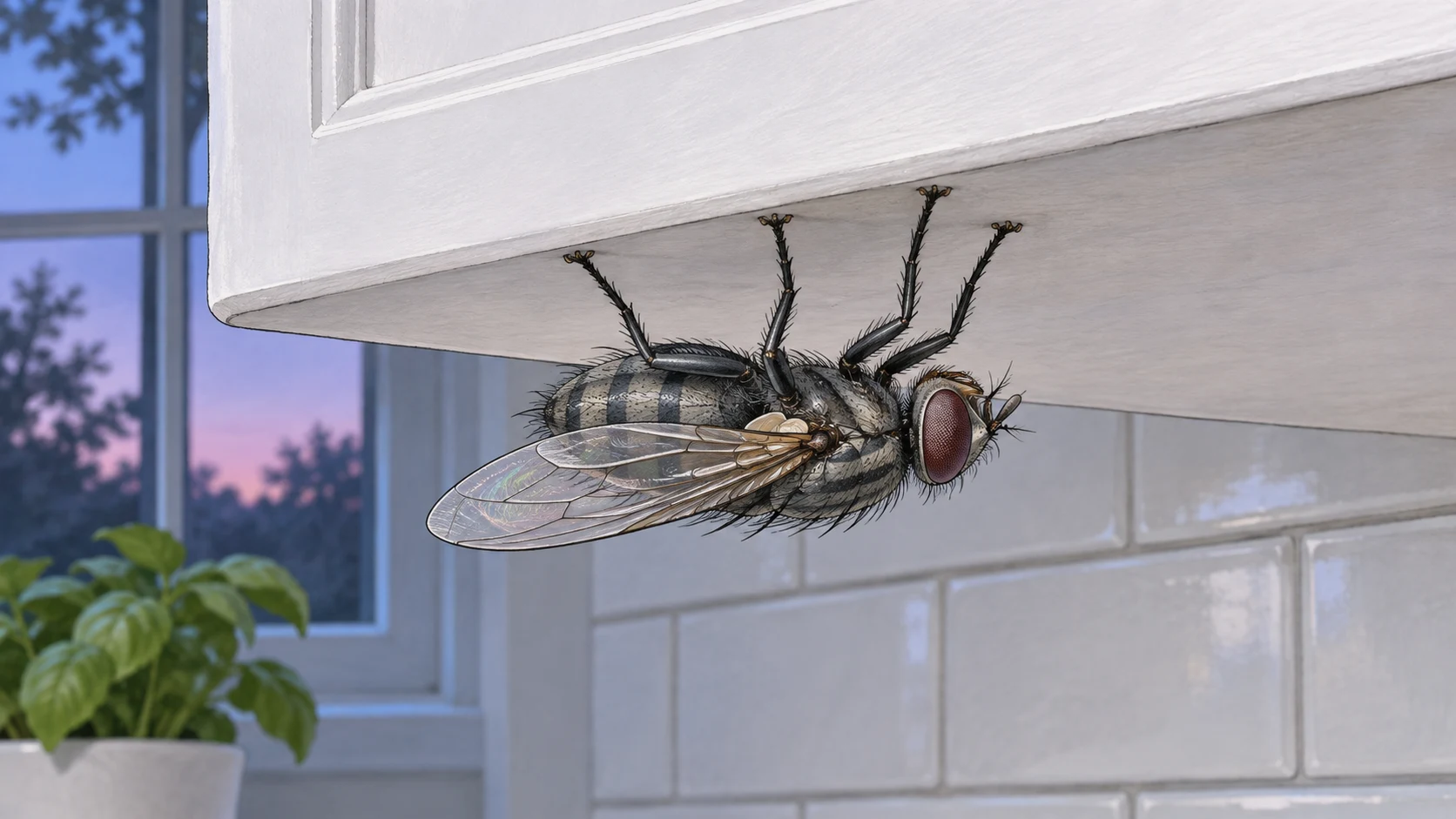
A house fly that remains motionless for hours during the night may look as though it has fallen asleep. But does it actually sleep, or is it simply resting until conditions become favorable for activity again?
The common house fly, Musca domestica, has a well-documented pattern of nighttime inactivity. Researchers have observed house flies becoming quiet after darkness begins, remaining largely motionless for extended periods, and showing changes in their activity that suggest an internal daily rhythm.
Whether that inactivity qualifies as sleep requires a more careful answer. Scientists have demonstrated genuine sleep-like behavior in fruit flies, including reduced responsiveness and recovery sleep after deprivation. However, most of those experiments involve Drosophila melanogaster, not the common house fly.
House flies clearly rest, and their nighttime inactivity resembles sleep, but the strongest experimental evidence for insect sleep comes from studies of other fly species.
Do House Flies Really Sleep or Just Rest?
House flies undergo regular periods of inactivity, particularly during the night. Their movement decreases, they stop flying, and they may remain motionless for considerable periods.
Scientists often describe this behavior as resting or quiescence.
Those terms are deliberately more precise than sleep because an animal can remain motionless for several reasons. It may be conserving energy, responding to darkness, experiencing unfavorable temperatures, or entering a regulated sleep state.
Sleep is more than the absence of movement.
Researchers generally look for evidence that an inactive animal becomes less responsive to ordinary disturbances, can awaken when sufficiently stimulated, and compensates for lost sleep by resting more afterward.
The scientific review Sleeping Flies Don’t Lie explains how these behavioral characteristics are used to distinguish insect sleep from ordinary inactivity.
House flies exhibit one important part of this pattern: consolidated periods of rest associated with the daily light-dark cycle.
The more demanding question is whether their resting state has been shown to satisfy the additional experimental criteria established in sleep research.
The evidence is much stronger for fruit flies than for house flies.
What House Flies Do When Night Falls
House flies generally become less active as daylight fades. Flight activity decreases, and individuals settle into periods of relative immobility.
This behavior has been investigated directly rather than inferred solely from casual observations.
In a 1966 study published in the Japanese Journal of Medical Science and Biology, researcher Chisato Tsutsumi examined house fly activity under different lighting conditions.
The study, Studies on the Behavior of the Housefly, Musca domestica L. I, documented a marked behavioral change when illumination was switched off.
The flies moved upward and then remained quiet during the dark period.
The researchers also examined what happened when flies that had experienced a regular light-dark schedule were subsequently exposed to continuous illumination.
Their behavior did not immediately become uniform throughout the day.
Instead, the flies showed a period of increased activity followed by a period of quiet resting behavior at approximately the time when darkness would normally have occurred.
This suggested that their activity was influenced by an internal timing mechanism rather than light alone.
However, the rhythm did not persist indefinitely under the experimental conditions. Continuous illumination tended to disrupt it.
The study provides direct evidence of nighttime resting behavior in Musca domestica. It does not, by itself, establish that the flies were experiencing every defining feature of sleep.
How Scientists Decide Whether an Insect Is Sleeping
Sleep research cannot depend entirely on whether an animal closes its eyes or appears comfortable.
Many insects do not have eyelids, and their resting behavior looks very different from human sleep.
Researchers therefore use behavioral tests that can be applied across animal groups.
Several characteristics are particularly important.
| Characteristic | What researchers examine |
|---|---|
| Sustained inactivity | Whether the animal remains still for a meaningful period |
| Reduced responsiveness | Whether stronger stimulation is needed to produce a response |
| Reversibility | Whether the animal can return to activity when disturbed |
| Daily regulation | Whether rest follows a recurring biological rhythm |
| Recovery after deprivation | Whether lost rest produces increased subsequent sleep |
No single observation provides the entire answer.
A fly remaining motionless for an hour demonstrates inactivity. It does not necessarily demonstrate reduced responsiveness or a compensatory response after sleep deprivation.
Likewise, an insect becoming quiet when the lights go out demonstrates a relationship between lighting and activity, but does not establish that the insect has entered a sleep state.
The combination of evidence is what allows researchers to distinguish sleep from other forms of rest.
Why Reduced Responsiveness Matters
An animal that is asleep generally requires a stronger stimulus to awaken than one that is already alert.
Scientists call this an increased arousal threshold.
For a fly, researchers might examine how strongly it responds to mechanical disturbances, changes in lighting, or other controlled stimuli.
A resting fly may respond slowly or require more stimulation than an active fly.
However, reduced movement alone does not prove that the arousal threshold has increased.
An insect may also move less because it is cold, weak, or otherwise physiologically impaired.
Researchers must separate these possibilities through controlled experiments.
Why Recovery Sleep Matters
Another important characteristic is sleep homeostasis.
Homeostasis means that an organism regulates a biological condition and responds when that condition is disturbed.
In sleep research, this can be tested by preventing an animal from resting normally.
If the animal subsequently spends more time sleeping or enters a deeper sleep-like state, researchers describe the response as sleep rebound.
A rebound suggests that the animal has an internally regulated need for sleep rather than simply becoming inactive whenever external conditions permit.
This is one of the strongest pieces of evidence used to establish sleep in fruit flies.
It should not automatically be attributed to house flies without equivalent species-specific evidence.
What Fruit Fly Experiments Tell Us About Insect Sleep
Much of the scientific understanding of sleep in flies comes from the vinegar fly or fruit fly, Drosophila melanogaster.
This species is widely used in laboratory research because its behavior, nervous system, and genetics can be studied under controlled conditions.
In 2000, two influential studies established that its periods of inactivity possess several characteristics associated with sleep.
One study, Correlates of Sleep and Waking in Drosophila melanogaster, found that resting fruit flies became less responsive to stimulation and showed homeostatic regulation of rest.
The researchers also identified similarities between the biological processes associated with sleep in fruit flies and those observed in mammals.
A second study, Rest in Drosophila Is a Sleep-like State, found that resting fruit flies could remain motionless for extended periods and were less responsive to sensory disturbances.
When researchers prevented normal rest, the flies subsequently displayed increased resting behavior.
Together, these experiments demonstrated that insect inactivity can represent a biologically regulated sleep-like state.
The findings were important because they showed that sleep does not necessarily require the complex brain structures found in mammals.
However, the experimental subjects were fruit flies, not house flies.
Both are true flies, belonging to the order Diptera, but they are different species with different ecological and behavioral characteristics.
Their shared ancestry makes comparisons scientifically useful. It does not make the results interchangeable.
Why Fruit Fly Sleep Studies Cannot Be Applied Directly to House Flies
The common house fly belongs to the family Muscidae. The laboratory fruit fly Drosophila melanogaster belongs to the family Drosophilidae.
Both possess nervous systems that regulate movement and daily activity, but they have evolved different behaviors and ecological adaptations.
A finding demonstrated in one species can suggest a question worth investigating in another.
It cannot establish that the second species has exactly the same sleep duration, arousal threshold, or response to deprivation.
For example, researchers commonly classify fruit fly sleep using periods of immobility lasting at least five minutes.
That threshold is based on experiments linking immobility with reduced responsiveness in Drosophila.
It should not be presented as a validated definition of sleep for Musca domestica.
Similarly, claims that house flies need a particular number of hours of sleep each day cannot be established simply by copying laboratory measurements from fruit flies.
A 2025 review of sleep states in Drosophila discusses how even the interpretation of sleep within the extensively studied fruit fly remains an active area of research.
Researchers increasingly recognize that different forms of inactivity may have different physiological properties.
That complexity makes species-specific evidence especially important.
Do House Flies Have an Internal Sleep-Wake Clock?
House flies possess daily patterns of activity that appear to involve internal biological timing.
These rhythms are commonly described as circadian rhythms, meaning biological cycles with a period of approximately 24 hours.
The 1966 study by Tsutsumi provides evidence for such timing in house flies.
When flies were exposed to a regular sequence of light and darkness, they developed a recognizable pattern of activity and rest.
After the lighting conditions changed, the flies initially continued displaying behavior associated with the earlier schedule.
This suggests that their activity was not determined solely by the immediate presence or absence of light.
An internal timing process contributed to the pattern.
A follow-up study published in 1968, Some Environmental Factors Affecting the Nighttime Resting Behavior of Flies, investigated how lighting, temperature, and feeding deprivation affected house fly resting behavior.
The existence of a daily biological rhythm is consistent with regulated rest, but a circadian rhythm is not the same thing as sleep.
An animal can have an internal clock controlling activity without every inactive period necessarily qualifying as sleep.
Does Darkness Make House Flies Sleep?
Darkness is strongly associated with reduced house fly activity, but it would be too simple to say that turning off the lights automatically makes a house fly sleep.
The original house fly experiments showed that a change from illumination to darkness produced a recognizable resting response.
However, they also demonstrated that previous exposure to a regular light-dark schedule could influence subsequent behavior.
The flies’ response therefore involved both immediate environmental signals and their recent biological history.
Darkness may encourage or coincide with inactivity, but the relationship is not identical to a switch that turns sleep on and off.
The temperature of the environment and the fly’s physiological condition can also influence how active it remains.
A motionless fly in darkness may be resting, but its exact physiological state cannot be determined from lighting alone.
Can House Flies Wake Up When Disturbed?
A resting house fly can respond to disturbances and resume movement.
The ability to return to activity is consistent with ordinary rest and with sleep-like states.
It also helps distinguish reversible inactivity from conditions such as death or severe physiological impairment.
However, waking in response to a disturbance does not establish that the fly was asleep beforehand.
An alert but motionless insect may also react when approached.
To determine whether a fly was in a sleep-like state, researchers would need to compare its responsiveness with that of an active fly under controlled conditions.
The strength of the disturbance matters.
A small movement nearby may produce no response, while direct contact or a stronger disturbance may cause the insect to move.
That difference is potentially informative, but casual household observations are not controlled measurements of arousal threshold.
For house flies, the safest interpretation is that resting individuals can be disturbed, while the exact relationship between their responsiveness and sleep remains less thoroughly characterized than in Drosophila.
Do House Flies Need to Make Up for Lost Sleep?
The clearest evidence for recovery sleep in flies comes from Drosophila melanogaster.
In controlled experiments, fruit flies prevented from resting normally subsequently showed increased rest.
This response indicates that their sleep-like state is regulated by an internal need.
The 2000 studies by Shaw and colleagues and Hendricks and colleagues helped establish this principle.
A later scientific review, Sleep, Arousal, and Rhythms in Flies, explains how sleep homeostasis and circadian regulation interact in fruit flies.
For common house flies, nighttime resting behavior has been documented, but those observations should not be treated as direct evidence of an equivalent recovery-sleep response.
The distinction matters when evaluating claims about sleep deprivation.
A house fly disturbed repeatedly during the night may experience changes in activity, stress, or energy expenditure.
That does not establish how much sleep it has lost or whether it will compensate by sleeping longer afterward.
Those questions require experiments specifically designed to measure sleep homeostasis in Musca domestica.
How Temperature Affects House Fly Resting Behavior
Temperature can influence the activity of house flies because their body functions depend strongly on environmental conditions.
At lower temperatures, movement and other physiological processes may slow.
A fly that is inactive because it is cold is not necessarily asleep.
The 1968 house fly study investigated temperature as one of the environmental factors affecting nighttime resting behavior.
This illustrates why researchers must consider the conditions under which inactivity occurs.
A fly that remains motionless at a low temperature may have reduced activity because its muscles and nervous system are functioning more slowly.
A fly resting at a suitable temperature may be inactive for different reasons.
The outward behavior can look similar, but the underlying physiological state may not be the same.
For that reason, temperature-controlled experiments are important when investigating insect sleep.
Can House Flies Rest During the Day?
Yes. House flies can remain inactive for periods during daylight.
A fly does not have to be continuously walking or flying whenever light is present.
It may pause between bouts of activity, remain stationary while environmental conditions change, or experience a period of reduced movement.
However, a short daytime pause should not automatically be classified as sleep.
The difference between a brief resting interval and a regulated sleep-like episode depends on more than how long the insect remains still.
Research on Drosophila has documented sleep-like rest during both daytime and nighttime periods.
Those results establish that insect sleep is not necessarily confined to darkness, but they do not provide a precise daytime sleep schedule for common house flies.
For Musca domestica, the strongest direct observations concern the broader daily pattern of activity and nighttime rest.
Can You Tell Whether a House Fly Is Sleeping Just by Looking?
Not reliably.
A stationary house fly may be resting, experiencing reduced activity because of environmental conditions, or occupying a state that resembles sleep.
Its posture and lack of movement do not reveal whether it has an increased arousal threshold or an internally regulated need for recovery sleep.
A fly that responds when disturbed might have been resting or sleeping. A fly that does not respond immediately might be deeply inactive, cold, injured, or otherwise impaired.
The same outward behavior can have several explanations.
Scientists distinguish among these possibilities by measuring responses to controlled stimuli and observing how behavior changes after rest deprivation.
A person watching a house fly on a wall cannot perform those tests simply by noting how long the insect remains still.
The most accurate everyday description is that the fly is resting or inactive.
Calling it asleep is understandable in ordinary conversation, but it implies a physiological conclusion that casual observation cannot establish.
What House Fly Research Actually Establishes
The evidence becomes clearer when studies of common house flies are separated from studies of laboratory fruit flies.
| Question | What the research supports |
|---|---|
| Do house flies become inactive at night? | Yes. Direct experiments document nighttime resting behavior. |
| Is house fly rest influenced by daily biological timing? | Yes. Experimental observations suggest an internal circadian component. |
| Can environmental conditions influence house fly rest? | Yes. Lighting, temperature, and feeding conditions have been investigated. |
| Do fruit flies experience a scientifically established sleep-like state? | Yes. Controlled experiments demonstrate reduced responsiveness and sleep rebound. |
| Have those same sleep criteria been established here for common house flies? | The cited house fly studies do not demonstrate the full set of criteria. |
| Can a person identify house fly sleep by watching a motionless insect? | No. Inactivity alone cannot establish sleep. |
A 2020 study, Diurnal Flight Activity of House Flies Is Influenced by Sex, Time of Day, and Environmental Conditions, provides further evidence that house fly activity changes across the day and responds to environmental conditions.
That study measured flight activity rather than directly testing sleep.
Together, the research supports a clear description of house fly rest and activity patterns while leaving room for further investigation into the physiological nature of their inactive state.
Questions About House Fly Sleep and Rest
Do house flies sleep at night?
House flies generally become inactive and rest during the night. Their behavior resembles sleep, but the strongest experimental demonstrations of sleep-like states come from fruit flies rather than common house flies.
Can house flies sleep with their eyes open?
House flies do not have eyelids like humans, so their eyes remain externally exposed during rest. Eye closure is not a useful way to determine whether an insect is sleeping.
How many hours do house flies sleep?
There is no reliable universal number of sleep hours established by the house fly studies discussed here. Nighttime inactivity is documented, but inactivity should not automatically be counted as physiologically confirmed sleep.
Can you wake a resting house fly?
Yes. Resting house flies can respond to disturbances. However, responsiveness alone does not establish whether the insect was asleep or merely inactive before being disturbed.
What a Motionless House Fly Can Tell Us About Sleep
House flies have a documented pattern of nighttime rest. Controlled experiments show that their inactivity responds to changes in lighting and is influenced by internal daily timing.
Research on Drosophila melanogaster provides stronger evidence that flies can experience a genuine sleep-like state. Those experiments demonstrate reduced responsiveness and increased rest following sleep deprivation, two characteristics that distinguish sleep from ordinary inactivity.
The common house fly is a different species, and the findings cannot be transferred without qualification.
A house fly sitting motionless through the night may reasonably be described as resting. Whether its state meets the full scientific definition of sleep requires more evidence than the absence of movement.
The clearest conclusion is that house flies have regulated periods of rest, while the detailed physiology of sleep is much better established in laboratory fruit flies.