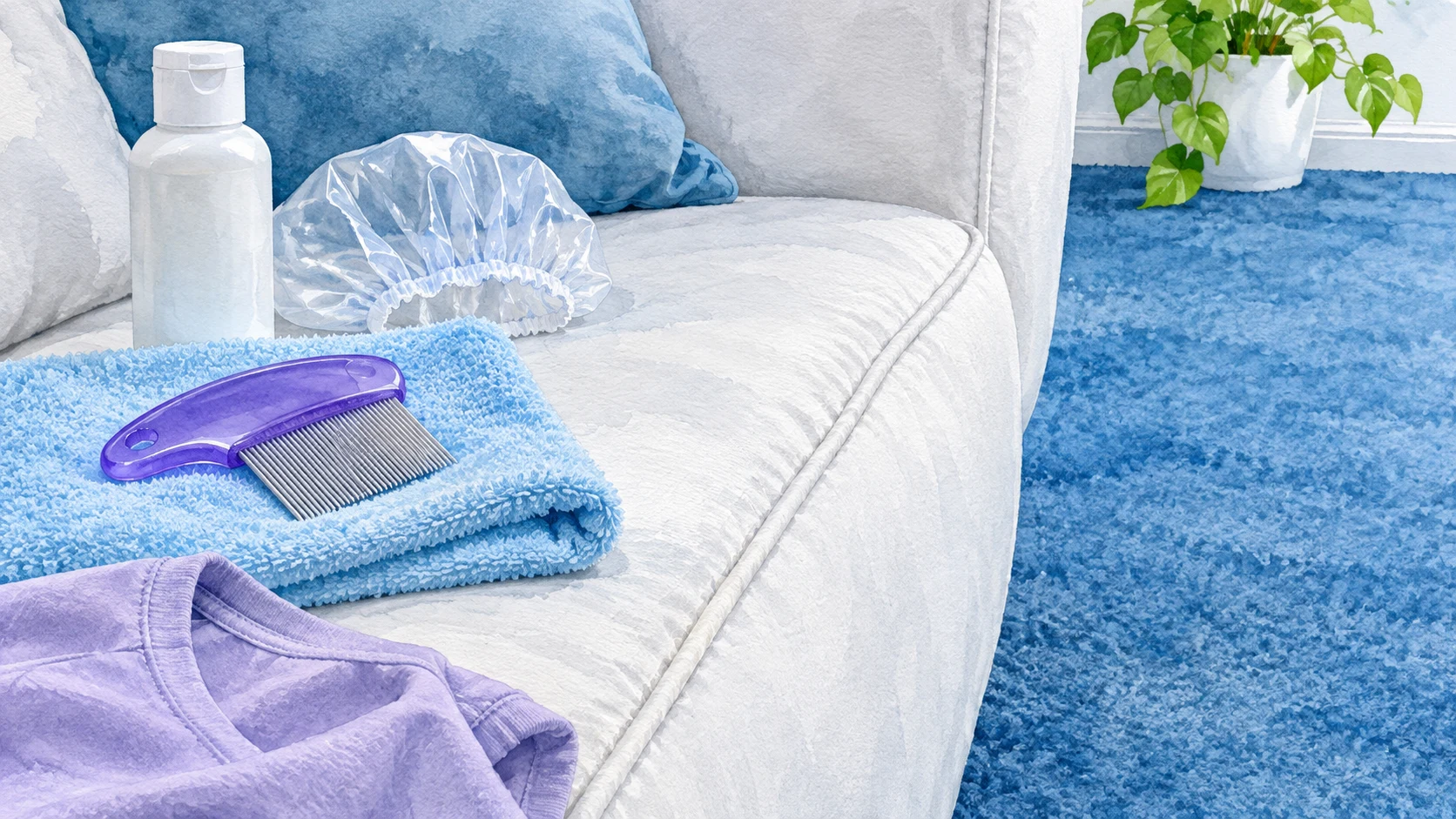
Head lice can occasionally end up on couches, carpets, chairs, and other household surfaces, but they cannot live or reproduce there for long. These insects depend on human blood for survival and are adapted to gripping hair rather than moving around furniture.
A living louse might become dislodged when someone rests their head against a couch cushion, lies on a rug, or leans against an upholstered chair. If another person’s hair contacts the same spot soon afterward, transmission is theoretically possible. However, the chance of getting head lice from furniture or carpeting is very small.
Head lice do not establish colonies inside cushions, hide permanently in carpet fibers, or reproduce beneath furniture. Finding lice in a household usually means someone is carrying them on their head, not that the building has developed an independent infestation.
Can Head Lice Actually Live on a Couch?
A head louse can remain alive briefly after leaving a person’s scalp, including when it lands on a couch. However, the couch cannot provide the blood meals or conditions needed for the insect to survive indefinitely.
Head lice spend nearly their entire lives on people. Their legs have specialized claws that grip individual hair shafts, allowing them to move through hair while remaining attached to their host. Upholstery fibers do not provide the same environment, even when their texture allows an insect to cling temporarily.
A louse may become separated from its host when someone rubs their head against a cushion or rests their hair on an upholstered armrest. It could also crawl onto fabric that is pressed directly against infested hair.
The documented possibility of head lice reaching couches and other recently contacted surfaces does not mean these objects are common sources of infestation. A living insect must first leave the scalp and then encounter another person’s hair before it dies.
The distinction between temporary presence and sustained survival is important. A couch can briefly hold a displaced louse, but it cannot support a continuing population of head lice.
Why Head Lice Do Not Establish Infestations in Furniture
Head lice are obligate blood-feeding parasites. Their survival depends on access to a human host, and their normal reproductive cycle takes place in scalp hair.
Unlike bed bugs, which can hide in furniture between blood meals, head lice generally remain on the person they infest. They do not routinely leave the scalp to shelter inside furniture and return later to feed.
A couch cushion contains no suitable blood source. Its foam, fabric, stuffing, and seams cannot nourish a head louse. Even if an insect becomes trapped among the fibers, it cannot establish a breeding population there.
The same limitation applies to recliners, upholstered dining chairs, padded headrests, and other furniture. None provides an alternative habitat where head lice can survive through successive generations.
This difference becomes especially relevant when someone finds a small insect near a furniture seam. Bed bugs, carpet beetles, fleas, and other arthropods may occur in living spaces for reasons unrelated to head lice.
The differences in where head lice and bed bugs live help explain why an insect found repeatedly in furniture should not automatically be identified as a head louse.
A true head louse on a couch is more likely to have arrived there accidentally from someone’s hair than to have emerged from an established furniture infestation.
Can Head Lice Survive in Carpets?
Head lice may occasionally fall onto carpeting, but carpets are not suitable habitats for them. The insects cannot feed on carpet fibers, dust, skin flakes, or debris trapped near the floor.
Their claws are specialized for grasping hair, not for moving efficiently through dense textile fibers. A louse that becomes separated from the scalp may remain alive for a limited period, but its ability to reach another person is restricted.
The risk is particularly small because most people do not routinely press their scalp directly against the same carpet fibers that recently contacted someone else’s infested hair.
Children sometimes lie on rugs while playing, reading, or watching television. In those circumstances, direct contact between hair and a recently contaminated area is possible. That makes transmission biologically conceivable, but it does not establish that carpeting is a meaningful source of most infestations.
Evidence from classroom investigations has found little support for carpet-mediated transmission. The clinical review of head-lice transmission discusses research in which classroom carpets were not identified as a source of lice, reinforcing the limited importance of environmental surfaces.
A carpet cannot develop a self-sustaining head-lice infestation simply because someone with lice walked across it, sat nearby, or spent time in the room.
What Happens When a Head Louse Falls Off the Scalp?
Once a head louse becomes separated from a person, it loses access to the regular blood meals required for survival. It is also exposed to temperature and humidity conditions that may differ substantially from those near the scalp.
An adult head louse generally dies within about two days without feeding, often sooner. Young lice also depend on blood meals and are poorly equipped for prolonged survival away from a host.
This biological limitation is the main reason furniture and carpets do not become lasting reservoirs.
A louse that falls onto a chair is not necessarily dead immediately. It may still move and could potentially reach hair that comes into contact with the surface. However, the opportunity is temporary and becomes less plausible as time passes.
The feeding requirements of adult and immature lice explain why survival away from a human host is so limited.
Environmental conditions can influence how long a detached louse remains alive. The detailed survival of head lice away from a human head involves differences in temperature, humidity, and insect condition.
For furniture exposure, the useful conclusion is that a louse cannot remain alive in an unused room for weeks waiting for someone to sit down.
Could You Catch Head Lice by Sitting on a Couch?
Simply sitting on a couch previously used by someone with head lice is extremely unlikely to result in an infestation.
The person’s clothing, back, and legs may contact the upholstery, but head lice normally live in scalp hair. They are not insects that routinely crawl from the head down the body and spread throughout furniture.
A more plausible situation involves direct contact between hair and a recently used cushion. For example, someone with an active infestation might lie with their head against a couch armrest. Another person could later rest their hair against the same area.
Even then, transmission would require a living louse to have left the first person’s hair, survived on the surface, and reached the second person’s hair.
There is no reliable percentage that predicts the outcome of such an encounter. The presence of an infested person does not establish that any lice were deposited on the couch.
The risk of acquiring head lice from a recently contacted chair or couch is recognized as a possible indirect route, but direct contact between people’s hair remains the principal means of spread.
A person who sat on the same couch as someone with lice should not assume they have become infested. The relevant question is whether living lice are actually present in their hair.
Are Fabric Couches Riskier Than Leather or Wooden Furniture?
Fabric upholstery, leather, vinyl, and wood differ in texture, but there is not enough reliable evidence to assign specific head-lice transmission risks to these materials.
A fabric couch may retain loose hairs more readily than a smooth leather surface. Upholstery fibers may also provide places where a displaced insect becomes caught.
However, retaining a hair or briefly holding an insect is not the same as supporting a living infestation.
Smooth surfaces may offer fewer places for a louse to cling, but that does not make them completely incapable of temporary contact with an insect. Conversely, a thick fabric cushion does not automatically contain lice because someone with an infestation sat on it.
The most relevant conditions are whether the person’s hair touched the surface, whether a living louse was deposited, and whether another person’s hair contacted that area soon afterward.
Furniture material alone cannot establish that transmission occurred.
A heavily upholstered chair that nobody has used for several days is less concerning than a recently contacted headrest, regardless of which material appears easier for an insect to grip.
Can Head Lice Hide in Couch Seams or Beneath Cushions?
A displaced louse could accidentally end up near a seam or beneath a cushion, but these locations are not normal hiding places for head lice.
Head lice do not have a behavioral cycle in which they retreat into furniture during the day and emerge at night to feed. They ordinarily remain among scalp hairs, where they can obtain blood meals repeatedly.
An insect found deep inside a couch seam may therefore be something other than a head louse.
Bed bugs are one example of insects that use seams and concealed furniture spaces as shelter. Other small arthropods may also become trapped in upholstery or accumulate near cushion edges.
A head louse has six legs, a relatively narrow, flattened body, and claws adapted to gripping hair. Its appearance differs from many insects commonly found around furniture.
The identifying characteristics described in what head lice look like are useful when an unfamiliar insect is discovered away from the scalp.
If insects repeatedly appear from the same furniture seam over several days or weeks, the pattern is not typical of head lice surviving independently of a human host. Correct identification becomes more important than assuming the couch contains a hidden colony.
Can Head Lice Move Across Floors or Furniture to Reach Someone?
Head lice can crawl, but they cannot jump or fly. They are not adapted to traveling long distances across floors or furniture in search of people.
A louse separated from the scalp may move over a nearby surface while it remains alive. That does not mean it can efficiently cross a room, climb furniture, or locate a new host in the way some other parasites do.
The insect’s legs are specialized for holding hair shafts. Movement across broad, smooth surfaces or dense carpet fibers does not provide the same grip or opportunities found among human hairs.
A louse on the floor would also need to reach another person’s scalp before it could establish an infestation. Contact with shoes, socks, or ordinary clothing would not by itself place the insect where head lice normally live.
The mechanics of how head lice pass between people explain why direct hair contact is much more effective than movement through a room.
A detached louse should not be imagined as a household insect actively searching through furniture for its next host. Its opportunities for successful transfer are considerably narrower.
Can Head Lice Eggs Develop in Carpets or Upholstery?
Head-louse eggs are normally attached firmly to individual hair shafts, usually close to the scalp. Female lice do not routinely deposit eggs throughout carpets, cushions, or furniture seams.
A shed hair carrying an attached egg may fall onto a couch or become trapped in carpet fibers. That does not mean the furniture has become a breeding site.
The egg remains attached to the hair rather than moving independently. Successful development also depends on environmental conditions that are normally provided by the area close to the human scalp.
An empty eggshell may remain attached to a shed hair even though it can no longer produce an insect.
These distinctions prevent a loose hair with a suspected nit from being mistaken for evidence of an active furniture infestation.
The specific conditions under which head-lice eggs might hatch away from the scalp are separate from the immediate risk posed by a living louse on a surface.
For someone concerned about a couch or carpet, finding a hair with an attached egg does not establish that the furniture can produce new generations of head lice.
What If You Find a Living Louse on Furniture?
Finding an insect that appears to be a living head louse on furniture warrants identification, but it does not automatically mean the furniture is infested.
If possible, examine the insect closely or preserve it in a sealed, transparent container. Its size, body shape, legs, and movement may help distinguish it from other small household pests.
The next question is whether someone who recently used the furniture has head lice.
A louse found on a cushion could have become dislodged from a person’s hair. The person may not be aware of an infestation, especially if itching has not developed.
Head lice can remain unnoticed because itching is not present in every infestation.
The presence of an insect on furniture alone cannot establish which person carried it or when it arrived. It also does not prove that another household member has acquired lice.
Confirmation of a head-lice infestation depends on finding living lice in a person’s hair. The signs that support an active head-lice infestation are more useful than assuming that a couch or carpet contains an established population.
Why Repeated Lice Findings Usually Do Not Mean the Furniture Is Infested
When head lice are discovered more than once in a household, furniture may become the suspected source. A family might wonder whether insects are hiding in the couch and repeatedly returning to people’s heads.
That explanation is not consistent with the normal biology of head lice.
A detached louse cannot continue feeding and reproducing inside furniture for weeks. If living lice are repeatedly found on household members over an extended period, the insects are more likely to be associated with people than with an independent furniture population.
Repeated findings could involve an infestation that was not fully eliminated, another person carrying living lice, or a new exposure. The presence of a couch in the home does not distinguish among those possibilities.
Similarly, repeatedly finding unidentified insects on furniture does not prove they are head lice. Other arthropods may have entirely different feeding habits and habitats.
The important distinction is between a temporary environmental occurrence and an infestation sustained by a suitable host.
A couch may occasionally receive a louse from someone’s hair. It cannot maintain an ongoing head-lice population in the absence of people.
Do You Need to Avoid Every Couch or Carpet After Head Lice Are Found?
There is no reason to treat every upholstered surface or carpet as dangerous after someone in the household is found to have head lice.
A recently contacted area where an infested person rested their head presents a more plausible opportunity for temporary transfer than furniture that had no contact with their hair.
Avoiding direct hair contact with that particular area until it has received ordinary attention is a reasonable precaution. It does not require keeping entire rooms closed or assuming that every seat contains living insects.
The public-health guidance on furniture and carpet exposure describes the risk of acquiring lice from these surfaces as very small. It also advises against spending excessive time and money on household cleaning.
The practical distinction is between acknowledging a rare route of transmission and treating the home as an independent source of infestation. Detailed furniture-cleaning methods, pesticide decisions, and treatment procedures belong to separate topics. The biological evidence does not support the idea that couches and carpets need to be treated as permanent louse habitats.
Questions About Head Lice on Household Surfaces
Can head lice live in carpet for weeks?
No. Head lice cannot feed or reproduce in carpeting. A detached adult louse generally dies within about two days without a human blood meal, often sooner. Carpets cannot sustain a long-term head-lice infestation.
Can you get head lice from a couch someone used yesterday?
It is theoretically possible if a living louse was deposited where the person’s hair touched the couch and subsequently reached your hair. However, this route is uncommon, and using the same couch does not establish that transmission occurred.
Do head lice hide inside recliners or upholstered chairs?
Head lice do not normally hide or breed inside recliners or upholstered chairs. An individual louse might become accidentally trapped in fabric, but it cannot maintain a population there. Repeated insect sightings inside furniture may indicate another pest.
Can head lice crawl from the carpet onto your head?
Head lice can crawl, but they are not adapted to traveling through rooms in search of people. For a louse on carpeting to cause an infestation, it would have to reach a person’s hair while still alive. This is an extremely unlikely route under ordinary household conditions.
The Bottom Line
Head lice can occasionally become separated from a person’s scalp and land on couches, carpets, chairs, or other household surfaces. A living insect may survive briefly, and indirect transfer is possible if another person’s hair contacts it soon afterward.
However, head lice cannot feed on furniture, reproduce in carpets, or establish hidden colonies inside cushions. Their survival away from people is limited, and the likelihood of acquiring an infestation from ordinary household surfaces is very small.
A couch or carpet may temporarily hold a displaced head louse, but it is not a lasting source of infestation. When living lice are repeatedly discovered, attention should remain on confirming their presence in human hair rather than assuming that furniture is producing them.
One thought on “Can Head Lice Live on Couches, Carpets, or Furniture?”