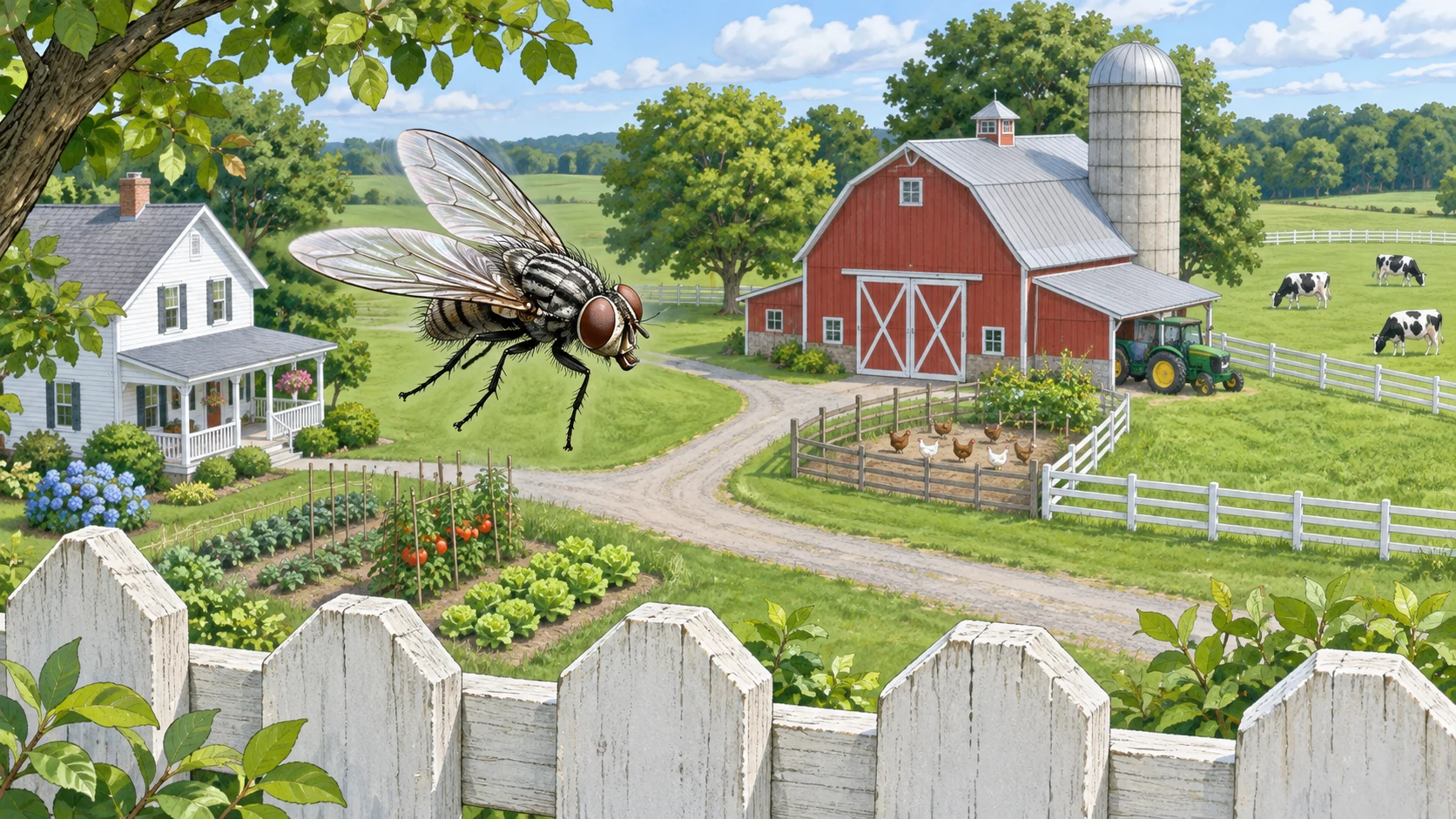
House flies (Musca domestica) commonly travel within approximately ½ to 2 miles of their breeding sites, although some individuals travel considerably farther. Mark-and-recapture experiments have documented exceptional journeys of 10 to 20 miles, with some historical records reaching approximately 20 miles or more. Most house flies remain relatively close to suitable feeding and breeding environments, so the maximum recorded distance should not be mistaken for their normal range.
How Far Do House Flies Usually Travel From Their Breeding Sites?
Most house flies remain within a relatively small area around the places where they develop. Their movement is generally less than 2 miles from their breeding environment, although individuals can travel beyond that distance.
A useful set of figures comes from experiments in which researchers marked house flies, released them and later captured them at different distances. A University of Kentucky extension summary reports that approximately 60% to 80% of recovered flies were captured within 1 mile of the release point. Within the first four days, approximately 85% to 95% of recovered flies had been caught within 2 miles.
These figures help establish a practical dispersal range. A house fly appearing at a property may have developed somewhere within the surrounding neighborhood, even when its breeding material is not present on the same property.
The house fly dispersal research and extension summary also explains why longer journeys are possible, particularly when environmental conditions and the availability of suitable resources influence movement.
Can House Flies Travel 5, 10 or Even 20 Miles?
House flies are capable of traveling much farther than their usual neighborhood range. Historical mark-and-recapture experiments have recorded individual flies at distances of approximately 5 to 20 miles from their release points.
The University of Maryland’s extension guidance places the effective dispersal range at approximately ½ to 2 miles, while acknowledging reports of distances as great as 10 to 20 miles. These exceptional records demonstrate the species’ ability to move beyond its usual area of activity.
The distinction between an ordinary dispersal distance and an exceptional record matters. A fly recovered 15 or 20 miles away does not establish that most flies travel that far. Such records represent unusual individuals rather than the typical movement of an entire population.
A separate mark-and-recapture investigation conducted at a poultry farm and a stable recorded house flies returning to their respective facilities from distances of 7 km and 5 km. These are approximately 4.3 miles and 3.1 miles. Recovery rates were very low, at 0.05% and 0.016%, respectively, illustrating the limitations of interpreting individual field-recapture experiments. The 2005 investigation of house fly flight range and homing behavior provides an example of these longer-distance movements.
Does Wind Help House Flies Travel Farther?
Wind can influence how far house flies disperse by changing the air currents they encounter during flight. Favorable airflow can help some individuals cover greater distances than they would under calmer conditions.
However, house flies are not simply passive passengers carried wherever the wind blows. Field observations have recorded flies moving in different directions, including against prevailing airflow. Their movement is influenced by environmental conditions and the availability of suitable places to feed and reproduce.
Research examining dispersal around poultry facilities has documented differences between flies moving downwind and those moving upwind. The study of house fly dispersal under different weather and sanitation conditions provides evidence that weather can influence movement without determining every fly’s direction.
The effect of wind should therefore be understood as one influence on dispersal. It can contribute to longer journeys, but individual movement, favorable conditions and the surroundings also matter.
The effects of wind and rain on house fly flight are relevant when interpreting outdoor observations, particularly around properties where fly activity changes with the weather.
Why Do Some House Flies Travel Farther Than Others?
House flies do not all move the same distance. Their dispersal varies according to the environment, the availability of resources and the conditions around their development sites.
Several factors can influence how far individual flies move.
Availability of food and breeding material: House flies tend to remain in areas where suitable food and egg-laying materials are available. Wet organic waste, animal manure and other decomposing substrates provide resources that can keep flies near their original surroundings. When suitable resources are scarce, some individuals may continue wandering elsewhere.
Population pressure: Large populations developing around animal facilities can contribute to greater dispersal. Competition for suitable breeding material may encourage some flies to leave the immediate area. This is particularly relevant when substantial numbers develop around concentrated manure or waste accumulations.
Environmental conditions: Temperature, moisture and airflow influence fly activity and the conditions under which dispersal occurs. Favorable weather can support greater movement, while unsuitable conditions may restrict activity.
Surrounding habitat: Buildings, vegetation and other environmental features can influence movement patterns. Open agricultural environments and densely developed areas do not necessarily produce the same dispersal behavior.
A review of house fly biology and dispersal discusses how movement varies with environmental conditions and the availability of resources. It also highlights the ability of adult flies to move between different environments.
Do House Flies Travel Farther in Rural or Urban Areas?
The surrounding environment can influence how far house flies disperse. Studies have reported differences between urban and rural environments, although the results are not identical across every investigation.
House flies in agricultural environments may encounter substantial breeding populations around livestock facilities. Some individuals leave these areas and disperse toward surrounding properties.
Urban environments present a different arrangement of resources. Garbage, food waste and other organic materials may occur at multiple locations, allowing flies to encounter suitable resources without traveling as far from their original surroundings.
A comparative review of house fly dispersal describes historical estimates of up to approximately 12 km in some urban and rural release studies. It also discusses exceptional records of 22 to 32 km. The review emphasizes that most adults remain much closer to their development sites, commonly within approximately 1 to 5 km.
This variation explains why there is no single maximum distance that applies to every population. The surrounding habitat and the distribution of resources influence how far individual flies move.
Does the Distance a Fly Travels Mean Its Breeding Site Is Nearby?
The distance between a house fly and its breeding site can help explain why flies appear on a property even when there is no obvious breeding material nearby.
A fly appearing in a kitchen or living room may have developed somewhere else in the surrounding area. Its presence alone cannot establish the exact location of its original breeding material.
Moist organic substrates provide suitable environments for development. Common examples include animal manure, wet garbage and decomposing food waste. These materials can support the production of adult flies that later disperse into surrounding properties. The relationship between adult activity and the value of garbage and rotting material to house flies helps explain why waste-producing locations can contribute to neighborhood fly activity.
Female house flies deposit eggs in suitable moist organic substrates, allowing the next generation to develop near available resources. Their preferred egg-laying materials are therefore relevant when considering how local breeding environments contribute to adult populations.
The distance estimates also explain why managing flies around a property sometimes requires attention beyond the immediate building. A useful integrated approach to house fly control considers breeding populations and their surrounding environments rather than focusing exclusively on individual adults.
How Far Should You Expect House Flies to Travel?
The following figures provide a practical way to interpret the available dispersal evidence.
|
Dispersal measurement |
Reported distance |
Interpretation |
|---|---|---|
|
Common dispersal range |
½–2 miles |
Typical neighborhood-scale movement |
|
Most marked-fly recoveries |
Within 1 mile |
Strong concentration relatively close to release sites |
|
Extended dispersal |
3–5 miles |
Documented movement beyond the usual range |
|
Exceptional records |
10–20 miles |
Unusual individual journeys |
|
Some historical maximum records |
About 20 miles or more |
Not representative of ordinary dispersal |
These figures summarize different studies and extension references, not a controlled experiment measuring every fly under identical conditions.
A further distinction matters when interpreting the numbers. Dispersal distance is not the same as flight speed. A fly may cover a substantial distance over several hours or days through repeated flights and resting periods. Its maximum speed during one flight cannot be used to calculate how far it normally travels from its breeding environment. The reported flying speeds of house flies address that separate measurement.
For householders, the approximately ½-to-2-mile range is the more useful reference. Longer journeys are biologically possible, but an individual fly found inside a home is not evidence that its original breeding site lies 10 or 20 miles away.