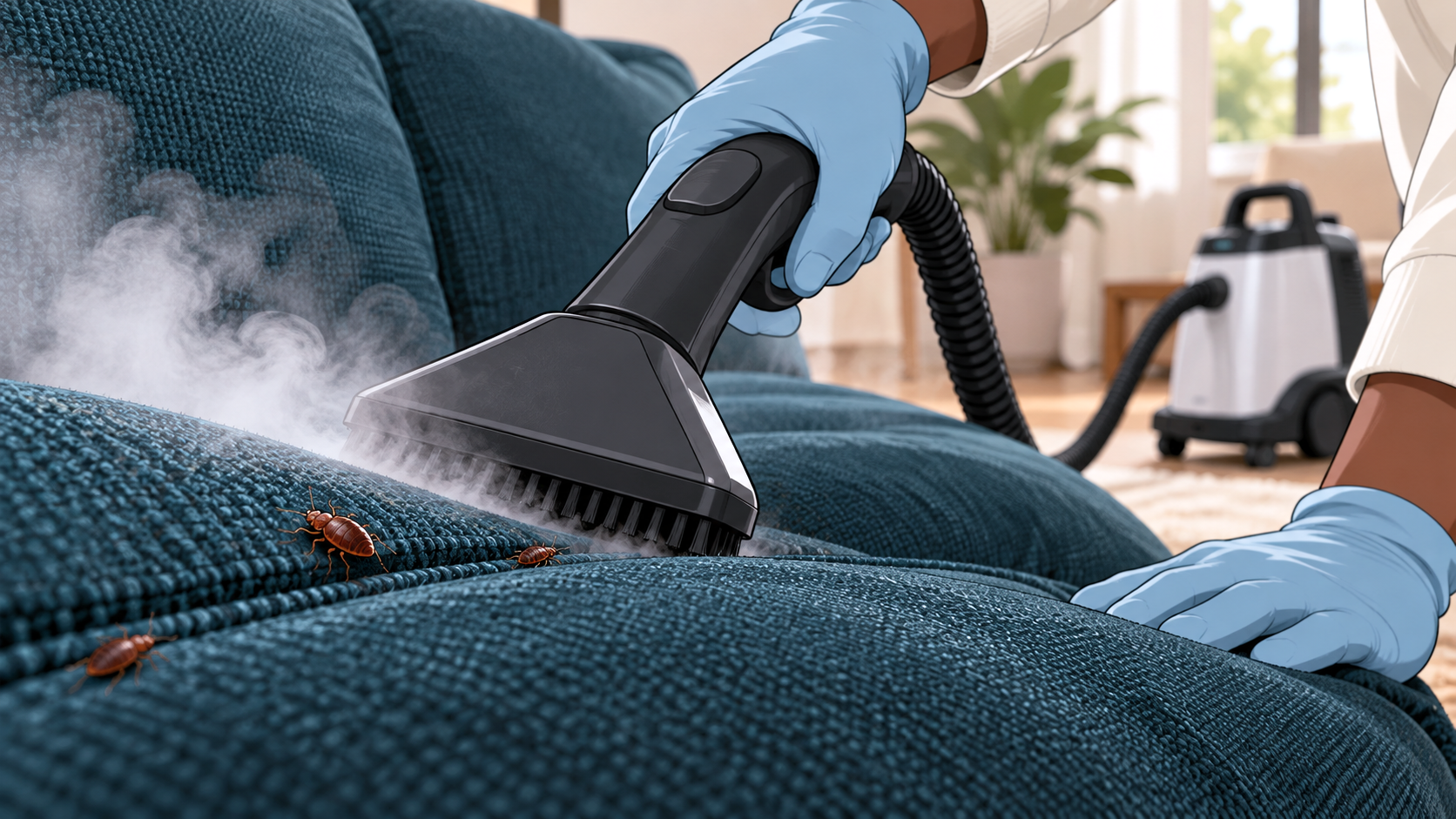
For most homeowners, the Vapamore MR-100 Primo is the best all-around steamer for bed bugs because it combines 210–220°F steam, adjustable output, a fabric tool, a 1.6-liter boiler, and roughly 50–60 minutes of operation. The Polti Cimex Eradicator is the strongest purpose-built option for professional or intensive bed bug work, while the Dupray Neat offers excellent heat and simpler general-purpose use. The machine still has to be moved slowly enough to bring the treated surface to lethal temperature.
Best Bed Bug Steamers at a Glance
| Steamer | Best For | Steam Output | Useful Bed Bug Features |
|---|---|---|---|
| Polti Cimex Eradicator | Best dedicated bed bug steamer | Up to 356°F / 180°C | Purpose-built dry steam system, 4-bar pressure, focused pest-control attachments |
| Vapamore MR-100 Primo | Best overall for homeowners | 210–220°F | Adjustable steam, fabric tool, 50–60-minute tank, long hose |
| Dupray Neat | Best compact multipurpose option | Up to 275°F | 50 psi, 54 oz boiler, upholstery capability, simple operation |
| McCulloch MC1385 | Best for long treatment sessions | Over 200°F | 64 oz tank, up to 120 minutes, variable steam, 23 accessories |
The temperature printed on the machine is not enough by itself. Effective steam treatment for bed bugs depends on the temperature that actually reaches the mattress seam, furniture joint, or fabric surface after steam leaves the attachment.
Vapamore MR-100 Primo Is the Best All-Around Home Option
The Vapamore MR-100 Primo is particularly well suited to household bed bug work because its specifications line up closely with what a practical treatment requires. It produces steam at approximately 210–220°F, provides adjustable output through a solenoid-operated control, holds 1.6 liters of water, and runs for roughly 50–60 minutes per tank. Its supplied fabric attachment and cotton cover allow steam to be spread over upholstery rather than forced through a narrow jet, while a six-foot hose makes mattresses, couches, bed frames, and lower baseboards easier to reach without constantly repositioning the machine.
Vapamore recommends moving its covered fabric tool at roughly one inch per second during bed bug treatment. That slow pace is consistent with independent guidance that the treated material, not merely the boiler, must remain hot enough long enough to kill insects. A machine capable of producing high-temperature steam but used too quickly can leave deeper folds and seams below lethal temperature. For someone working through bed bugs associated with a mattress and surrounding furniture, the MR-100’s combination of heat, runtime, and upholstery attachments is more useful than extreme pressure alone.
Polti Cimex Eradicator Is the Best Purpose-Built Bed Bug Machine
The Polti Cimex Eradicator differs from ordinary household steam cleaners because it was developed specifically for bed bug treatment. Its patented dispenser superheats dry saturated steam to as much as 180°C, or 356°F, with up to 4 bar of pressure and approximately 110 grams of steam output per minute. Polti’s system is designed to deliver a broad cloud of superheated steam into harborages without relying on insecticide residue.
Its principal advantage is specialization. The machine is intended for mattresses, furniture, seams, joints, and other bed bug sites rather than being a household cleaner adapted to pest work. Polti also offers a Cimex Eradicator Plus aimed at professional applications. The cost and availability make either model excessive for many single-room household infestations, but pest-control businesses, hotels, landlords, and people facing repeated treatment needs may benefit from equipment engineered specifically for this task.
Steam reaches only where it is physically directed, so even a specialized machine remains one part of a complete bed bug elimination program when insects occupy wall voids, belongings, neighboring furniture, or other inaccessible spaces.
Dupray Neat Is the Best Compact Multipurpose Choice
The Dupray Neat produces steam up to 275°F, uses a 1.6-liter stainless-steel boiler, reaches up to 50 psi, and provides about 50 minutes of cleaning time after an eight-minute warm-up. At approximately nine pounds, it is easier to carry between rooms than many larger canister systems, while its included accessories support mattress and upholstery work as well as normal household cleaning.
Its higher listed boiler-output temperature provides ample thermal capacity, but the attachment and technique determine what reaches the fabric. A narrow lance can be useful for some cracks, yet concentrating high-velocity steam directly on exposed bed bugs can blow them away before the heat kills them. Professional steaming guidance recommends a broad steam head and a post-pass surface temperature around 160–180°F, which makes a covered upholstery-style attachment preferable on broad seams and fabric surfaces.
The Neat is especially attractive when the steamer needs to remain useful after the infestation is gone because the same machine is designed for floors, grout, furniture, car interiors, bathrooms, and other routine cleaning tasks.
McCulloch MC1385 Is the Best Choice for Long Sessions
The McCulloch MC1385 sacrifices some compactness for capacity. Its 64-ounce water tank can provide up to 120 minutes of continuous steam, and variable output gives the operator more control over how much moisture reaches a surface. The unit heats water to over 200°F, runs at up to 58 psi, and includes 23 accessories.
Long runtime becomes valuable when the inspection has identified numerous upholstered chairs, bed frames, mattress seams, couches, carpet edges, and other treatment points. Constantly stopping a small machine to cool, refill, and reheat makes thorough steaming considerably harder, particularly because effective work is intentionally slow. Cornell recommends professional-style steamers with large water capacity, variable output, and multiple attachments for this reason.
High pressure should be reduced where necessary rather than treated as a bed bug advantage. The goal is sustained heat transfer into the harborage, not blasting debris or insects out of a crack.
Surface Temperature Matters More Than the Highest Number on the Box
Bed bugs die at temperatures substantially below the maximum output of every machine listed here, but steam cools immediately after leaving the nozzle and continues losing heat as it enters fabric or crosses open air. A specification such as 275°F does not mean a mattress seam reaches 275°F.
A practical steamer should be able to leave the treated surface around 160–180°F immediately after the head passes. Cornell’s bed bug guidance recommends a steamer capable of bringing surfaces into that range, while Rutgers notes that both inexpensive consumer steamers and commercial machines have killed all bed bug stages when used slowly enough. A non-contact infrared thermometer is useful for checking surface temperature while adjusting speed.
Moving too quickly is one of the easiest ways to waste a capable machine. Moving excessively slowly can overwet fabrics or damage finishes. Treat a hidden area first when working on stained wood, delicate textiles, laminates, or unfamiliar upholstery.
Choose a Broad Fabric Attachment Before Chasing Maximum Pressure
A strong jet nozzle looks useful because it can reach narrow spaces, but high-velocity steam can scatter live bugs and eggs. A broad rectangular or triangular upholstery tool distributes heat across more material and reduces air velocity, particularly when covered with a cotton cloth.
Research-based guidance recommends slow steaming with a large head rather than a concentrated jet. For mattresses, upholstered couches, fabric headboards, carpet edges, and box springs, attachment design can consequently matter more than whether one machine produces 50 psi and another produces 58 psi.
Crack tools still have a place where the opening is too narrow for an upholstery head, but hold the outlet far enough away and reduce steam force if bugs or debris begin moving from the air pressure.
A Larger Tank Is Worth Paying for on Heavier Infestations
Steam treatment is slow because every relevant seam, fold, edge, joint, and accessible crevice needs attention. A small handheld garment steamer may become inconvenient long before a heavily infested queen mattress, box spring, frame, couch, and nearby furniture have been treated.
A 1.5- to 2-liter boiler is a useful starting point for substantial household work. Continuous-fill professional machines go further because water can be added without waiting for the pressurized boiler to cool, although their additional cost is difficult to justify for occasional home use.
The treatment area should follow inspection findings rather than expanding indiscriminately. A systematic room-by-room bed bug inspection can identify where steaming is worth the time and where another control method is more suitable.
Do Not Use Steam Around Live Electrical Components
Steam is water and can carry electrical current. Do not direct it into outlets, switches, energized electronics, extension sockets, or plugged-in appliances. Steam can also damage certain veneers, waxed finishes, adhesives, paints, leather, musical instruments, and heat-sensitive materials.
Mattresses and most upholstery tolerate careful steaming better, but moisture still needs time to evaporate before bedding is replaced or an encasement is installed. Thorough drying reduces the risk of mildew and prevents moisture from interfering with any desiccant dust subsequently placed nearby.
For objects that cannot safely tolerate steam, another method should be selected rather than forcing the machine into every harboraging site.
A Steamer Has No Residual Effect After the Surface Cools
Steam kills through heat during application. Once a treated seam cools, it provides no continuing protection against a bug that later walks across it. An insect hiding behind a baseboard during treatment can survive and return to the steamed mattress afterward.
That makes careful inspection and follow-up more important than repeatedly steaming the easiest visible surfaces. Purdue includes steam as one component of integrated bed bug management, alongside encasements, monitoring, sanitation, and other appropriate treatments.
After steaming, monitor for live insects, fresh fecal spotting, cast skins, or other evidence that bed bug activity continues. A sustained lack of new evidence over follow-up inspections is more meaningful than the number of insects killed during the first steaming session.
Questions About Bed Bug Steamers
Can a clothes steamer kill bed bugs?
Some garment steamers can kill an exposed bug if enough heat actually reaches it, but many have small tanks, narrow heads, inconsistent output, or insufficient sustained surface heat for systematic infestation treatment. A canister-style steam cleaner is generally easier to control.
How hot should a bed bug steamer be?
The machine should have enough thermal capacity to leave the treated surface at approximately 160–180°F during normal use. Measure the surface rather than relying only on the advertised boiler temperature.
How slowly should you move the steamer?
A useful starting range is roughly 10–30 seconds per foot, adjusting speed according to measured surface temperature and the material being treated. Dense seams may require slower treatment than a thin exposed fabric.
Should you use the highest pressure setting?
Not necessarily. Excessive velocity can blow bed bugs away from the treatment area. Temperature, distribution, and contact time matter more than maximum pressure.
Can steam alone eliminate bed bugs?
A very localized infestation can sometimes be reduced dramatically with meticulous steaming, but steam has no residual activity and cannot reach every hidden location. Continued monitoring is necessary to determine whether bed bug treatment actually worked.
Can you steam a mattress and sleep on it the same night?
Usually, provided the mattress material tolerates steam and has dried completely. Avoid remaking the bed while seams and padding are still damp.