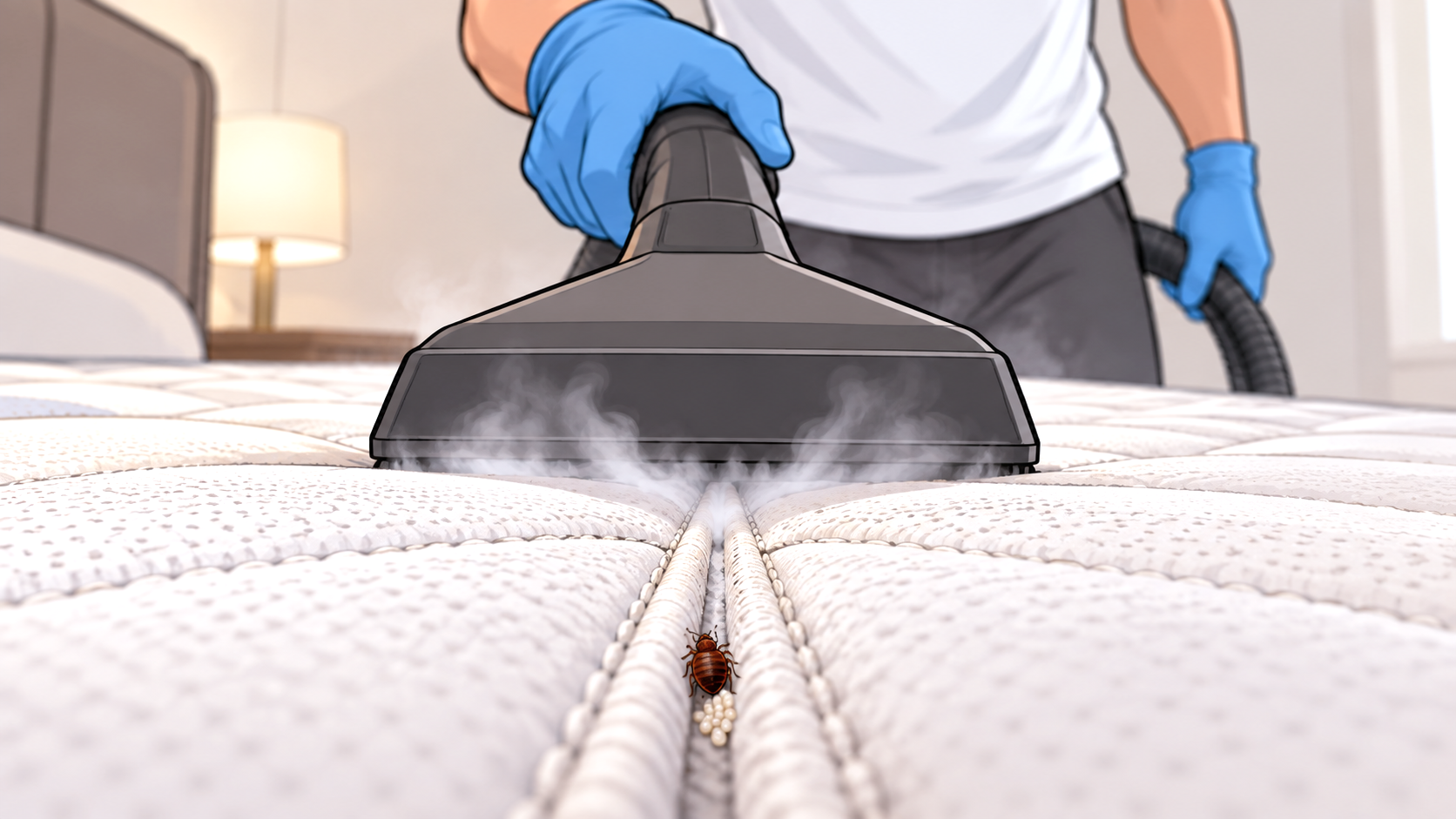
Steamers can kill bed bugs and their eggs when used correctly. The EPA recommends steam at a temperature of at least 130°F (54°C), while cautioning against forceful airflow that can scatter bed bugs before the heat kills them. The biggest limitation is penetration. Steam works extremely well where sufficient heat actually reaches the bugs, but it doesn’t heat deeply into every crack, mattress, or piece of upholstered furniture. That makes slow, targeted application more important than simply using the hottest steamer available.
How Deep Does Steam Reach?
Steam loses heat quickly as it moves through materials. Cornell’s bed bug steam guidance notes that lethal temperatures are thought to penetrate about 6 centimeters, or 2⅜ inches, into cracks and crevices and less than an inch beneath fabric surfaces.
Those figures are useful estimates rather than guaranteed treatment depths. Actual penetration depends on the material, steam output, application speed, starting temperature, and other conditions.
This limitation explains why steam is best suited to accessible harborages such as mattress seams, bed frames, baseboards, furniture joints, carpet edges, and upholstery. Bugs concealed deeper inside an object may escape sufficient heat.
High Pressure Can Make Steam Less Effective
A powerful jet isn’t desirable for bed bug treatment. The EPA recommends avoiding forceful airflow because it can blow bed bugs away from the treatment area.
A wider attachment, such as an upholstery tool, helps distribute steam while reducing the concentrated airflow produced by a narrow nozzle. The goal is to heat the surface and hiding place thoroughly without pushing live bugs farther into the room.
Move the Steamer Slowly
Steam needs enough contact time to heat the treated area. Cornell recommends moving the nozzle slowly, approximately 10 to 30 seconds per linear foot, while keeping it close to the surface.
A quick sweep over a mattress or furniture seam may not transfer enough heat to bugs or eggs concealed within it. Work methodically through seams, folds, joints, edges, and other likely harborages rather than steaming large surfaces as quickly as possible.
A thermometer can help verify the temperature being delivered to the treated surface rather than relying on the temperature of the steam inside the machine.
Vacuuming Before Steam Can Help
Vacuuming accessible bed bugs before steaming can physically remove part of the population and reduce the number that might move away as treatment begins. A crevice attachment is particularly useful around seams, joints, edges, and other narrow hiding places.
Vacuuming and steam therefore complement each other rather than serving the same purpose. Vacuuming can help remove accessible bed bugs, while steam can kill bugs and eggs that receive sufficient heat.
Let Everything Dry Completely
Steam introduces moisture into mattresses, upholstered furniture, carpets, and other porous materials. Avoid soaking surfaces and allow treated items to dry completely. This is especially important before installing a mattress or box-spring encasement. Trapping moisture beneath an encasement can encourage mold or mildew and create a separate problem.
Steam Shouldn’t Be Your Only Bed Bug Treatment
Steam has no residual effect. Once a treated surface cools, it provides no continuing protection against bed bugs that were missed or later move across it.
Its limited penetration also means hidden bugs can survive if sufficient heat never reaches them. For that reason, steam works best as part of an integrated approach that can include inspection, vacuuming, laundering and drying suitable items, encasements, monitoring, and appropriately selected pesticides when necessary.
The same limitation applies to mattresses. Steam can treat accessible seams and surfaces, but getting rid of bed bugs in a mattress may require additional measures when bugs are concealed where steam can’t reliably reach them.
Questions About Steam and Bed Bugs
Can you kill bed bug eggs with steam?
Yes. Bed bug eggs are susceptible to sufficient heat, making steam useful for treating accessible eggs as well as nymphs and adults. The limitation is whether the steam actually delivers enough heat to where the eggs are attached.
Can you steam electrical outlets?
No. Don’t direct steam or moisture into electrical outlets, switches, appliances, or other energized electrical components. Bed bugs hiding around electrical areas require a treatment method appropriate for that location.
Does steaming a mattress eliminate the need for an encasement?
Not necessarily. Steam and bed-bug-proof encasements perform different jobs. Steam kills bugs and eggs that receive sufficient heat, while a properly installed encasement can trap bed bugs remaining inside a mattress or box spring and simplify future inspection.
How do you know the surface is getting hot enough?
Measure the treated surface with an appropriate thermometer. The temperature produced inside a steamer doesn’t guarantee that the target surface reaches the same temperature after the steam travels through the nozzle and into the material.