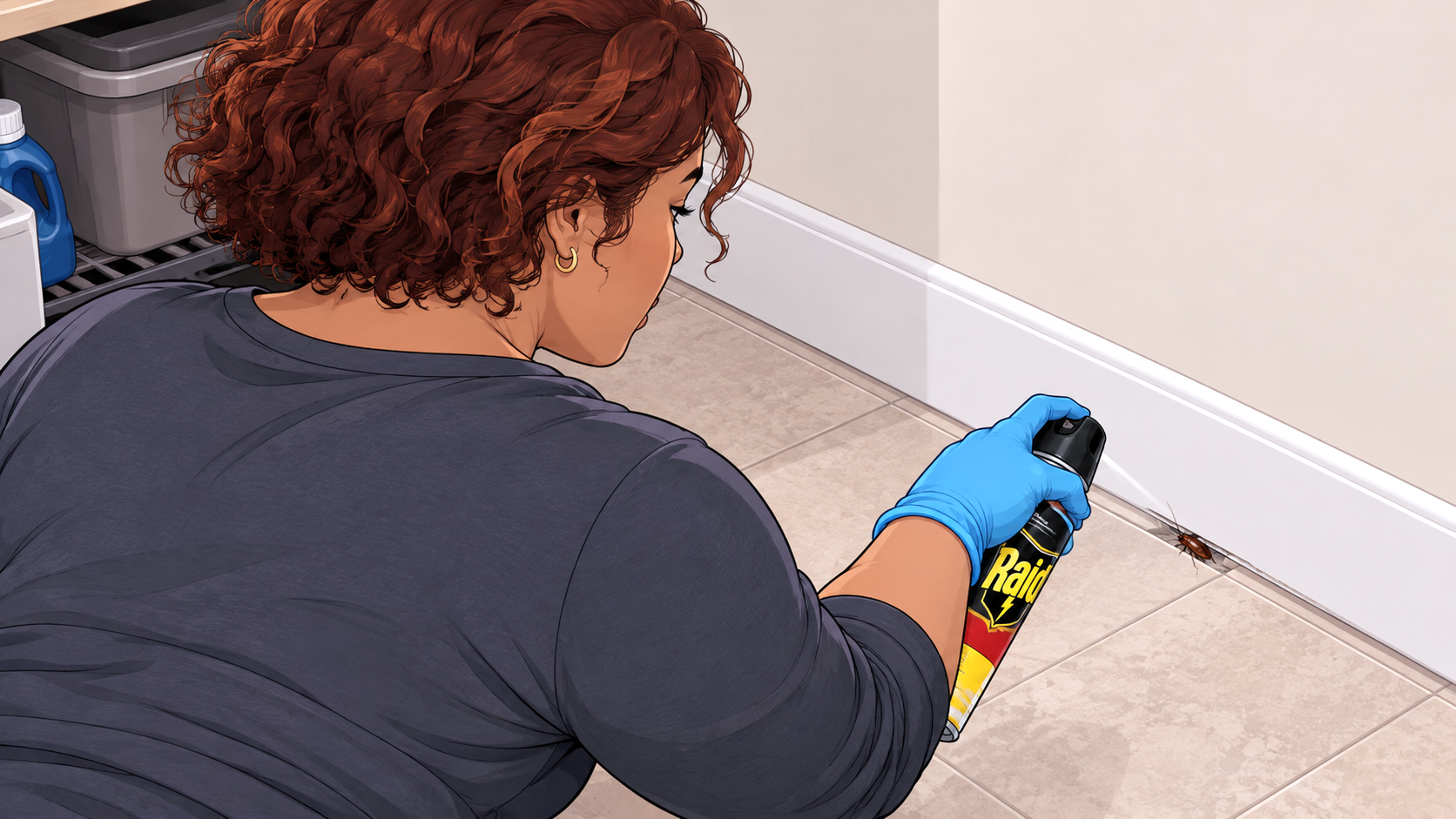
Raid kills cockroaches, including German and American cockroaches, when the insects receive an effective dose of a product labeled for their control. Raid Ant & Roach Killer sprays kill exposed insects through contact, while Raid Double Control bait stations poison cockroaches that feed on the bait. Certain Raid sprays also leave insecticidal residues, but killing visible cockroaches does not establish that an infestation has been eliminated.
The product you choose makes a substantial difference. A can of Raid Ant & Roach Killer 26 provides an immediate treatment for exposed insects and labeled surfaces. Raid Double Control Small Roach Baits work through feeding, making them more appropriate when cockroaches are repeatedly appearing from concealed kitchen harborages. Both approaches have limitations, particularly where German cockroach populations have developed resistance to commonly used insecticides.
What Different Raid Cockroach Products Actually Do
Raid sells several formulations under similar names, and their active ingredients are not interchangeable. Some kill insects directly, others continue working on treated surfaces, and the enclosed baits require cockroaches to enter and eat the insecticide.
| Raid product | Active ingredient | How it works | Manufacturer’s residual or protection claim |
|---|---|---|---|
| Raid Ant & Roach Killer 26 | Imiprothrin 0.060%, cypermethrin 0.100% | Contact and residual spray | Up to 13 weeks on specified nonporous surfaces |
| Raid Max Ant & Roach | Pyrethroid insecticides | Contact and residual spray | Up to 6 months |
| Raid Essentials Ant, Spider & Roach Killer 30 | Spearmint oil 1.50%, rosemary oil 0.82% | Direct-contact botanical spray | No comparable prolonged residual claim |
| Raid Double Control Small Roach Baits | Avermectin B1 0.05% | Ingested insecticide bait | Up to 3 months |
| Raid Double Control Large Roach Baits | Avermectin B1 0.05% | Ingested insecticide bait | Up to 3 months |
| Raid Small Roach Baits with Plus Egg Stoppers | Avermectin B1 0.05% in bait; (S)-hydroprene 95% in egg-stopper device | Ingested bait plus insect growth regulator | Replace components every 3 months under the listed directions |
These are figures and claims for the identified U.S. formulations. Ingredients, product names, and permitted applications can differ in other countries. Read the label on the actual container before purchasing or applying any Raid product.
The Raid Ant & Roach Killer 26 formulation contains imiprothrin and cypermethrin, two synthetic pyrethroids that interfere with insect nervous-system function. It is designed to kill exposed cockroaches and leave a residue on permitted surfaces. Raid’s 13-week claim applies to cockroaches and ants on nonporous materials such as ceramic and laminate, not to every surface inside a home.
Raid Max Ant & Roach emphasizes longer residual protection and more precise application through its two-way spray design. The advertised six-month period is a qualified product claim rather than a guarantee that every cockroach crossing a treated location will die throughout that entire interval.
The botanical alternative, Raid Essentials Ant, Spider & Roach Killer 30, uses spearmint and rosemary oils. Its directions require direct contact with the insect. Although the product uses plant-derived active ingredients, it remains a pesticide with exposure precautions, flammability warnings, and restrictions on where it can be sprayed.
Why Raid Spray Can Kill Roaches Without Clearing the Infestation
A cockroach running across a kitchen floor is relatively easy to expose to aerosol insecticide. Those concealed behind refrigerator components, inside wall openings, or deep in cabinet joints are harder to reach. Raid spray can kill the insect in front of you without reaching the cockroaches occupying those protected spaces.
The contact and residual instructions for Raid Ant & Roach Killer 26 address these two exposure routes. Direct application targets accessible insects, while labeled surface treatments leave deposits that may affect insects contacting them afterward. A cockroach must still encounter a lethal amount of insecticide, and residual performance can change with the surface and its condition.
This creates a particular limitation with German cockroaches. Their small bodies allow them to occupy narrow spaces around appliances and fixtures, while reproduction can continue away from sprayed surfaces. Cockroach egg cases also complicate a treatment aimed only at moving insects, because eggs inside a protected case are not necessarily exposed to the same dose.
Pyrethroid resistance presents another obstacle. Some German cockroach populations carry physiological resistance to these insecticides, so individuals receiving exposure may survive doses that kill susceptible cockroaches. A failed application does not prove resistance by itself, since inadequate contact and untreated harborages produce similar outcomes. The University of California’s cockroach management guidance places insecticides within a broader treatment program rather than treating repeated aerosol applications as a complete remedy.
A homeowner who repeatedly sprays visible insects may therefore see dead cockroaches every night while the underlying population remains active. The spray is demonstrating contact toxicity, but the continuing sightings indicate that the treatment has not resolved the infestation.
Raid Roach Baits Work Differently From the Aerosols
Raid Double Control bait stations contain avermectin B1, an insecticide that cockroaches consume when feeding on the bait. The enclosed station allows insects to enter and reach the toxic food without requiring a homeowner to spray them directly. This makes bait particularly relevant for cockroaches that spend much of their time hidden.
The Raid Double Control Small Roach Baits contain 0.05% avermectin B1. The manufacturer advertises reduced activity within days and instructs users to replace the stations every three months. Those expectations are conditional on feeding and access, rather than a promise that every infestation will disappear within that period.
Larger cockroaches have a separately marketed product. Raid Double Control Large Roach Baits use the same stated active-ingredient concentration but are packaged for large-roach control. Choosing between these packages should begin with the identified pest, not merely which box has more stations.
The feeding behavior behind cockroach bait treatments also explains why sprays and baits should not be casually combined in the same location. Repellent insecticide deposits can discourage cockroaches from approaching bait or contaminate its food attractant. Bait effectiveness requires insects to feed rather than avoid the station.
Does Raid Kill Cockroach Eggs?
Raid’s product claims about eggs require careful interpretation. Killing a female cockroach does not automatically establish that every egg inside her egg case has been killed, and spraying an egg case does not guarantee that the insecticide penetrates it.
The Raid Small Roach Baits and Plus Egg Stoppers package combines avermectin bait stations with separate devices containing (S)-hydroprene, an insect growth regulator. Hydroprene disrupts cockroach development and reproduction. Its purpose is to interfere with the life cycle, not to act as an instant contact poison that directly destroys eggs.
This combination addresses a different stage of infestation control from an ordinary aerosol. It remains dependent on correct placement, continued exposure, and the product’s labeled operating period.
Raid’s Residual Claims Have Specific Limits
The phrase keeps killing for 13 weeks can sound as though a single application protects an entire room for three months. Raid Ant & Roach Killer 26 makes a narrower claim, tied to residual activity against cockroaches and ants on specified nonporous surfaces. The insecticide must remain on a permitted surface, and the insect must encounter it.
Raid Max Ant & Roach carries a longer advertised period, but neither product creates an invisible barrier that prevents cockroaches from entering. The residual insecticide acts on exposed insects rather than physically excluding them. Conditions such as cleaning, surface composition, and insecticide resistance affect the usefulness of a deposit.
Raid Max Perimeter Protection has a different intended use. Its 18-month residual claim applies to specified pests and surfaces, including American cockroaches on nonporous materials. It should not be transferred to ordinary Raid aerosols or interpreted as an 18-month guarantee against German cockroaches indoors.
A residual spray also differs from a true repellent. Some pyrethroid deposits cause cockroaches to avoid treated surfaces, but avoidance does not establish population reduction. Homeowners looking for cockroach deterrence through odors should recognize that an insecticide’s primary purpose is poisoning exposed pests, even when its residues also change their movement.
Precautions When Using Raid Indoors
Raid aerosol labels impose several restrictions that should determine whether a particular location is suitable for treatment. For Raid Ant & Roach Killer 26, these include using the product in well-ventilated areas, protecting food and food-handling equipment, and keeping the aerosol away from flames and ignition sources. Its water-containing formulation must not be applied in or on electrical equipment because of the shock hazard.
Spraying directly into a refrigerator motor compartment, electrical outlet, or energized appliance is therefore inappropriate. A cockroach disappearing behind an appliance does not justify directing aerosol into inaccessible electrical components. Treatment should remain within the locations and application methods permitted on the specific label.
Children and pets introduce additional exposure considerations. Insecticide deposits may remain on treated surfaces after the initial spray has dispersed. Keep children and animals away during application and observe all label requirements for reentry, ventilation, and contact with treated areas. Pet-conscious cockroach treatment also requires preventing animals from reaching bait contents or freshly treated locations.
Raid Essentials botanical spray is subject to safety restrictions despite its plant-derived ingredients. Its label warns against spraying people, pets, food-contact surfaces, or electronic equipment. The aerosol is also flammable, and excess liquid can make flooring slippery. Its rosemary and spearmint oils should not be treated as harmless merely because they occur naturally.
The EPA’s pesticide safety guidance also applies when disposing of unused products and containers. Aerosol cans should not be punctured or burned, and unused pesticide should not be poured into household drains. Follow the container’s disposal instructions and applicable local requirements.
When Raid Is the Wrong Choice for the Problem
A single exposed American cockroach can be an appropriate target for Raid contact spray. By contrast, recurring small cockroaches around a refrigerator, stove, or kitchen sink call for an assessment of the broader population. Killing the individuals that emerge does not reveal how many remain concealed.
Raid foggers are another poor substitute for targeted treatment when cockroaches occupy inaccessible harborages. Cockroach foggers and bug bombs present distribution and exposure problems that cannot be solved merely by releasing more aerosol. The EPA’s fogger safety guidance also identifies fire, explosion, and pesticide-exposure hazards associated with these products.
For repeated indoor sightings, the next useful step is to identify where activity is concentrated and whether the number of cockroaches is declining. Monitoring traps placed along suspected travel routes can provide evidence that occasional visual encounters cannot. Correcting accessible food and water sources and using an appropriate bait treatment can address an active population more directly than repeatedly spraying individuals.
Professional intervention becomes appropriate when cockroaches continue appearing despite properly implemented control measures, particularly in connected housing where neighboring units may maintain the infestation. At that stage, further aerosol purchases can add unnecessary exposure without reaching the source.
Is Raid Worth Using Against Cockroaches?
We would choose Raid Ant & Roach Killer 26 for occasional exposed cockroaches, provided the application location is permitted by its label. Its contact action is useful for an immediate encounter, and its residual capability offers a separate benefit on eligible surfaces.
For recurring German cockroach activity, Raid Double Control Small Roach Baits are the more relevant product within the brand. Their ingestion-based action can reach cockroaches that emerge from concealed harborages to feed, while the separate Plus Egg Stoppers formulation adds a developmental-control component.
Raid’s strongest products solve different problems. The spray is suited to exposed insects and permitted surface treatments; bait stations target feeding cockroaches over time. A homeowner who chooses between them based on the location and persistence of activity is more likely to select a useful treatment than someone who assumes every Raid product performs the same job.