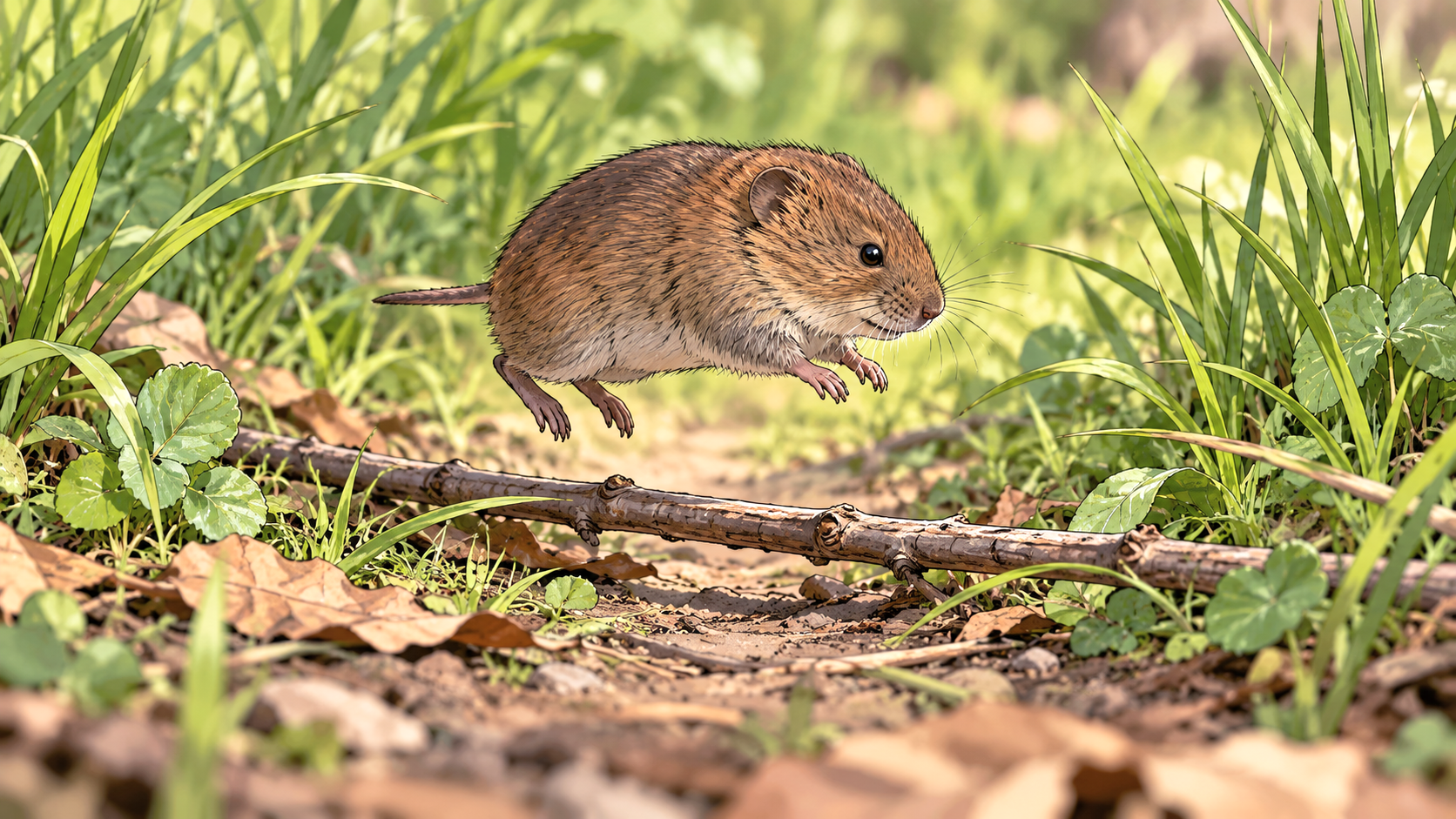
Voles can make short hops and bounds, but they are not powerful jumpers like jumping mice. Running is their usual form of movement, and their ability to climb or squeeze through openings is generally more important than jumping when they encounter obstacles. Jumping ability also varies between vole species, so there is no reliable maximum jumping height that applies to every vole.
A vole suddenly springing across a patch of grass may appear to be jumping farther than it actually is. Its compact body and quick movements can make several short bounds look like one continuous leap.
How Far Can a Vole Jump?
Meadow voles can move with a bounding gait, particularly when crossing exposed ground. Observations of meadow vole tracks in snow describe bounds measuring approximately 4–9 inches (10–23 centimeters). These measurements represent distances between successive tracks, not maximum jumping heights.
Their usual movement is quite different. Meadow voles normally run with frequent sudden stops and starts, allowing them to travel through narrow paths in vegetation. Their compact bodies and relatively short hind legs are better suited to this movement than to sustained, powerful leaps.
Jumping ability should not be generalized across the entire vole group. Montane voles, for example, are not known for jumping or climbing. They normally move through established ground-level runways instead.
The short legs and stocky proportions typical of voles help explain why their movement differs from that of more specialized jumping rodents.
Can Voles Jump Over Garden Fences?
A vole getting over a fence does not necessarily mean it jumped over it. Some voles can climb mesh barriers, using their feet to grip the openings.
In a controlled experiment involving common voles (Microtus arvalis), 87.5% crossed a 30-centimeter wire-mesh fence without an overhang. The successful animals climbed over the barrier rather than jumping over it. Adding an 8–10-centimeter overhang prevented successful crossings by the tested common voles under those experimental conditions.
This measured ability to climb wire fencing is more informative than an unsupported claim that voles can jump a particular number of feet.
A fence can also fail without an animal going over it. Voles may exploit openings near the bottom or dig beneath an inadequately buried edge. For garden exclusion, fencing with 1/4-inch mesh extending approximately 12 inches above ground and 6–10 inches below is recommended.
These specifications address multiple ways animals can enter rather than relying entirely on their limited jumping ability. The protection of vulnerable garden plantings should account for underground access as well as movement over the surface.
Can Voles Jump Into Raised Garden Beds?
A raised bed is not automatically inaccessible to voles. Its protective value depends on the height and construction of its sides, surrounding vegetation, and whether animals can reach the growing area from underneath.
Smooth, continuous walls offer fewer footholds than wire mesh, rough timber, or structures with exposed joints. A raised bed that appears difficult to jump into may still provide other routes through gaps or soil openings.
Underground vole fencing can help prevent animals from entering protected planting areas, but the barrier must remain continuous and securely installed.
For gardeners concerned about repeated losses, the natural management of voles can reduce favorable conditions around beds. A raised structure alone should not be considered proof that voles cannot reach the plants.
Can Voles Jump Like Mice?
Voles and jumping mice are different rodents, despite sometimes occupying similar grassy habitats.
The meadow jumping mouse (Zapus hudsonius) has long hind legs and a tail longer than its head and body combined. These proportions support a much more specialized hopping movement. Meadow jumping mice can travel in hops of one or two feet, considerably farther than the short bounds commonly observed in meadow voles.
A jumping mouse also has a distinctly different silhouette. Its elongated hind feet, long tail, and relatively slender body contrast with the short-tailed, compact appearance of a typical vole.
Someone who sees a small rodent repeatedly making long leaps through a meadow should therefore consider a jumping mouse rather than assuming the animal is a vole.
What If You See a Vole Suddenly Spring Into the Air?
A short upward movement can occur when a small animal is startled, changes direction abruptly, or crosses uneven ground. Such behavior does not establish that the animal regularly uses jumping to travel or escape predators.
A clear observation should distinguish an actual airborne leap from rapid bounding movement. The surface runways used by meadow voles generally allow them to move quickly while remaining close to protective vegetation.
If a suspected vole repeatedly leaps much farther than its own body length, examine its tail, hind feet, and overall proportions. The animal may belong to another small-mammal group.
For practical purposes, jumping is a relatively minor concern when evaluating vole movement around a property. Climbing, squeezing through gaps, and tunneling beneath obstacles present more realistic routes into protected areas than a dramatic leap over a tall, smooth barrier.
One thought on “Can Voles Jump?”