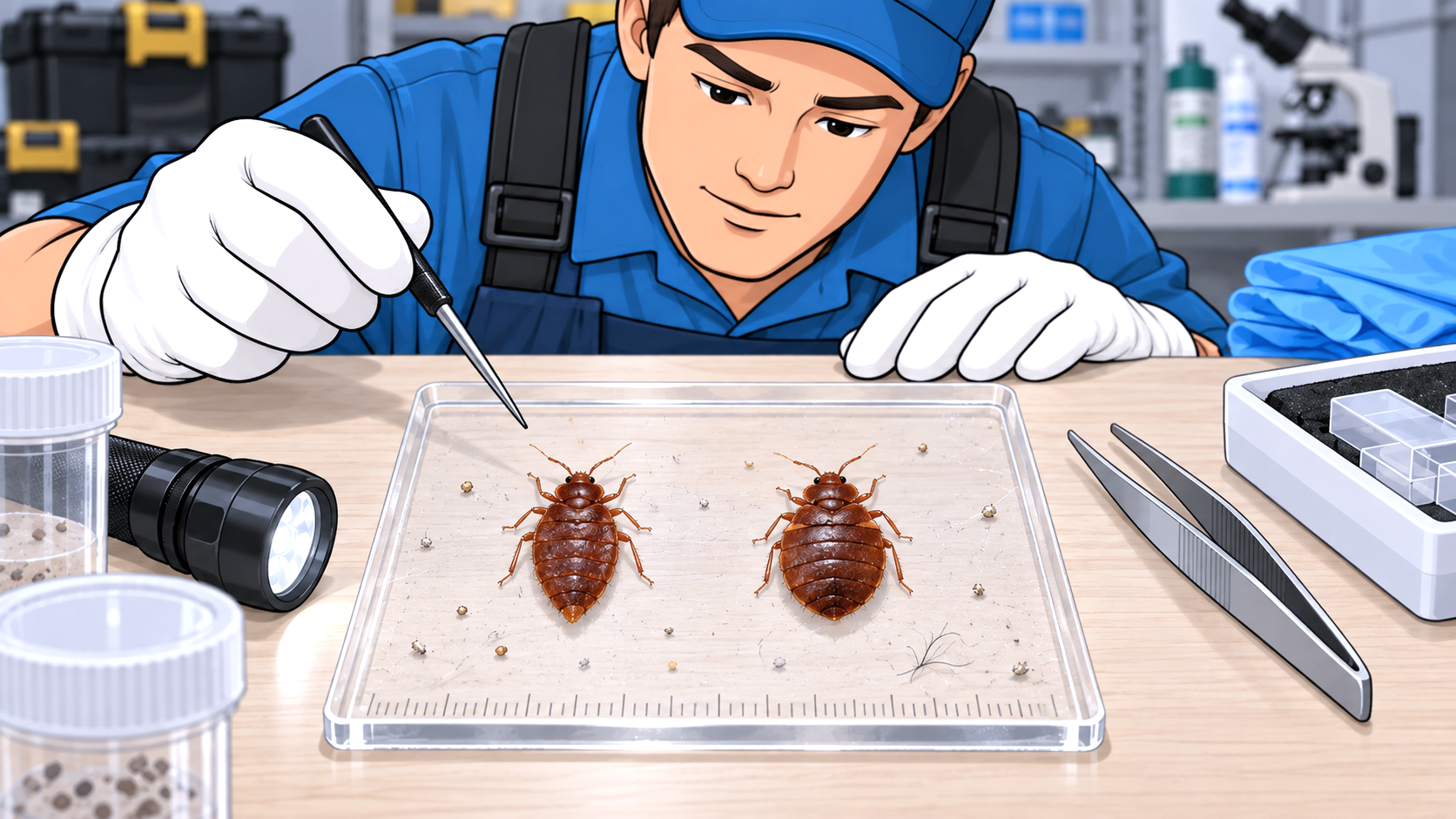
Male and female bed bugs are similar in color and overall size, but adult specimens can often be distinguished by the shape of the abdomen. Male bed bugs have a more tapered, pointed rear end, while females have a broader, more rounded abdomen. Under magnification, females also have a specialized structure called the spermalege on the right side of the abdomen. This unusual feature is associated with the equally unusual way bed bugs mate.
Male vs. Female Bed Bug Abdomen Shape
For practical identification, abdomen shape is the easiest difference to look for in an adult bed bug.
A female’s abdomen is generally broader and more rounded toward the rear. A male’s abdomen narrows more noticeably toward the tip, giving it a more pointed appearance.
The difference is easiest to see from above in an adult specimen that hasn’t recently fed. Feeding stretches the abdomen considerably, which can temporarily make the overall body shape less useful for sexing the bug.
Color isn’t a dependable distinction. Both adult males and females are typically reddish brown, and both become more elongated after taking a blood meal. Size isn’t a reliable standalone feature either because individual adults vary.
Female Bed Bugs Have a Spermalege
A more specialized difference becomes visible under sufficient magnification. Female bed bugs have a structure known as the spermalege on the right side of the abdomen.
A 2024 anatomical and biomechanical study of bed bug mating describes two associated structures: the externally located ectospermalege and the internal mesospermalege. The ectospermalege extends across the fourth to sixth abdominal sternites, with the paragenital sinus associated with this specialized region.
The spermalege exists because bed bugs don’t mate through the conventional female genital tract.
Bed Bugs Mate Through Traumatic Insemination
During mating, the male uses a specialized intromittent organ called a paramere to pierce the female’s abdominal wall. Sperm is introduced through the spermalege and subsequently reaches the female reproductive system.
This process is known as traumatic insemination. The spermalege is an adaptation associated with reducing the costs of repeated wounding at the insemination site.
The same 2024 study examined the mechanics of the male paramere and found structural differences along the organ associated with its puncturing function. The anatomy of both sexes is therefore closely tied to this unusual reproductive system.
For a broader explanation of mating, egg production, and development, bed bug reproduction follows the process beyond the external differences between males and females.
The Female Spermalege Is Normally on the Right Side
The location of the spermalege isn’t random. In the common bed bug, Cimex lectularius, it occurs on the right side of the female abdomen.
Related research on the tropical bed bug Cimex hemipterus has also demonstrated pronounced right-sided mating behavior. In a PLOS ONE study of asymmetrical traumatic insemination, males overwhelmingly inseminated females through the normal right-sided spermalege, even when unusual females possessed an additional functional spermalege on the left.
That study is useful for understanding the extreme asymmetry of bed bug reproduction, but findings from C. hemipterus shouldn’t automatically be treated as measurements of mating behavior in C. lectularius.
Don’t Use Mating Scars to Judge Infestation Age
Repeated traumatic insemination can leave microscopic evidence of wounding around the female’s spermalege. However, those scars aren’t a practical way to determine how old or severe a household infestation is.
A female’s mating history doesn’t tell you when bed bugs first entered a particular home. She may have mated before arriving, and the number of observed wounds doesn’t provide a validated timeline for an infestation.
Infestation severity is better judged from the number and distribution of bugs, eggs, fecal evidence, shed skins, and occupied harborages rather than reproductive scars on an individual female.
Questions About Male and Female Bed Bugs
Do male bed bugs have a spermalege?
No. The spermalege is a female structure associated with traumatic insemination. Males instead possess the paramere used to pierce the female during mating.
Can you tell a male from a female bed bug with the naked eye?
Sometimes. Adult males generally have a more pointed abdomen while females have a broader, rounded abdomen. A magnifying lens makes the distinction easier, particularly with small specimens.
Can male bed bugs lay eggs?
No. Only adult females produce eggs. Finding eggs therefore means that a female has been present, although it doesn’t tell you whether the female is still in the same harborage.
One thought on “Male vs. Female Bed Bugs: How to Tell Them Apart”