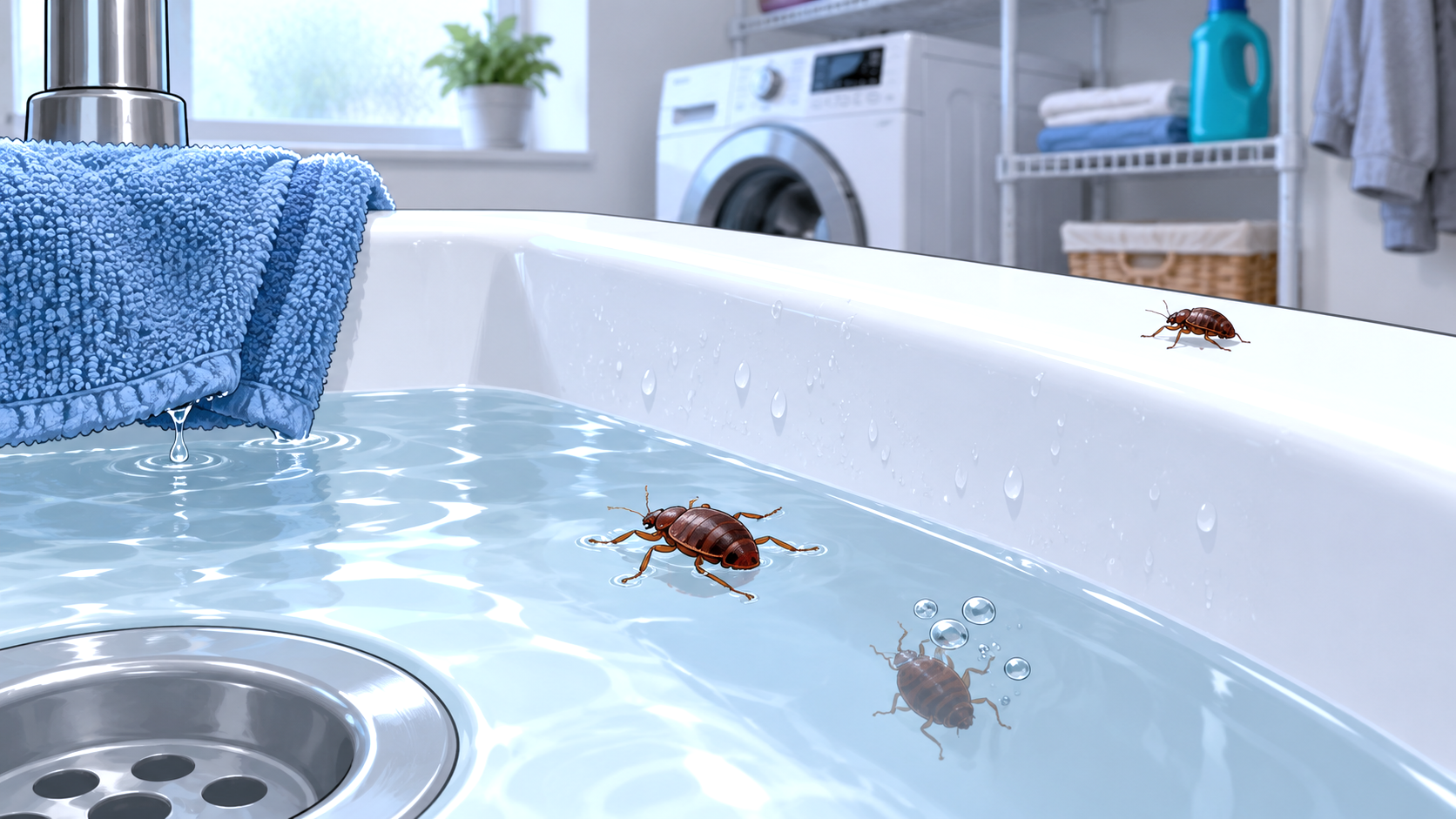
Bed bugs aren’t aquatic insects, and swimming isn’t part of their normal behavior. Put one in plain water, however, and that doesn’t mean it will immediately sink and die. Bed bugs can remain at the surface, while soap changes how water interacts with them and makes drowning easier.
Bed bugs cannot swim in the ordinary sense, but plain water isn’t a dependable way to kill them. Soap helps drown bed bugs by breaking the surface tension of the water, and laundering can remove or kill some bugs. However, bed bugs can sometimes survive a washing-machine cycle when the water isn’t hot enough, which is why heat from a clothes dryer is a more reliable control method for suitable items.
There is also no good reason to rely on one universal online claim about exactly how many minutes or hours a bed bug can survive underwater. Submersion has been studied, including historically, but survival depends on conditions and life stage.
Bed Bugs Don’t Swim, but Plain Water Isn’t an Instant Kill
Bed bugs are terrestrial insects adapted to crawling, hiding in narrow spaces, and feeding on blood. They don’t have the specialized swimming structures associated with aquatic insects, and swimming isn’t a normal means of movement for them.
That still leaves an important difference between not being able to swim and drowning immediately.
Cornell’s Integrated Pest Management program specifically explains that soap helps drown bed bugs by breaking the surface tension of water. Its guidance recommends hot, sudsy water for washing suitable hard items and notes that bed bugs collected during cleaning can be rinsed into the soapy water.
That makes soapy water useful for direct cleaning and removal. It doesn’t establish plain-water submersion as a dependable treatment for an infested room or belongings.
Bed Bug Submersion Has Actually Been Studied
Claims about exact drowning times should be treated carefully, but the subject isn’t completely absent from scientific literature.
In 1914, entomologist A. W. Bacot published an experiment specifically examining temperature, submersion, and burial in relation to the survival of bed bug eggs and larvae. The work was prompted partly by questions about whether bed bug eggs could survive when infested building material was reused.
That historical experiment is useful evidence that submersion survival isn’t a new question. However, we wouldn’t turn century-old experimental conditions into a universal household rule such as “a bed bug drowns after X minutes.” Modern control recommendations don’t use a simple underwater timer as a standard treatment method.
The practical answer is therefore more useful than an unsupported countdown: don’t assume that putting a bed bug or an infested object in plain water briefly has eliminated the problem.
Soap Makes Water More Effective Against Bed Bugs
Cornell’s current hand-washing guidance gives soapy water a legitimate role in bed bug management.
Soap reduces surface tension, helping water wet and overwhelm the insect rather than simply allowing it to remain at the surface. Cornell also notes that washing and scrubbing can physically remove live bugs, eggs, shed skins, and fecal material from suitable surfaces.
For water-safe objects such as some plastic, metal, glass, toys, furniture components, and other hard items, scrubbing thoroughly with hot, sudsy water can therefore be useful. Cracks and crevices deserve particular attention because wiping only the exposed surface can leave hidden bugs or eggs untouched.
Cornell recommends watching for escaping bed bugs during the process and ensuring captured insects actually end up in the soapy water or are physically killed. Some finishes and materials can also be damaged by water, so the cleaning method should be tested before treating an entire object.
This is different from filling a bathtub with plain water and assuming everything submerged in it has been reliably treated.
Bed Bugs Can Survive a Washing-Machine Cycle
A washing machine combines water, detergent, agitation, and sometimes heat, yet even that isn’t guaranteed to eliminate every bed bug.
Cornell states that bed bugs can sometimes survive a wash cycle when the water isn’t hot enough. The EPA makes the same practical distinction, warning that washing alone will generally not kill bed bugs.
That tells us something important about drowning. If immersion and agitation during a complete laundry cycle aren’t dependable on their own, simply soaking infested clothing in ordinary water shouldn’t be treated as a reliable bed bug treatment either. Our separate look at whether washing clothes kills bed bugs covers the laundry question in more detail.
Dryer Heat Is More Reliable Than Trying to Drown Them
For clothing, bedding, and other dryer-safe belongings, authoritative guidance consistently puts more confidence in dryer heat than washing alone.
The EPA recommends placing suitable bedding and clothing in a dryer at high temperature for 30 minutes and explicitly notes that washing by itself generally won’t kill bed bugs. Its treatment-preparation guidance similarly recommends a household dryer on high heat for 30 minutes for appropriate clothing, bedding, and other items.
University of Minnesota Extension gives comparable practical guidance. It states that clothes exposed to temperatures above 122°F for 20 minutes can kill all bed bug life stages and recommends roughly 30 minutes at medium-high heat for a full load of suitable objects.
Those recommendations shouldn’t be combined into a homemade universal temperature-and-time formula because load size, dryer performance, material, and the temperature reached throughout the items all matter. For ordinary household use, following established dryer guidance is more dependable than trying to measure how long a bed bug can remain underwater.
The specific laundry procedure is covered in whether a clothes dryer kills bed bugs.
Don’t Use Water as a Standalone Treatment for an Infestation
Soapy water has legitimate uses, particularly for cleaning water-safe hard surfaces and directly disposing of captured bugs. It isn’t a substitute for treating all the places where an infestation can persist.
Bed bugs spend much of their time concealed in mattress seams, furniture joints, cracks, crevices, baseboards, bed frames, and other protected areas. Pouring water onto those areas can damage furniture and buildings without reaching every hidden insect or egg.
A bed bug that falls into water is one thing. An established infestation spread through a room is an entirely different control problem.
For that reason, we would use soapy water where current guidance specifically supports it and rely on established integrated bed bug control methods for the infestation itself.
Questions About Bed Bugs and Water
Will a bed bug drown if you put it in water?
A bed bug can be drowned, but plain water shouldn’t be treated as an instant or reliably timed kill method. Current Cornell guidance recommends soapy water because soap breaks the water’s surface tension and helps drown captured bugs.
Does dish soap kill bed bugs in water?
Soapy water can help drown bed bugs and immobilize them, according to Cornell IPM. It is useful when directly cleaning appropriate hard surfaces or disposing of bugs you have captured, but it isn’t a complete treatment for an infestation.
Can bed bugs survive in a washing machine?
Yes, some can survive a wash cycle when the water isn’t hot enough. The EPA likewise warns that washing alone generally won’t kill bed bugs. Dryer heat is therefore an important treatment step for items that can safely tolerate it.
Will flushing a bed bug down the toilet get rid of it?
Cornell recommends dumping used soapy wash water containing captured bed bugs into the toilet and flushing it rather than emptying the water into a sink. That is a practical disposal method for bugs removed during cleaning.
Can you wash hard objects in soapy water to remove bed bugs?
Yes, when the material can safely tolerate water. Cornell recommends hot, soapy hand washing for suitable hard items and thorough scrubbing of cracks and crevices. The goal is direct removal and elimination of bugs and eggs on accessible surfaces, not simply leaving the object underwater.