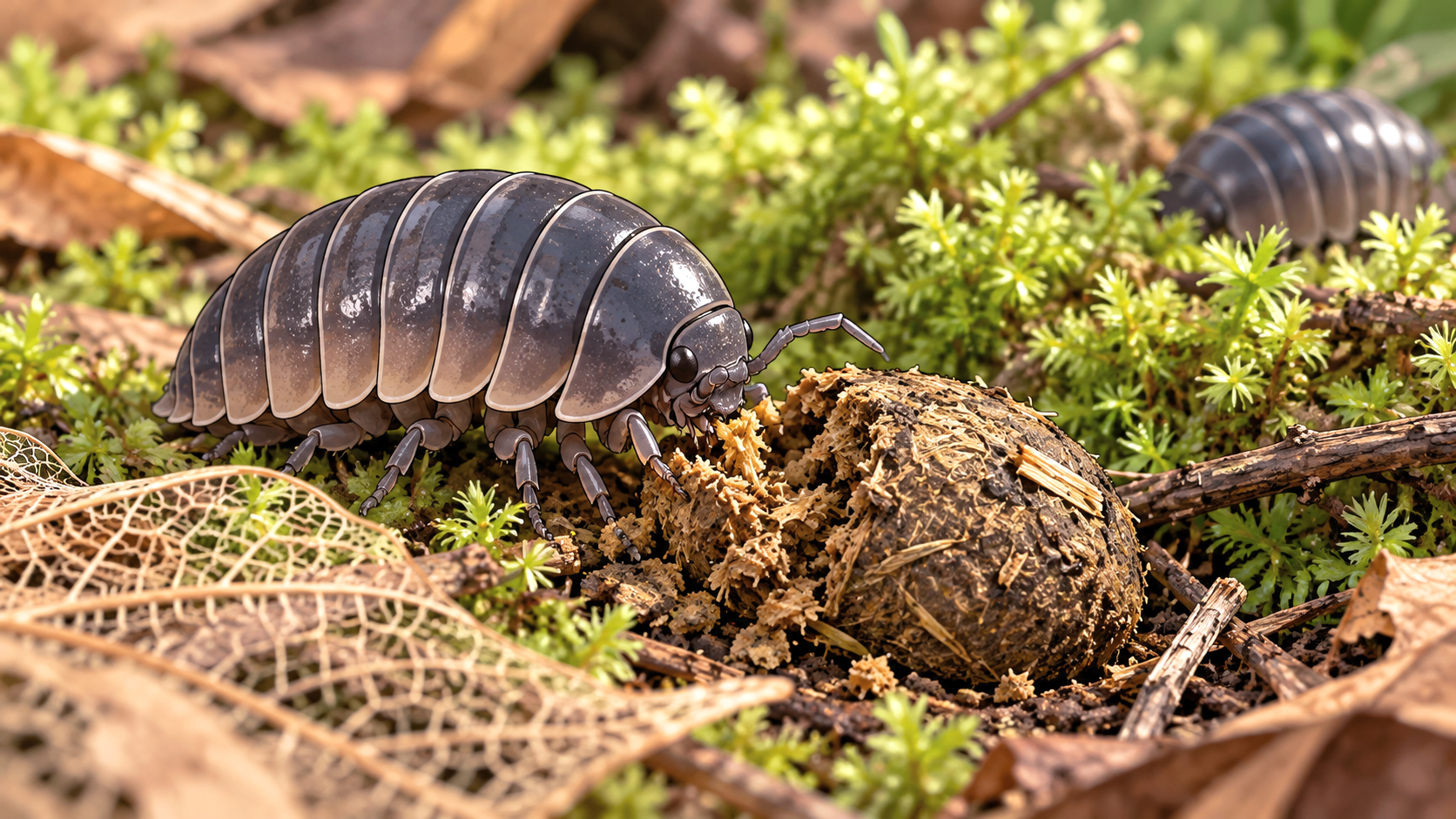
Roly-polies eat poop to recover nutrients and consume microorganisms that grow on their droppings. This behavior, called coprophagy, allows terrestrial isopods to obtain additional nutritional value from material that has already passed through their digestive systems. Their feces can contain undigested plant matter, nitrogen-rich compounds, and bacteria that make the material suitable for consumption again. The nutritional benefit varies with the quality of their original food.
For the common roly-poly, Armadillidium vulgare, coprophagy is part of the feeding behavior associated with terrestrial isopods. The animals primarily consume decaying vegetation, which can contain substantial amounts of difficult-to-digest plant material.
What Nutrients Do Roly-Polies Recover From Their Droppings?
Dead leaves contain cellulose and other structural compounds that require considerable digestive processing. When a roly-poly eats decomposing vegetation, some nutrients are absorbed during the first passage through its gut, while other organic compounds leave the body in fecal pellets. Those pellets remain potential food because digestion has not removed every usable substance.
Copper is particularly interesting in terrestrial isopod nutrition. These crustaceans require copper for physiological functions, including their copper-containing oxygen-transport protein, hemocyanin. Experiments involving terrestrial isopods found that animals eating litter with low copper concentrations could lose more copper through their feces than they absorbed from their food. Researchers examining copper balance and coprophagy in terrestrial isopods identified fecal recycling as a possible way to recover some of that mineral.
Other compounds can also remain available after digestion. Fecal material contains nitrogen-rich organic substances, including components associated with microorganisms. Reingesting it creates another opportunity to use material that would otherwise leave the animal’s digestive system permanently. The nutritional ecology of terrestrial isopods describes how digestive efficiency, microbial activity, and nutrient availability interact in these animals.
Why Bacteria Make Roly-Poly Poop More Nutritious
Fecal pellets are favorable environments for certain microorganisms because they contain organic compounds that remain available after digestion. Once deposited in a suitable environment, the pellets can become colonized by bacteria and fungi, which continue breaking down the material.
This creates a feeding opportunity. The roly-poly can consume microbial cells alongside the partially decomposed material, obtaining substances that were less accessible during the original meal. Microbial activity can also change the chemical composition of the pellets.
An experiment involving the woodlouse Oniscus asellus examined fecal pellets produced after feeding on wood. The pellets were consumed again, and researchers measured their microbial populations and nitrogen-containing compounds across successive digestive passages. Bacterial numbers and certain protein-related compounds increased in older pellets. The research on repeated fecal consumption demonstrated how microbial growth and digestion can alter the nutritional composition of material passing repeatedly through an isopod’s gut.
The process helps explain why roly-polies are attracted to decomposing organic matter. A fallen leaf that has undergone microbial decomposition can be more suitable for feeding than fresh, resistant plant tissue.
Does Eating Poop Always Help Roly-Polies Grow?
The nutritional advantage of coprophagy changes with the quality of the original food. Feces produced from nutrient-rich leaves do not necessarily provide a better diet than the leaves themselves.
A feeding experiment involving the common rough woodlouse, Porcellio scaber, compared alder and oak leaf litter with feces produced from those materials. Woodlice grew better on alder leaves than on feces derived from alder. With the less nutritious oak material, feces containing suitable microbial populations supported improved growth.
The experimental comparison of leaf litter and fecal diets established that the benefits of coprophagy are conditional. Microbial colonization improved the value of some food sources but did not produce the same advantage across all treatments.
This prevents a misleading interpretation of the behavior. Roly-polies are capable of obtaining nutrients from ordinary decomposing vegetation. Consuming feces can provide another feeding opportunity, especially when their original diet offers limited nutrition, but it is not automatically superior to eating fresh portions of suitable decaying material.
Do Roly-Polies Eat Only Their Own Poop?
Terrestrial isopods can consume fecal material originating from other individuals, as well as material they have produced themselves. Their feeding behavior is influenced by the properties of the available food rather than a requirement that a pellet belong to a particular animal.
The term coprophagy covers feces consumption generally. It does not specify whether the material came from the same individual or another member of the species.
Repeated feeding also contributes to the movement of organic material through the soil ecosystem. Isopods fragment leaves, digest part of the material, and deposit pellets that microorganisms subsequently colonize. Those pellets can undergo further decomposition or be consumed again. The ecological study of consumer strategies in terrestrial isopods connects their digestive limitations with the recycling of substances that remain after an initial meal.
Should You Remove Roly-Poly Droppings From a Terrarium?
A small amount of fecal material is a normal part of a functioning isopod enclosure. Removing every pellet is unnecessary and would eliminate material associated with the natural feeding and decomposition processes occurring in the substrate.
However, coprophagy does not mean feces should replace a varied diet. Captive roly-polies still require suitable decaying leaves and other species-appropriate food. Their digestive system relies on the nutritional quality of the material available, and repeatedly consuming a nutritionally inadequate substrate does not make it complete.
For enclosure maintenance, prioritize an appropriate leaf-litter supply, suitable moisture, and the removal of uneaten food that begins spoiling. A healthy substrate supports microbial decomposition without allowing accumulations of unwanted food waste to dominate the enclosure.