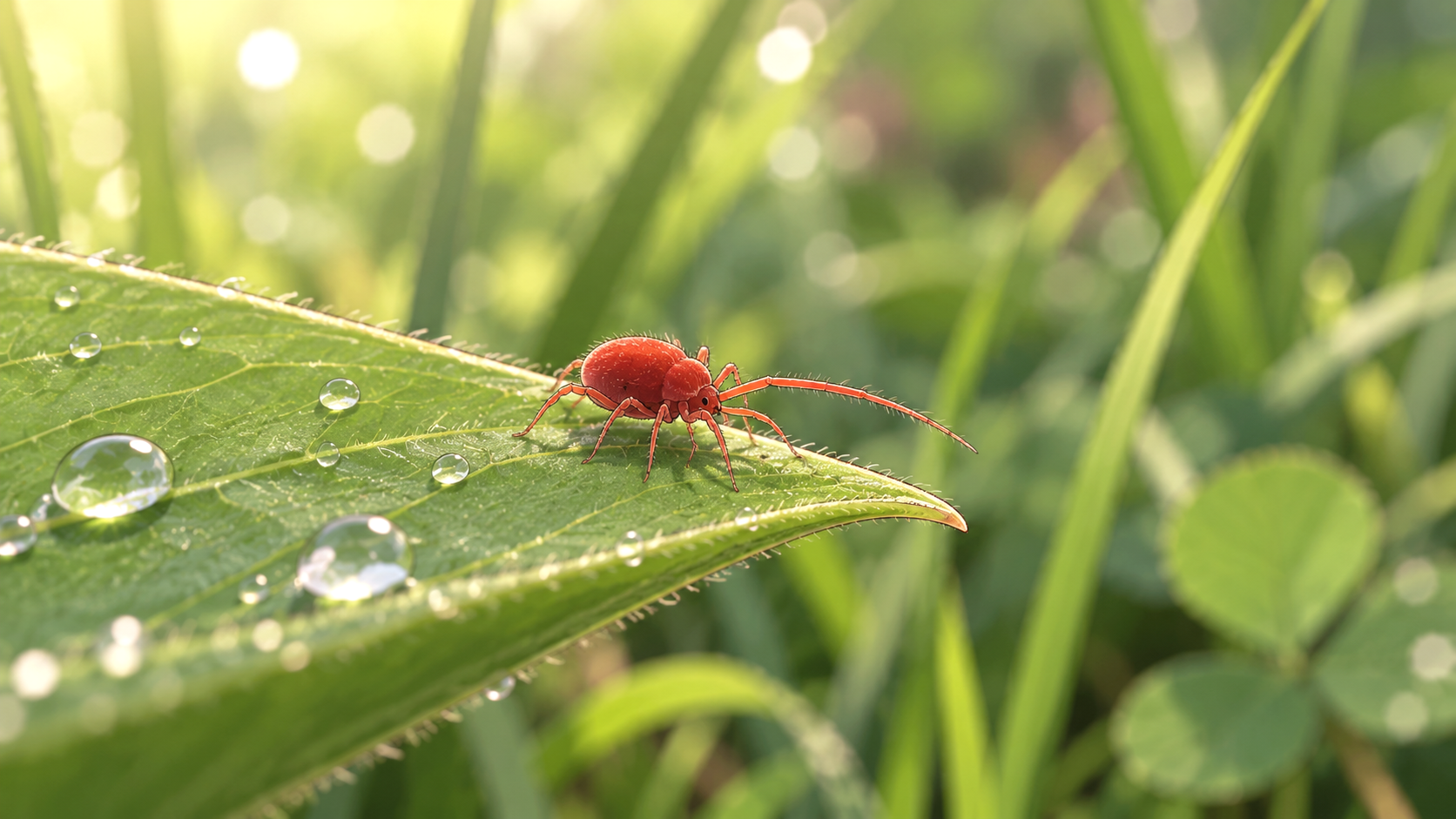
Clover mites are tiny, plant-feeding mites that live mainly outdoors but sometimes move onto and into buildings in very large numbers. They are arachnids rather than insects and belong to the spider mite family. For homeowners, their significance is less about what they do outdoors and more about the sudden appearance of hundreds or even thousands of tiny crawling mites around a home.
Their scientific name is Bryobia praetiosa. Despite the word “clover” in their common name, they are not restricted to clover. They use grasses and numerous other plants, which helps explain why a home can have a clover mite problem even when there is no obvious patch of clover anywhere nearby.
Clover Mites Are Plant-Feeding Arachnids
Clover mites belong to the class Arachnida and the family Tetranychidae, the group commonly known as spider mites. Calling them insects is therefore technically incorrect. Their relationship to other mites, spiders, and ticks also explains some basic features that separate mites from true insects, although the classification differences deserve their own treatment in whether clover mites are spiders or insects.
Outdoors is where clover mites actually make their living. They feed on vegetation and are particularly associated with turfgrass and other plants around buildings. Their host range is much broader than their name suggests, with more than 200 plant species reported as hosts. Lawns are especially relevant around homes, and populations can become conspicuous around lush or heavily fertilized turf. For the specifics of what they consume rather than the broader overview here, see what clover mites eat.
We think the name causes an easy misunderstanding. Finding clover mites does not mean clover itself must be the source of the problem. Grass and other vegetation can support them perfectly well, so searching a yard for clover alone can send you looking for an explanation that was never there. Their broader outdoor habitat is covered separately in where clover mites live.
Why Homeowners Suddenly Notice Clover Mites
Most people do not discover clover mites while inspecting their lawn. They notice them when large numbers start crawling over foundations, exterior walls, windows, or indoor surfaces. Clover mites can become a household nuisance when they migrate from vegetation onto buildings, and the numbers involved can make a tiny mite look like a much larger pest problem.
Season and weather can influence those movements. Clover mites are commonly troublesome around buildings during spring and fall, although local conditions affect exactly when they appear. Changes in weather can trigger large movements into buildings, while sunny exterior surfaces and areas around windows are common places to encounter them. The full seasonal pattern belongs in when clover mite season occurs, rather than turning this overview into a month-by-month calendar.
Once mites start appearing inside, it is also easy to assume the house itself is supporting the population. Clover mites are fundamentally outdoor plant feeders, and they do not establish reproducing populations indoors. That makes an indoor sighting different from finding a household pest that lives, feeds, and multiplies inside the structure. The indoor biology is covered in whether clover mites can live and reproduce indoors, while why clover mites enter houses deals with the separate question of how they end up there.
Why Such Tiny Mites Get So Much Attention
Numbers are a large part of it. A single clover mite is easy to overlook, but populations can reach the point where many mites appear together on walls, windows, and other surfaces. Their tendency to invade buildings in quantity has made Bryobia praetiosa one of the plant-feeding mites of particular concern around homes.
They also have an unfortunate feature for something people instinctively try to wipe away. Crushing clover mites can leave a reddish stain from their body pigments, so smearing a cluster across a light windowsill, wall, curtain, or carpet can create a second problem. Vacuuming indoor mites instead of crushing them avoids that staining. The red residue is not evidence that the mites have been feeding on blood.
Beyond that nuisance, the questions about whether clover mites bite, threaten people or pets, or damage a home belong in the site’s dedicated harm coverage rather than being folded into this overview. Likewise, if you are trying to identify a tiny mite you have already found, use what clover mites look like instead of relying on the broad identification points here.
What Finding Clover Mites Actually Tells You
Seeing clover mites around a building usually points back outdoors. They are plant feeders associated with lawns and other vegetation, and buildings become conspicuous to homeowners when mites leave those outdoor areas and start crawling across structural surfaces. That makes the surrounding property more informative than the room where one mite happened to appear.
For now, resist the urge to crush every tiny speck you find. Vacuum indoor mites where practical and identify the pest before deciding whether anything more needs doing. If the mites are repeatedly entering the building, the next useful question is what attracts clover mites to a property or why they are getting indoors, not whether the house has somehow become their normal habitat.
Other Questions About Clover Mites
Are clover mites the same as spider mites?
Clover mites belong to the spider mite family, Tetranychidae, but “spider mite” covers many species rather than one single pest. Clover mites are specifically Bryobia praetiosa.
Are all tiny red mites clover mites?
No. Several mites can appear red or reddish, so color alone is not enough for a reliable identification. The combination of physical characteristics matters more, which is why clover mite appearance is more useful than identifying them from color alone.
Are clover mites found only in lawns?
No. Turfgrass is an important habitat, but clover mites use many kinds of vegetation. Their documented host range includes grasses, herbaceous plants, shrubs, trees, and agricultural plants.
Why are they called clover mites if they eat other plants?
Clover is one of their host plants, but the common name does not describe the limits of their diet. Clover mites can feed on a much broader range of vegetation.