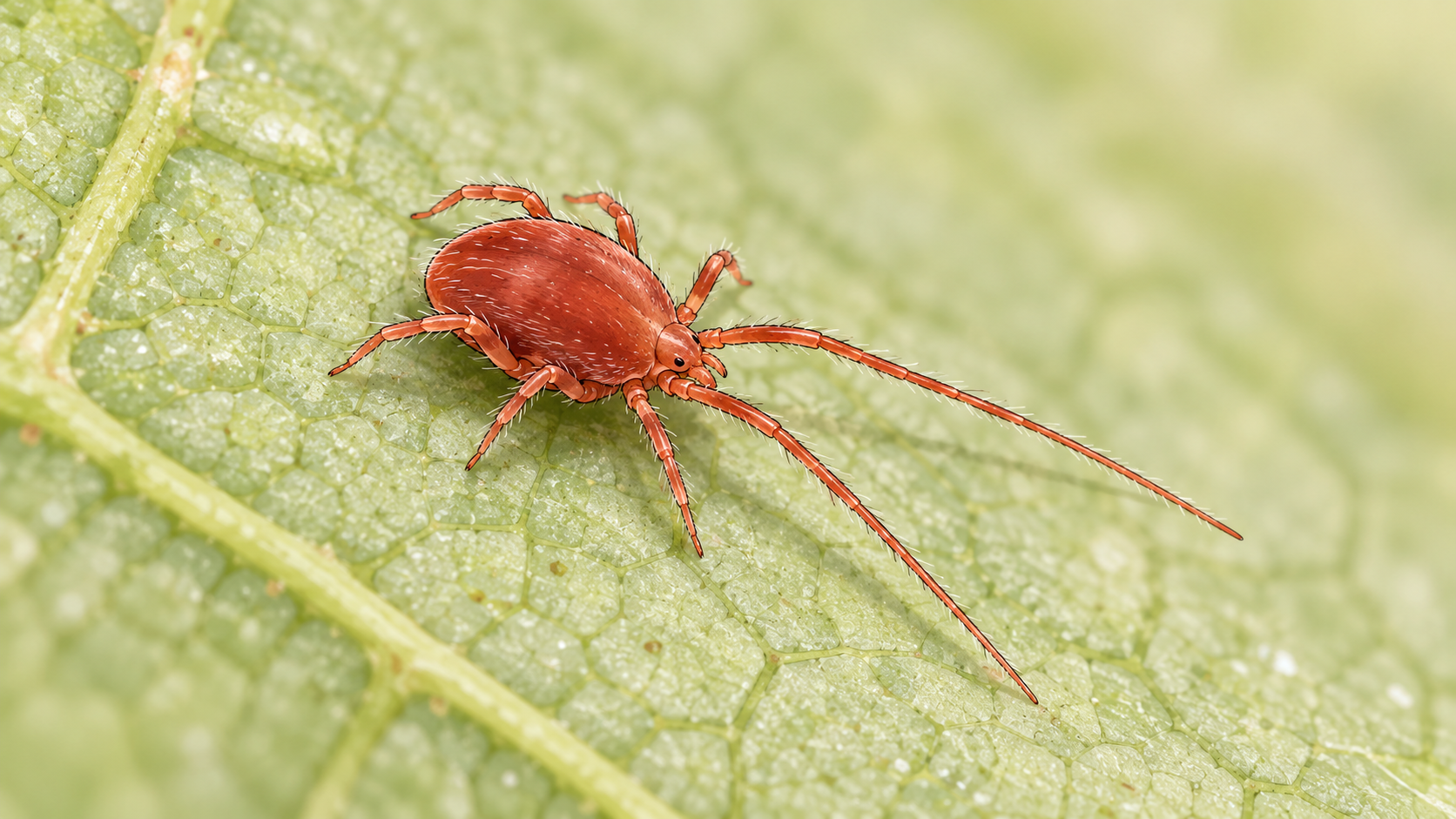
Clover mites are tiny, rounded to oval mites with eight legs and an unusually long front pair of legs. Adults are about 0.75 mm long, so they usually look like moving specks to the naked eye. Their extended front legs are the most useful identifying feature because they can look almost like antennae. That combination of minute size, rounded body, and exaggerated front legs is more useful for identification than color alone. Clover mite coloration varies, so the dedicated guide to clover mite colors covers that characteristic separately.
Clover Mites Are Barely More Than Moving Specks
An adult clover mite is about 0.75 mm long, making it smaller than the head of a pin. Even though clover mites are relatively large compared with some other plant-feeding mites, they are still difficult to examine properly without magnification. At normal viewing distance, you are more likely to notice a tiny speck crawling across a windowsill or wall than to make out individual body parts. Their small, rounded to egg-shaped bodies become much clearer once magnified.
We would not try to identify one from size alone. Plenty of mites and tiny insects occupy the same general size range, and estimating fractions of a millimeter by eye is unreliable. Instead, size works best as the first filter: a creature large enough for you to see its body structure easily without getting close is unlikely to match the usual appearance of a clover mite.
The Extra-Long Front Legs Are the Best Visual Clue
Look closely enough and one feature stands out. Clover mites have four pairs of legs, but the first pair is considerably longer than the other three pairs. They hold those elongated legs forward, which can make them look like antennae when the mite is moving. That unusually long first pair helps distinguish clover mites from other common spider mites.
This feature can also create a surprisingly convincing insect-like illusion. Someone looking at a clover mite without magnification may think they are seeing six walking legs plus two antennae. In reality, those two long projections are legs. Clover mites are arachnids, and the separate question of their classification is covered in whether clover mites are spiders or insects.
The rest of the legs are much shorter in proportion to the body. As the mite walks, the extended front pair can be conspicuous enough to notice even when finer anatomical details remain invisible. For us, that is the feature worth checking first once you have magnification.
Their Body Is Rounded Rather Than Long and Segmented
The clover mite body has a compact, broadly rounded to oval appearance. You do not see the obvious head, thorax, and abdomen divisions associated with insects. Under stronger magnification, adults also have sparsely arranged featherlike scales on the abdomen, although that is far beyond what most homeowners will see when examining a mite on a wall.
Movement can make the overall shape easier to recognize. Clover mites crawl rather than fly or jump, and they can move surprisingly quickly for their size. A magnifying glass or close-up photograph is much more useful than trying to inspect a moving mite directly. If your mystery speck disappears by jumping or takes flight, clover mite locomotion gives you a straightforward reason to reconsider the identification.
What Clover Mites Look Like Around the House
Indoors, their tiny size changes how they appear in real life. You may first see a scattering of mobile dots on a light-colored windowsill, wall, curtain, or other surface rather than recognize individual mites. Outdoors, they can appear in much larger groups on foundations, sidewalks, and exterior walls. Clover mites are particularly noticeable around sunny surfaces and windows during periods when they are moving away from outdoor vegetation.
A useful identification mistake to avoid is treating a reddish smear as the mite’s normal appearance. Clover mites can leave a rusty or reddish stain when crushed, but that residue comes from their body pigments rather than blood. Vacuuming them instead of wiping or crushing them avoids creating those marks on pale surfaces.
Where you find the mites can support an identification, but location cannot prove it by itself. Several tiny arthropods turn up around windows and walls. When clover mites are involved, the physical combination remains more persuasive: a sub-millimeter rounded mite, eight legs, and a front pair dramatically longer than the rest.
What to Check When You Find a Tiny Mite
Start by getting a closer view rather than judging the mite from across the room. A phone camera with a useful macro mode or a hand lens may reveal enough structure to see whether the body is rounded and whether the first pair of legs extends conspicuously forward. Those features are more dependable than assuming every tiny reddish moving dot must be a clover mite.
Age complicates identification because immature clover mites do not look identical to adults. We have kept those differences out of this guide deliberately because baby clover mite appearance has its own identification page. Likewise, the appearance of clover mite eggs is a separate identification problem. For an adult or near-adult mite, focus on the overall size, compact shape, eight-legged form, and especially those elongated front legs.
Other Questions About Clover Mite Appearance
Can you see clover mites without a microscope?
Yes. Adult clover mites are visible to the naked eye, although at about 0.75 mm long they often look like moving dots. Magnification makes their identifying features much easier to see.
Do clover mites have antennae?
No. The structures that resemble antennae are their unusually long first pair of legs. This is one of the easiest features to misread when the mite is viewed without magnification.
Do clover mites have wings?
No. Clover mites are wingless. They move by crawling, so a tiny pest that clearly flies does not match a clover mite.
Are clover mites bigger than other spider mites?
They can be. Clover mites are comparatively large among plant-feeding mites, although “large” is relative here because an adult is still less than 1 mm long.
2 thoughts on “What Do Clover Mites Look Like?”