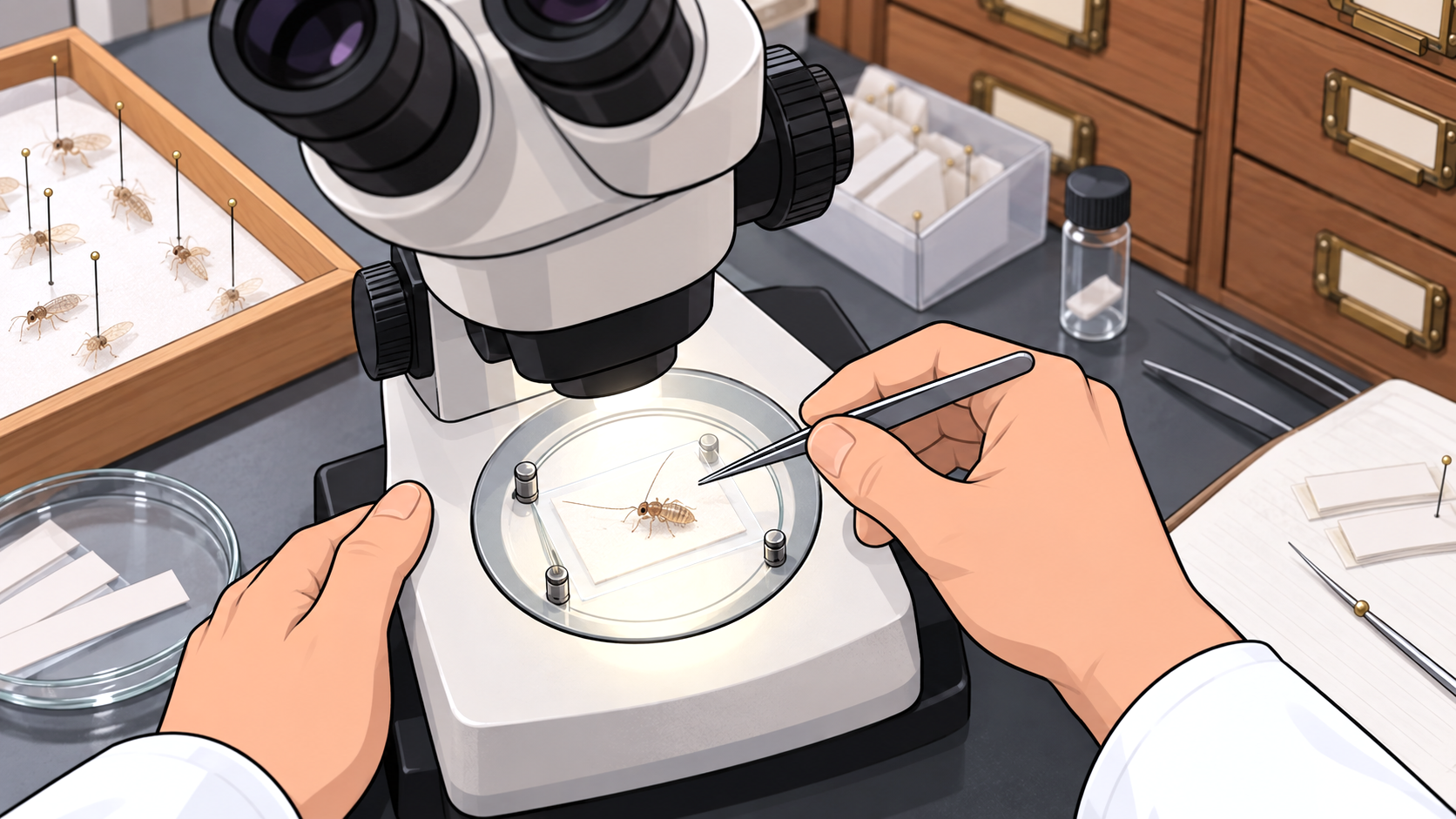
Searching for the scientific name of booklice sounds as though it should produce one neat Latin name. It does not. “Booklice” is a common name applied to multiple related insects, rather than the common name of one single species.
Booklice do not have one genus-and-species scientific name. Many of the booklice found inside buildings belong to the genus Liposcelis, so they may be written as Liposcelis spp. Booklice are classified in the family Liposcelididae within the order Psocodea, which also includes barklice and parasitic lice. That hierarchy is more useful than assigning every booklouse the same species name.
Is Liposcelis the Scientific Name for Booklice?
Liposcelis is a genus containing many booklouse species, not the scientific name for every insect called a booklouse. Many of the tiny, wingless psocids encountered inside buildings are Liposcelis species, which is why the genus appears so often in discussions of household booklice.
When the exact species has not been identified, you may see Liposcelis sp. or Liposcelis spp. The abbreviation “sp.” refers to an unspecified single species within a genus, while “spp.” refers to multiple or unspecified species collectively. Neither expression is a complete species name.
This matters because calling every booklouse simply “Liposcelis” can give the impression that booklice constitute one species. They do not. The appearance of booklice and even characteristics such as booklouse color can vary, so identifying an insect as a booklouse does not automatically identify it to species.
What Family Do Booklice Belong To?
A useful taxonomic level for booklice is the family Liposcelididae. Current classification information identifies Liposcelididae as the booklice family.
A family sits above genus in biological classification. In simplified form, the relationship looks like this:
Order Psocodea → Family Liposcelididae → Genus Liposcelis → individual Liposcelis species
That sequence explains why “booklice” and Liposcelis should not be treated as interchangeable taxonomic terms. Liposcelididae contains the booklice being discussed at the family level, while Liposcelis is a more specific genus within that classification.
For a homeowner who has found tiny insects around paper, cupboards, or damp materials, identifying the exact species is rarely necessary. Recognizing the insect as an indoor booklouse and understanding the moisture conditions supporting it will usually be more useful.
What Order Are Booklice In?
Booklice belong to the order Psocodea. This order includes booklice, barklice, and parasitic lice. The classification is useful because it shows that several insects carrying “lice” in their common names are related at a broad taxonomic level without being the same kind of organism.
The word psocid is also commonly used when discussing booklice and barklice. Psocids are small, soft-bodied insects, and the group contains both winged and wingless forms. Indoor booklice are generally wingless, while many outdoor forms called barklice possess wings. That difference is covered more closely when looking at whether booklice have wings.
Some older references place psocids under Psocoptera. You may therefore encounter Psocoptera when reading older pest-management publications or identification material. Current classification places these insects within Psocodea, so Psocodea is the order we use for booklice on Exterminator Secrets.
Why Are Booklice Called Psocids?
“Psocid” is a broader descriptive name historically used for insects commonly called booklice and barklice. That is why pest-identification resources may describe an indoor insect as a booklouse in one place and a psocid in another.
The words are useful at different levels. “Booklouse” usually describes the tiny forms associated with buildings, books, stored materials, and other indoor environments. “Barklouse” is commonly applied to related outdoor forms found on bark, leaves, trees, and shrubs. Both belong to the broader group of insects traditionally called psocids.
Indoor species are typically tiny and wingless, whereas outdoor psocids are often winged and called barklice. This naming convention explains why searching for photographs of “psocids” produces insects that can look surprisingly different from the booklice crawling across a wall.
Are Booklice Actually Lice?
Booklice are not the parasitic lice that infest people or other animals. Their common name creates an unfortunate amount of confusion.
Household booklice live in environments where moisture allows microscopic fungi and mold to grow. They feed on fungi and other suitable organic material rather than feeding on human blood. Indoor booklice do not bite people or transmit disease, and their presence is primarily a nuisance and moisture indicator.
Human lice have a very different lifestyle. They are specialized parasites associated with human hosts and feed on blood. Sharing the word “lice” does not make booklice equivalent to head lice, body lice, or pubic lice.
That difference becomes much clearer when booklice and true lice are compared directly. The common name may sound alarming, but the biology behind it is completely different.
Does Every Booklouse Belong to Liposcelis?
No. Liposcelis is particularly important because species in this genus are commonly encountered indoors, but “booklice” is broader than a single genus.
This is another reason a photograph of a booklouse cannot automatically be assigned a species name. Even identifying a specimen as Liposcelis does not tell you which Liposcelis species it is. Species-level identification can require characteristics that are not visible in an ordinary phone photograph.
For everyday household identification, that level of precision usually adds little practical value. A tiny, wingless psocid associated with damp materials and fungal growth can often be managed based on the conditions supporting it rather than determining its exact species. Booklice commonly occupy warm, humid or damp places where mold can develop, making the environment an important part of the identification.
Why the Scientific Name Matters for Identification
Scientific classification becomes useful when common names start overlapping. “Booklouse,” “psocid,” and “barklouse” can appear in discussions of related insects, while the word “lice” can send someone toward an entirely different group of household pests.
Taxonomy gives those names structure. A typical indoor Liposcelis booklouse belongs among psocids, but it is not a human louse. Likewise, an outdoor winged barklouse can belong to the same broader insect group without being the tiny wingless booklouse you find around damp paper.
Physical identification still matters. Booklice are extremely small, soft-bodied insects with long antennae and a comparatively large head. Many common indoor forms are only about 1 to 2 millimeters long, and understanding how big booklice actually are helps separate them from larger insects that happen to share a similar color or shape.
Other Questions About Booklice Classification
What does Liposcelis spp. mean?
It means multiple or unspecified species belonging to the genus Liposcelis. It should not be interpreted as the full scientific name of one particular booklouse species.
Should the word Liposcelis be italicized?
Yes. Genus and species names are conventionally italicized in scientific writing. Higher taxonomic ranks such as Liposcelididae and Psocodea are not italicized.
Is Psocodea the same thing as booklice?
No. Psocodea is a much broader taxonomic order. It includes booklice as well as barklice and parasitic lice, so using Psocodea as though it referred only to booklice would be inaccurate.
Can you identify a booklouse species by looking at its color?
No. Booklice occur in several colors, including pale, gray, tan, and brown forms. Color can contribute to an identification, but it cannot establish the species. The combination of anatomy, size, habitat, and other characteristics is more useful.
Which Name Should You Use for a Booklouse You Find?
For an ordinary household sighting, booklouse is perfectly adequate once the insect has been identified correctly. If you need a more scientific description without knowing the exact species, “booklouse” or “psocid” is safer than inventing a species-level identification.
For the indoor forms commonly encountered in buildings, Liposcelis spp. may be appropriate when the genus is actually established. At the broader levels, Liposcelididae identifies the booklice family and Psocodea identifies their order.
The scientific hierarchy is therefore not a choice between competing names. Each name describes a different level of classification. Once you understand that hierarchy, the seemingly conflicting labels used for booklice make considerably more sense, and what booklice are becomes easier to separate from what their misleading common name suggests.
8 thoughts on “What Is the Scientific Name for Booklice?”