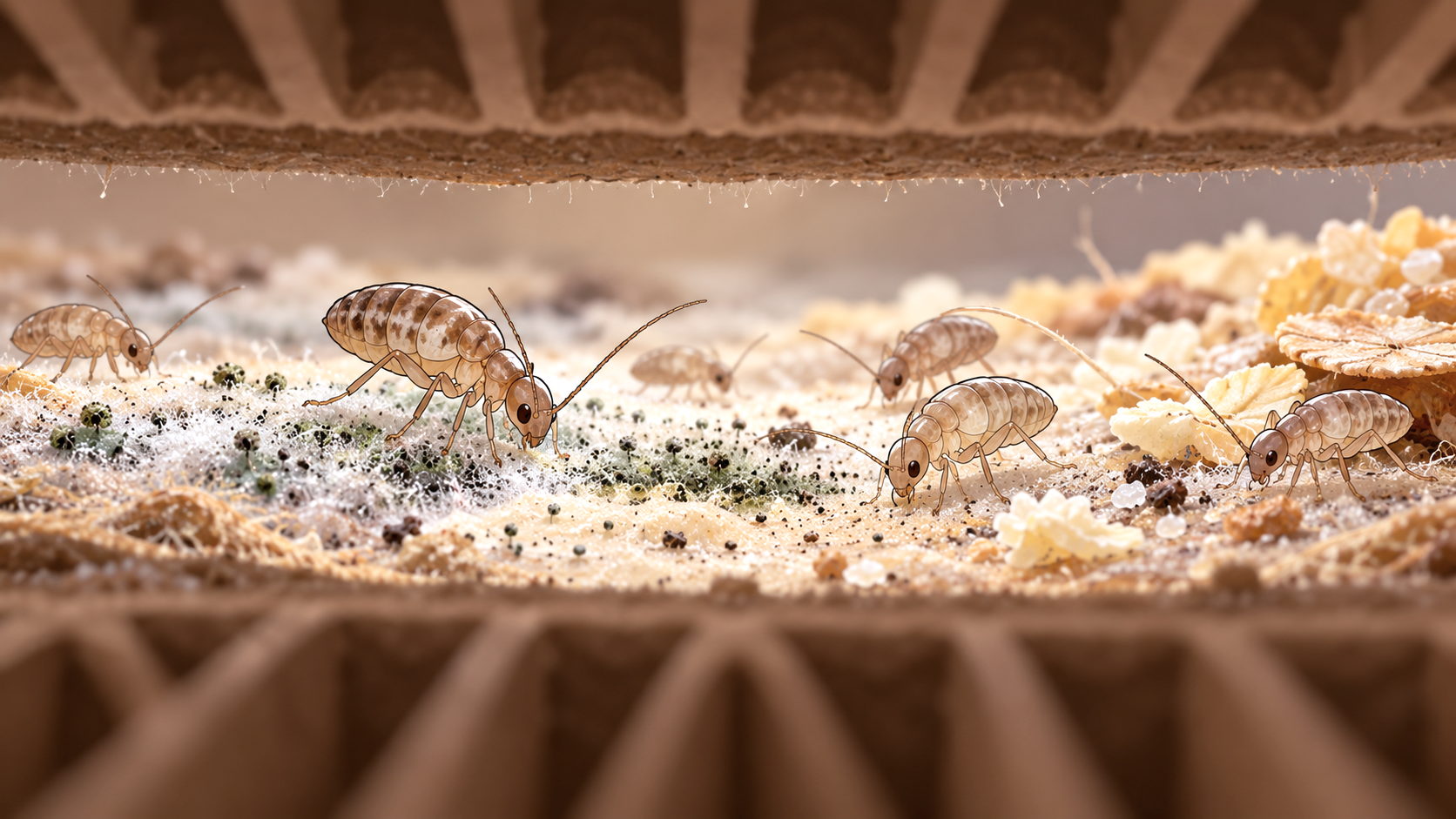
The name “booklice” gives the impression that these tiny insects survive by chewing through books. Their actual diet is broader and much more closely connected to moisture. Indoors, booklice primarily feed on microscopic molds and fungi, although some species can also consume grains, insect fragments, and other starchy or organic materials.
Booklice mainly eat mold and fungi. Depending on the species and environment, they can also feed on grains, cereal products, insect fragments, starches, bookbinding glue, and other organic material. Booklice found on books are often feeding on microscopic fungal growth rather than eating the paper itself, which is why infestations are strongly associated with humidity and damp materials.
This diet explains much of their behavior inside houses. A humid cupboard, damp cardboard box, poorly stored bag of flour, or moisture-affected book can provide food that would not be available if the same material remained dry.
Mold and Fungi Are Major Foods for Booklice
For household booklice, fungi are among the most important foods. These insects commonly occur in warm, damp, undisturbed locations where mold and fungal growth can develop, including around books, cardboard, stored products, leaking pipes, and moisture-affected building materials.
The fungi do not have to be obvious. Booklice can feed on microscopic growth long before a surface develops the fuzzy or discolored appearance people normally associate with mold. That means finding booklice on apparently clean paper, wood, or drywall does not prove that they are eating the material itself.
This relationship also explains why mold and booklice so often occur together. Moisture helps the insects maintain their water balance while simultaneously encouraging their food to grow. When humidity stays high, a previously unsuitable surface can become much more favorable without anything visibly changing at first.
Booklice Eat Mold Spores
Mold spores are another documented part of the booklice diet. Indoor psocids can feed on mold and fungal spores developing on damp materials, including stored foods.
That makes booklice remarkably well suited to exploiting places where moisture has been allowed to accumulate. A cardboard box does not need to contain conventional “food” for booklice. If dampness supports fungal growth on its surface, the insects can have something to feed on.
The same principle applies around construction materials, cupboards, paper, and other surfaces. Booklice are commonly found anywhere mold growth can be supported, which is why their presence often tells you more about moisture than about the material they are crawling across.
Reducing the fungal food supply therefore begins with controlling the conditions that allow fungi to grow.
Do Booklice Actually Eat Books?
Books can provide food for booklice, but the insects are not simply consuming sheets of paper because they have an appetite for books.
Booklice found around damp books commonly feed on mold and fungi growing on the materials. Some species can also consume starches, including materials associated with bookbinding glue. Household booklice are documented feeding on molds, fungi and other starchy material, including glue from bookbindings.
This makes an old book stored in a humid basement much more attractive than the same book kept dry in a climate-controlled room. The physical book provides protected crevices, while moisture can support fungal growth and make certain binding materials available as food.
It is therefore more accurate to understand whether booklice eat paper by separating the paper itself from everything growing on or associated with it.
Booklice Do Not Normally Chew Holes Through Pages
Booklice should not be confused with pests that directly damage paper products.
Finding them crawling across a book does not mean they are responsible for missing sections, ragged edges, large holes, or extensive surface scraping. Booklice are not considered direct paper-damaging pests in the same way as silverfish and firebrats. They are primarily exploiting fungi and suitable starchy materials associated with damp books.
That distinction becomes especially important when an old collection shows obvious physical damage. The insects currently visible may not be responsible for it.
If pages or bindings have clearly been eaten, investigate other possibilities rather than assuming booklice caused everything because they happen to be present. The difference between booklice and silverfish is particularly useful in that situation because silverfish can directly damage paper and other starchy materials.
Booklice Can Eat Bookbinding Glue
Bookbinding materials help explain how booklice earned their common name.
Some booklice can consume starch-containing materials, including glue used in bookbindings. This does not mean every modern adhesive is suitable food or that booklice can digest any glue they encounter. “Glue” covers many chemically different products, and booklice feeding claims should not be extended to every adhesive.
The established connection is with suitable starchy materials associated with bindings. A damp book can therefore offer more than fungal growth. Depending on its construction, it may contain other materials that some booklice can use.
Even then, moisture remains crucial. A dry book collection is far less favorable because booklice themselves depend strongly on humidity and fungal growth is suppressed as conditions become drier.
That is why preventing booklice in books depends heavily on storage conditions rather than trying to make books physically inaccessible to an insect that may already be only a millimeter long.
Booklice Can Feed on Grains
Some booklice have become important pests of stored grain and processed foods. Several species of Liposcelis occur in grain storage, handling, processing, and warehouse environments, where they can exploit food commodities directly as well as fungal material associated with them.
Their ability to use cereal grains has been demonstrated experimentally. For example, Liposcelis entomophila can reproduce on several cereal diets, with wheat and barley supporting particularly strong population growth. Rice, oats, milo, and corn were also tested, although they did not support identical population growth.
This is an important refinement to the simple statement that booklice “only eat mold.” Some household guidance emphasizes fungal feeding because it is central to residential infestations, but particular stored-product species can use cereal-based foods successfully.
The exact diet therefore depends partly on which booklouse species you are dealing with.
Flour Can Support Booklice
Flour is one of the stored products particularly associated with psocid infestations. Powdery cereal products can provide a substantial food resource, especially when storage conditions are warm and humid.
Booklice have been documented infesting flour and other farinaceous products, and some laboratory colonies are maintained on mixtures containing wheat flour, yeast, and other ingredients. Stored-product research identifies flour and similar powdery products among foods frequently infested by psocids.
Finding booklice directly in flour therefore deserves a different interpretation from finding one wandering across the outside of a sealed package. Numerous insects inside the food indicate that the product itself has become part of the infestation.
Infested food should be discarded rather than sifted and eaten. Booklice in stored foods can contaminate those products with insects and fecal material, while their presence can also accompany mold.
Booklice Can Eat Other Cereal Products
Wheat is not the only cereal material that can support stored-product psocids.
Experimental work has shown that particular species can develop on barley, oats, rice, milo, corn, and other cereal-based diets, although some foods support population growth much better than others. For Liposcelis entomophila, wheat and barley were especially suitable among the plain cereals tested.
Another psocid associated with stored products, Lepinotus reticulatus, has shown strong population growth on oats as well as rice, barley, milo, and wheat.
These species-specific differences are important. “Booklice” covers multiple psocids rather than one insect with one fixed diet. A food that supports one species particularly well may not produce exactly the same result with another.
For a homeowner, the practical point is simpler. Tiny psocids repeatedly appearing inside dry foods should not be dismissed just because no visible mold is present.
Booklice Can Eat Insect Fragments
Booklice are also documented feeding on insect fragments.
That part of their diet makes sense in the environments they occupy. Cracks, stored materials, warehouses, old collections, and undisturbed household spaces can accumulate tiny pieces of dead insects and other organic debris. Booklice can exploit some of this material rather than depending exclusively on living fungal growth.
This does not make booklice predators. They are not hunting other household insects in the way a pseudoscorpion does. The distinction is between feeding on insect remains and actively capturing living prey.
That is also why the relationship discussed in what eats booklice runs in the opposite direction. Booklice themselves can become prey for tiny predators even though some booklice consume dead insect material.
Outdoor Psocids Have an Even Broader Diet
The word booklice usually refers to indoor psocids, but their outdoor relatives help show how broad psocid feeding can be.
Outdoor psocids, commonly called barklice, can feed on fungi, lichens, pollen, decaying vegetation, and other organic material. They may occur across tree bark, leaves, shrubs, stones, and similar surfaces without damaging the plants themselves.
This is another reason not to define every psocid as a mold-eating insect that lives around books. The larger group contains many species occupying different habitats and exploiting different food resources.
For household booklice, however, the fungus-and-moisture relationship remains particularly important because it explains why populations become established in specific parts of a building.
Do Booklice Eat Wood?
Finding booklice on wood does not mean they are eating the wood.
A damp wooden windowsill, shelf, joist, or piece of furniture can support microscopic fungi on its surface. Booklice can then feed on that growth while appearing to be associated directly with the timber.
They do not consume structural wood in the manner of termites. If wood contains galleries, extensive internal damage, or other evidence of a wood-destroying insect, booklice should not be blamed simply because tiny insects are visible nearby.
The distinction between booklice and termites matters because the consequences are completely different. Booklice are primarily nuisance and moisture-associated insects, while termites can cause significant structural damage.
Booklice on wood should make you think about dampness and fungal growth before wood consumption.
Do Booklice Eat Clothes?
Clothing is another area where simply finding an insect on a material can create the wrong conclusion.
Booklice are not typical fabric-destroying pests. They may wander across clothing or occur around stored materials when the surrounding area is humid, but their presence does not mean they are feeding on cotton, wool, or other clothing fibers.
Damp stored clothing can still become part of a favorable environment if moisture allows fungal growth. In that situation, the booklice are associated with the conditions around the fabric rather than behaving like clothes moth larvae.
That distinction is explored further in whether booklice eat clothes. Obvious holes in clothing should prompt an investigation for another cause.
What Booklice Eat Explains Where You Find Them
Their diet helps make apparently random sightings much less random.
Booklice on a damp bookshelf can have fungal growth and binding materials nearby. Booklice in flour can exploit a cereal-based food. Booklice around cardboard may have microscopic fungi available. Those appearing near moisture-affected construction materials can be feeding on fungal growth rather than the wall itself.
Humidity ties many of these habitats together. Booklice need moisture physiologically, while fungi also benefit from damp conditions. A humid location can therefore provide both the water balance and food supply necessary for a population to grow.
This is why booklice need humidity to survive and why simply removing one visible food item does not always end an infestation. Another damp food source may remain nearby.
Removing Their Food Usually Means Removing Moisture
You cannot realistically remove every fungal spore or microscopic piece of organic material from a house. Fortunately, you normally do not need to.
Changing the environment is much more practical. Keeping affected areas dry suppresses fungal growth and makes conditions physiologically unfavorable for booklice. Household populations do not persist when relative humidity remains below roughly 45 to 50 percent.
That means a dehumidifier can sometimes remove two advantages at once. It reduces the moisture available to booklice and makes it harder for their fungal food to flourish. Leaks, condensation, damp wall cavities, and wet materials still need to be corrected directly rather than relying on room-level dehumidification alone.
For stored foods, remove infested products and keep unaffected foods dry in tightly closing containers. For books and paper, dry storage is more important than repeatedly applying pesticides to shelves.
These environmental changes are central to getting rid of booklice because they interfere with the resources sustaining the population.
Questions About What Booklice Eat
Booklice found on paper are commonly feeding on microscopic fungi associated with damp material rather than directly consuming the paper itself. Some can also use suitable starchy materials associated with bookbindings.
Yes. Mold and other fungi are major foods for household booklice. This is one reason the insects are strongly associated with damp environments where fungal growth can develop.
Do booklice eat flour?
Some stored-product booklice can infest flour and other cereal products. Numerous booklice inside flour should be treated as a stored-food infestation, and the contaminated product should be discarded.
Do booklice eat wood?
Booklice are not structural wood feeders. When they occur on damp wood, they can be feeding on fungi and other suitable material on the surface rather than consuming the timber itself.
What can booklice eat when there is no visible mold?
Fungal growth does not have to be visible to provide food. Depending on the species, booklice can also consume grains, insect fragments, and suitable starchy materials. Removing visible mold alone therefore does not prove that every food source has disappeared.
11 thoughts on “What Do Booklice Eat?”