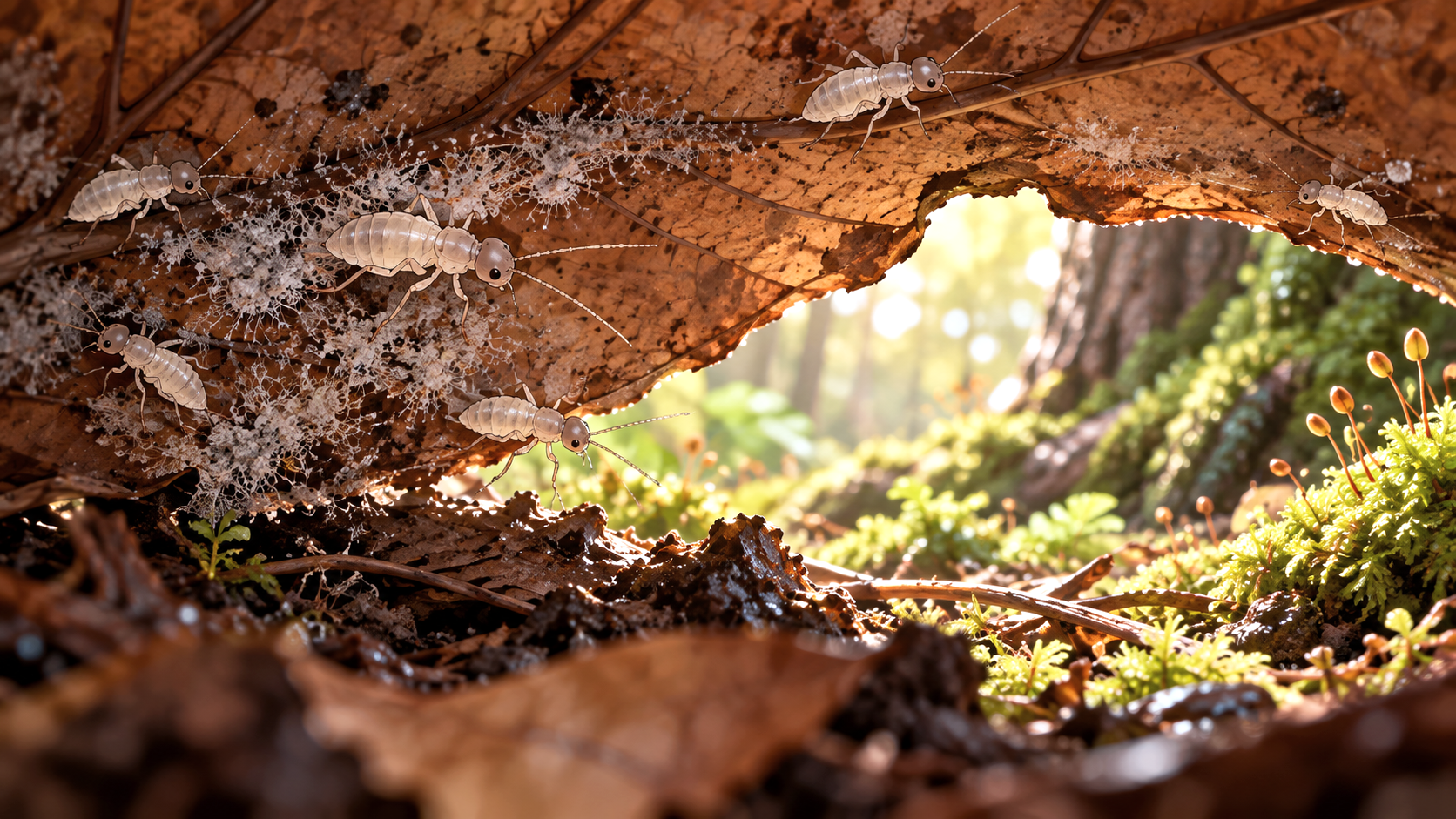
Booklice and their close psocid relatives can live outside. Most psocids are actually outdoor insects, although the small wingless species commonly called booklice are especially successful inside buildings. Outdoors, psocids occur on tree bark, leaves, shrubs, damp wood, stones, nests, and other surfaces where fungi, algae, lichens, pollen, and organic debris provide food.
Most Psocids Never Depend on Buildings
The insects people call booklice belong to Psocodea, a much broader group containing both indoor and outdoor species. The scientific classification of booklice places them alongside barklice and other psocids rather than defining them as insects restricted to books or houses. Outdoor habitats are actually normal for much of the group. Minnesota records psocids as common outdoor insects found on tree bark, leaves, shrubs, and beneath stones, while only some species regularly occupy buildings.
The familiar household form is more specialized. Species in Liposcelis are often tiny, flattened, and wingless, characteristics that suit cracks, stored products, cardboard, and other protected indoor spaces. Penn State describes household booklice in the family Liposcelididae as worldwide insects distinct from the many psocids occupying outdoor habitats. Finding a psocid outdoors is therefore not unusual and does not mean an indoor infestation has spilled into the yard.
Tree Bark Is One of the Main Outdoor Psocid Habitats
Tree trunks and branches provide a large feeding surface covered with microscopic organisms and decaying material. Outdoor psocids commonly graze on fungi, algae, lichens, pollen, and organic debris without feeding on the living wood itself. Some species gather conspicuously on trunks, while others remain hidden in bark crevices where humidity is higher.
These insects are often called barklice outdoors. University of Georgia information on barklice living and feeding on tree surfaces notes that they consume lichens and decaying material rather than damaging the tree. Large gatherings can look alarming, but their feeding is closer to surface grazing than plant parasitism.
Outdoor psocids may also occur on leaves and shrubs. The broader foods eaten by booklice and other psocids help explain why surfaces supporting fungal films and organic debris are more useful to them than clean, dry plant tissue.
Damp Wood, Leaf Litter, and Stones Provide Other Refuges
Tree bark is only part of their outdoor range. Utah State records barklice on or beneath bark, grass, leaves, and damp wood, while other psocids shelter beneath stones and within protected organic material. These locations buffer the insects from rapid drying and provide access to fungi and decomposing matter.
Their association with damp microhabitats reflects the same physiological limitation seen indoors. The strong humidity dependence of booklice does not disappear outdoors. Instead, suitable moisture comes from shaded bark, vegetation, decaying wood, litter, and other protected surfaces rather than a humid bathroom or basement.
Outdoor distribution can therefore change with weather. Extended damp periods increase the amount of suitable fungal growth and reduce desiccation stress, while hot, dry exposure can make an open surface much less favorable. Small pockets beneath bark or vegetation may remain usable even when the surrounding air becomes comparatively dry.
Some Psocids Also Live in Bird and Animal Nests
Outdoor habitat extends beyond vegetation. Psocids can occur in bird nests and comparable accumulations of organic material, where feathers, plant fibres, detritus, fungi, and sheltered humidity create a complex microhabitat. Penn State lists bird nests among normal outdoor booklouse and psocid habitats.
They are not living there as parasites. Booklice do not need blood and are not equivalent to the parasitic lice found on birds or mammals. Their small chewing mouthparts are used on fungi and organic material instead. The misleading word “lice” in their common name reflects superficial resemblance and historical naming rather than a parasitic lifestyle.
Outdoor Barklice Often Have Wings
Many outdoor psocids look different from the tiny wingless insects found among household books and cupboards. Barklice are frequently winged, and some are noticeably larger. Minnesota notes that most outdoor psocids have wings, whereas common indoor booklice such as Liposcelis are generally wingless.
Their wings can make an outdoor specimen look surprisingly unlike the booklice encountered indoors. Psocids as a whole include both winged and wingless forms, so whether booklice have wings depends on which member of the group is being examined rather than on a single rule covering every species.
An insect on a tree with transparent wings, long antennae, and the characteristic psocid head can still belong to the same broader lineage as a one-millimeter wingless booklouse in a pantry.
Outdoor Psocids Usually Do Not Hurt Trees or Garden Plants
Seeing dozens of barklice on a trunk can resemble a plant-pest outbreak, particularly when some species occur in groups. Their food, however, is usually growing or accumulating on the bark rather than coming from the tree’s vascular tissues. Minnesota describes barklice as harmless to plants and not requiring treatment.
They can even be viewed as part of the ordinary community of organisms grazing tree surfaces. Removing them simply because they are visible is generally unnecessary. A web-like covering on bark can also belong to certain barklice species rather than a destructive caterpillar or disease. Correct identification prevents a harmless outdoor insect from being treated as a tree pest.
Outdoor Psocids Can Occasionally Reach the House
An outdoor population near a building creates one possible source of indoor specimens, although it is not the only way booklice arrive. Their small size allows psocids to pass through gaps around windows, doors, vents, and other openings, while cardboard, plants, firewood, or other belongings can transport insects accidentally.
The broader routes explaining how booklice get into a house include both outdoor movement and hitchhiking introductions. Once inside, continued survival depends far more on the indoor environment than on how the original insect arrived. An outdoor psocid entering a dry room may die quickly, while suitable moisture can allow certain indoor-adapted species to persist.
Real Christmas trees provide a simple example of accidental transport. Barklice can inhabit outdoor trees and may come indoors with them, but low indoor humidity commonly causes these outdoor psocids to die rather than establish a household infestation.
Questions About Booklice Outdoors
Can booklice live in a garden?
Psocids can live throughout garden environments, especially on bark, foliage, damp wood, stones, and organic debris. A garden specimen may be an outdoor barklouse rather than the wingless household species people normally call booklice.
Can booklice live in soil?
Psocids are more commonly associated with surfaces containing fungi, litter, bark, vegetation, and decaying organic matter than with living deep in mineral soil. Insects found beneath stones or among surface litter may appear to be “in the soil” while actually occupying the humid organic layer above it.
Will outdoor booklice infest outdoor furniture?
They can occur on damp wooden surfaces if fungi, algae, or organic deposits provide food. Their presence does not mean they are eating sound wood or destroying the furniture.
Can barklice move from a tree into a nearby house?
Individual outdoor psocids can enter buildings accidentally, particularly when trees, vegetation, or organic debris lie close to the structure. Finding one indoors does not establish that a reproducing household population exists.
Are outdoor booklice the same insects found in books?
They belong to the same broader psocid group, but the species and habits can differ considerably. Many outdoor forms are winged barklice, while the common appearance of indoor booklice is typically smaller, flattened, and wingless.
Does finding lots of barklice outside mean booklice will appear indoors?
No. Outdoor abundance and an indoor infestation are separate conditions. Indoor populations need a suitable habitat, and the usual signs of established booklice depend on insects surviving and reproducing within the building rather than simply existing nearby.