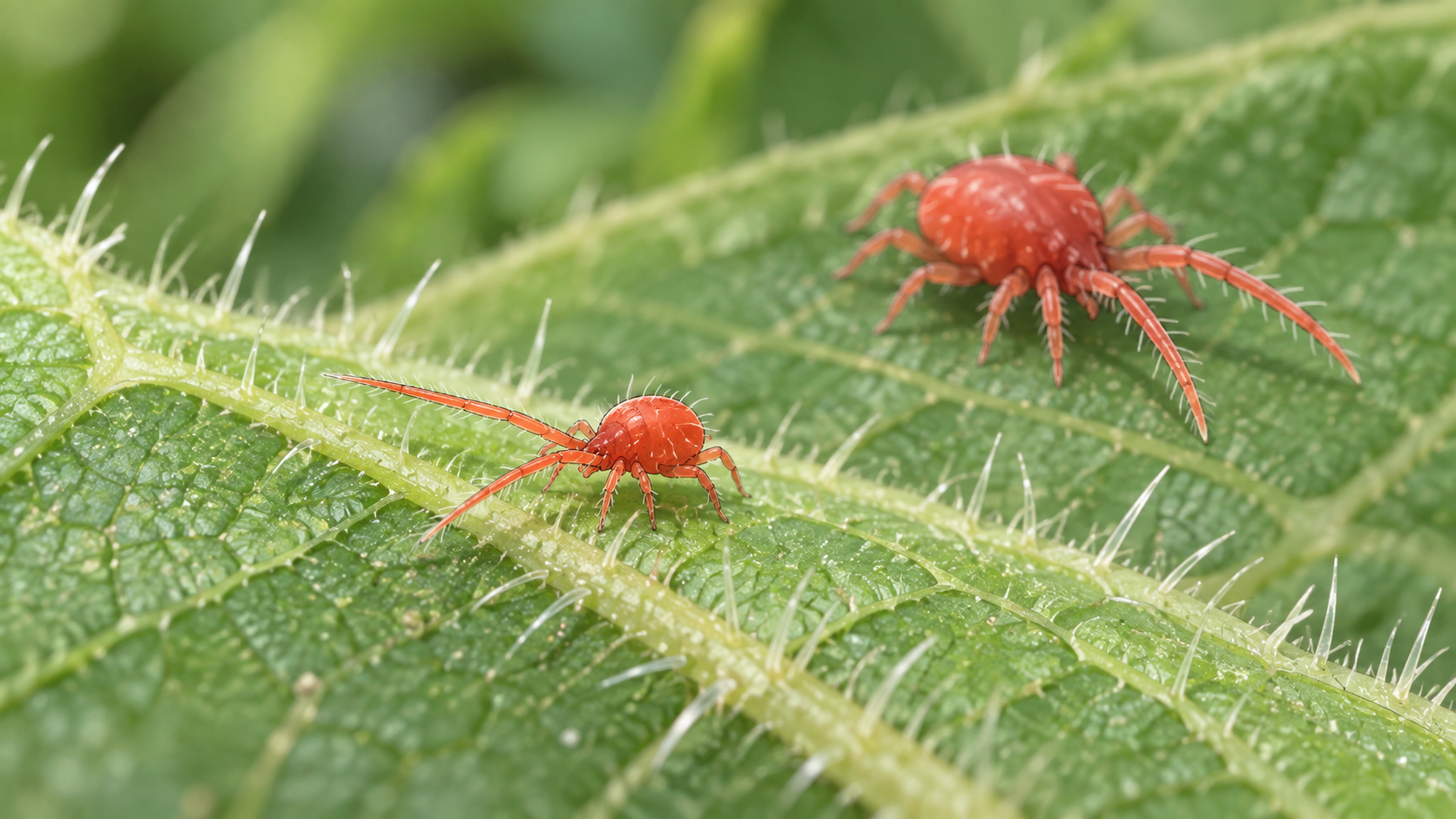
Baby clover mites change noticeably as they develop. Newly hatched larvae are tiny, bright red, disc-shaped, and have six legs. After the larval stage, clover mites become eight-legged nymphs called protonymphs and deutonymphs. Their color can also darken after feeding, so a baby clover mite will not necessarily remain bright red.
The easiest mistake is assuming every immature clover mite should simply look like a miniature adult. Larvae differ in both leg count and coloration, while the later nymphal stages look progressively more adult-like.
Newly Hatched Clover Mites Are Bright Red and Six-Legged
The first mobile stage to emerge from a clover mite egg is the larva. Newly hatched larvae have bright red, disc-shaped bodies and six legs, which gives you a useful way to separate them from later stages. Adults have eight legs, so leg count can tell you whether you are looking at a newly hatched mite when the specimen is clear enough to examine.
Those six legs do not mean the larva is an insect. Clover mites are arachnids, but mites commonly hatch with six legs and acquire their fourth pair as they develop. At clover mite scale, however, counting legs with the naked eye is difficult. Magnification is much more useful than trying to judge a moving speck on a wall or plant.
Color can be easier to notice. The bright red of newly hatched larvae is particularly conspicuous, especially against pale surfaces. Yet that color does not stay constant once feeding begins.
Feeding Changes the Color of Young Clover Mites
A larva can look quite different after it starts feeding. Newly hatched larvae change from bright red to green or greenish-black after feeding, while orange coloration can remain on the legs and portions of the body. Consequently, two immature clover mites at different feeding stages may not look like the same kind of mite at first glance.
This makes color useful but unreliable as a standalone identification method. Bright red strongly fits a newly hatched clover mite, but a darker immature mite should not automatically be ruled out. The wider range of clover mite colors is covered separately because color changes are not limited to one developmental stage.
We would be particularly cautious with photographs showing nothing more than a tiny red dot. Other mites can be red too, and the features that separate them may be impossible to see in a distant or blurry image.
Clover Mite Nymphs Have Eight Legs
After the larval stage, clover mites pass through two nymphal stages, the protonymph and deutonymph. Both are eight-legged, unlike the six-legged larva. Nymphs are oval in form and resemble adults more closely than newly hatched larvae do. (schoolipm.tennessee.edu)
There is still a useful difference to look for. In the nymphal stages, the legs appear more nearly equal in length. Adults develop the conspicuously elongated front pair that gives mature clover mites their characteristic antenna-like appearance. That makes the exaggerated front legs described in adult clover mite identification less dependable when the specimen is still a nymph.
You therefore have three practical clues when examining an immature clover mite: very small size, leg count, and the relationship between the front legs and the remaining pairs. Color can support the identification, but it should not carry it by itself.
Telling a Larva From a Nymph
The clearest dividing line is the number of legs. A clover mite larva has six, while a protonymph or deutonymph has eight. Later nymphs also look more like the adult form, although they have not yet developed the adult’s most exaggerated proportions.
For something this small, we would use a hand lens or a sharp macro photograph before making that call. A naked-eye sighting usually tells you little beyond “tiny moving speck,” and even photographs can hide individual legs when they overlap beneath the body. If you can clearly count six legs on a bright-red clover mite, however, you are looking at the larval stage rather than a nymph or adult.
This page stops at what those immature stages look like. The sequence connecting larva, protonymph, deutonymph, and adult belongs in the clover mite life cycle, while the stationary stage before hatching is covered in what clover mite eggs look like.
Other Questions About Baby Clover Mites
Are baby clover mites always red?
No. Newly hatched larvae are bright red, but their coloration changes after feeding. Young mites can become green or greenish-black while retaining some orange coloration.
Do baby clover mites have eight legs?
It depends on the stage. Newly hatched larvae have six legs. Protonymphs and deutonymphs have eight.
Do clover mite nymphs have the long front legs seen on adults?
Not to the same degree. The legs of the nymphal stages appear more nearly equal in length, while adults have a much more conspicuously elongated first pair.
Can you identify a baby clover mite by color alone?
No. Color changes as immature clover mites feed, and other tiny mites can also be red. Leg count and body features provide stronger evidence when they are visible.