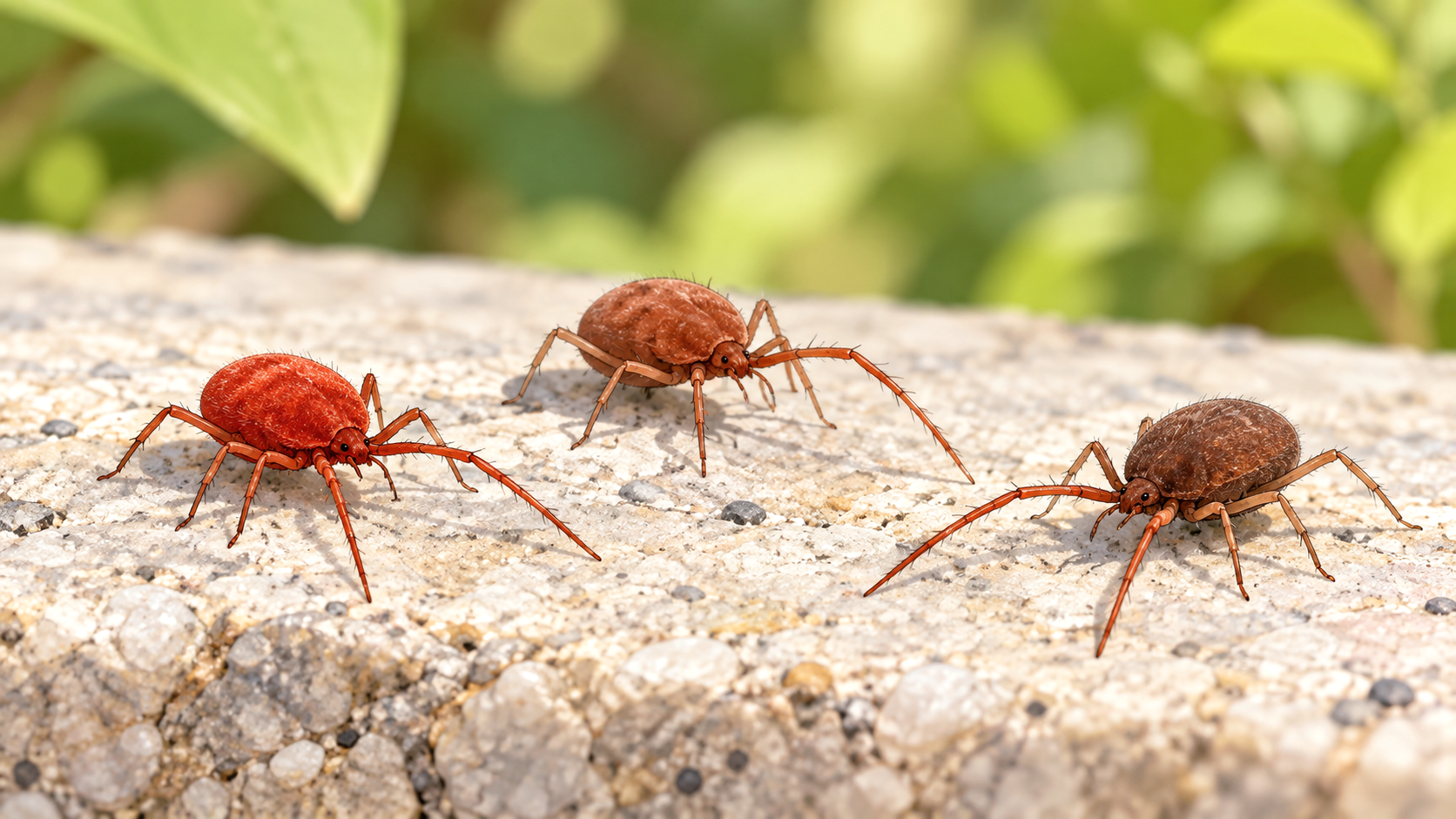
Clover mites can be red, reddish-brown, rusty brown, greenish-brown, dark green, or nearly black. Their color is not fixed throughout development or feeding. Newly hatched clover mites are bright red, while feeding can make the body considerably darker and greener. This variation is why color alone is a poor way to identify one.
Why Clover Mites Are Not Always Red
Calling clover mites “tiny red bugs” is convenient, but it hides quite a bit of variation. Adult Bryobia praetiosa can range from reddish-brown to dark green-brown, while other descriptions include dark red, rusty brown, olive green, and almost black individuals. Even the legs and markings can contrast with the main body color.
Some of that difference comes from feeding. Clover mites can appear greener or darker after they have fed on plant material. Newly hatched mites begin bright red and become green to greenish-black after feeding, with orange tones remaining on parts of the body and legs. So two clover mites photographed at different points can look surprisingly unlike each other without either image being incorrectly identified.
This is also why we would not reject a possible clover mite simply because it looks brown or dark green instead of vivid red. Clover mites can range from reddish or brown to dark green, and some adults are dark enough that their warmer-colored legs are more noticeable than the body itself.
Bright Red Clover Mites Are Usually Younger
The strongest red coloration is associated with the earlier stages. Clover mite eggs are bright red, and newly hatched larvae are also bright red before feeding changes their appearance. The dedicated guides to clover mite eggs and baby clover mites cover those stages in detail rather than repeating their identification here.
Adults can still look reddish, though. Some are described as reddish-brown or brick red, so seeing a red mite does not automatically mean it is immature. Likewise, a greenish-brown individual is not necessarily a different species. Color changes enough within clover mites that age and feeding status have to be considered before treating a shade difference as an identification clue.
Why Crushed Clover Mites Leave a Red Stain
A dark or greenish clover mite can still leave a reddish or orange-red mark when crushed. That sometimes creates the impression that the mite must contain blood, especially when the stain appears on a white windowsill, curtain, wall, or other pale surface. It does not. The reddish stain comes from pigments in the mite’s body fluids, not from blood taken from people or animals.
That pigment is also a good reason not to test an identification by squashing the mite. A red smear tells you very little because the living mite may have looked quite different before it was crushed. If clover mites are appearing indoors, vacuuming them avoids grinding those pigments into fabric or painted surfaces.
Color Helps, but It Cannot Identify a Clover Mite by Itself
A tiny red mite could be a clover mite, but redness alone is weak evidence. Other mites can have similar coloration, including Balaustium mites, which can resemble clover mites closely enough that magnification may be needed to separate them reliably. That matters because a photograph showing nothing more than a red dot may not contain enough information for a confident identification.
Instead, use color as one clue alongside the features covered in what clover mites look like. In particular, clover mites have a characteristically elongated first pair of legs. A dark green, brown, or reddish mite with the correct structural features is more persuasive than an unidentified bright-red speck with no visible anatomy.
Other Questions About Clover Mite Colors
Can clover mites be black?
They can appear extremely dark. Clover mites are described in authoritative identification resources as ranging through dark green and greenish-black tones, so an individual may look nearly black without magnification.
Can clover mites be brown?
Yes. Reddish-brown, rusty brown, and greenish-brown are all documented clover mite colors. Brown coloration does not rule them out.
Are baby clover mites redder than adults?
Newly hatched larvae are bright red, while feeding changes their coloration toward green or greenish-black. Adults can still retain reddish, brown, orange, or green tones.
Does a red stain prove the mite was a clover mite?
No. Although crushed clover mites can leave a reddish stain, the stain is not enough to identify the mite. Body structure provides stronger evidence.
4 thoughts on “What Colors Are Clover Mites?”