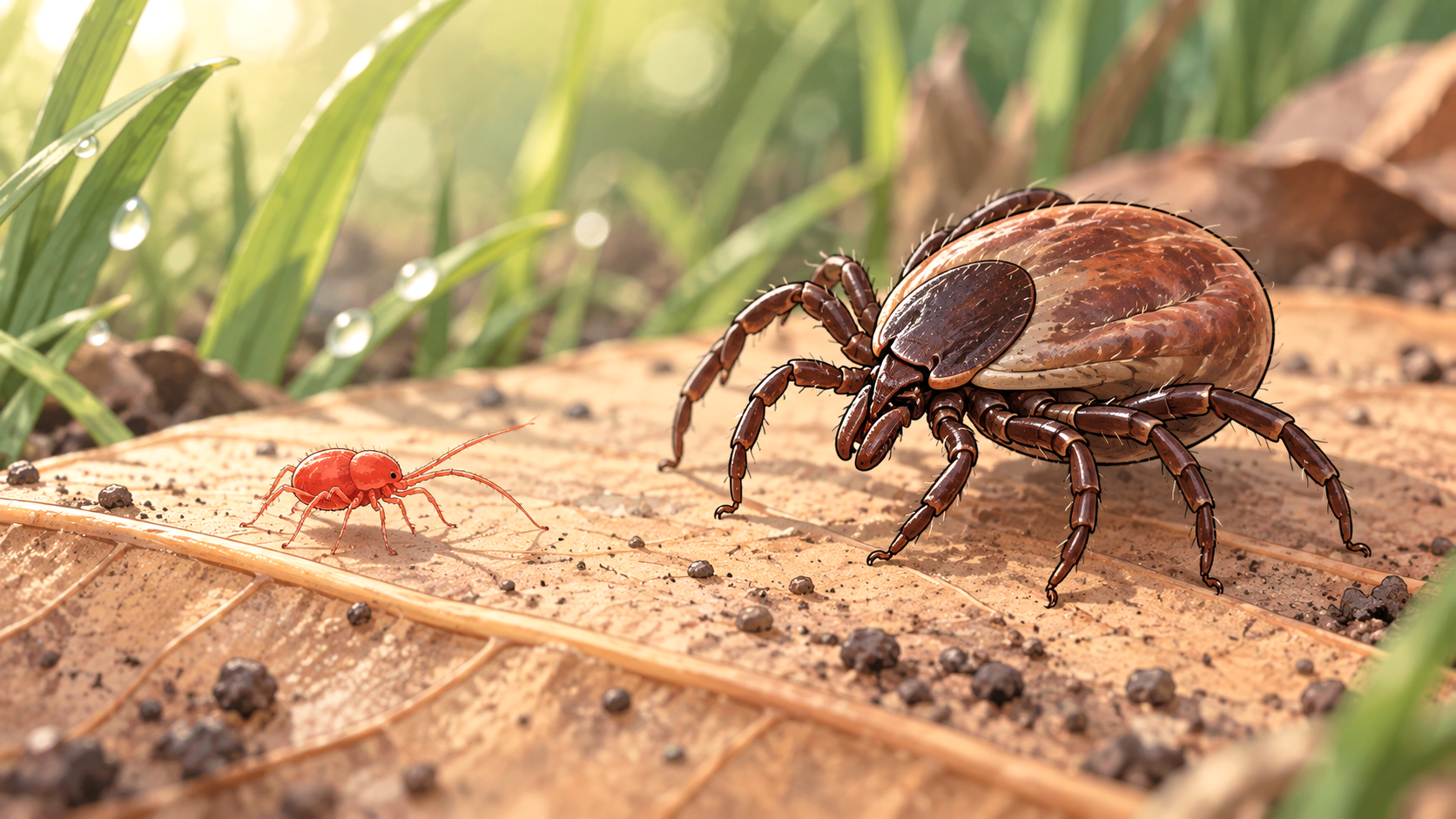
Clover mites and ticks both have eight legs after the larval stage, but their similarities become thin after that. Clover mites are tiny plant feeders that frequently wander onto buildings. Ticks are blood-feeding parasites that attach to vertebrate hosts, and some species can transmit pathogens to people and animals. A mite-like creature fixed firmly to skin deserves a very different response from a red speck running across a window sill.
An Attached Specimen Is Far More Likely to Be a Tick
Ticks are built to remain on a host while feeding. After climbing onto a person or animal, a hard tick cuts into the skin, inserts its feeding structures, and can remain attached while taking a blood meal. Depending on the species and life stage, tick feeding can continue from minutes to days. The body may enlarge substantially as the tick becomes engorged.
Clover mites have no comparable host-feeding behavior. Their diet consists of grasses and other plants, and they cannot establish themselves on people or pets. One can accidentally crawl over skin, fur, or clothing after wandering indoors, but clover mites do not bite humans or remain attached for a blood meal.
Size and Shape Usually Separate Adults Quickly
Clover mites are about 1/64 inch long, with a soft oval body and a first pair of legs much longer than the other three pairs. Those front legs project forward and are sometimes mistaken for antennae. Their small size can make the body look like little more than a moving dot without magnification.
Ticks vary by species and life stage, but common adult ticks are substantially larger. Adult blacklegged ticks, for example, are approximately sesame-seed sized, while their nymphs are closer to a poppy seed. Hard ticks also have a compact body with specialized mouthparts at the front rather than the exaggerated first pair of legs that makes clover mites recognizable.
| Feature | Clover mite | Tick |
|---|---|---|
| Food | Plant material | Blood |
| Adult/nymph legs | 8 | 8 |
| Larval legs | 6 | 6 |
| Standout feature | Extremely long first pair of legs | Specialized structures for attachment and blood feeding |
| Typical human contact | Accidentally crawls on skin | Some species attach and feed |
| Common household pattern | Numerous mites near windows, walls and entry points | Individual ticks may be carried indoors on people or animals |
| Disease-vector importance | Not recognized as a human disease vector | Some species transmit important pathogens |
Eight Legs Do Not Make a Tiny Arachnid a Tick
Counting legs can confirm that an adult specimen belongs among the arachnids, but it cannot distinguish these two by itself. Both clover mites and ticks develop from six-legged larvae into eight-legged later stages. Ticks pass through egg, larva, nymph, and adult stages, with blood meals required by their active developmental stages. Clover mites follow a separate egg-to-adult life cycle supported by plant feeding.
Color is equally unreliable. Clover mites may be rusty brown, reddish, or dark red, while tick coloration varies greatly among species and can change in appearance after feeding. A red or brown arachnid should therefore be judged by its proportions, size, behavior, and attachment rather than color alone.
Where You Find Them Reflects Two Different Lifestyles
Large numbers of clover mites on foundations, siding, patios, and windows often originate in surrounding vegetation. They may enter buildings through tiny openings, producing the familiar concentrations of clover mites around window sills and walls. They can also be crushed easily, leaving a red pigment stain.
Ticks encounter people and animals outdoors through host-seeking behavior. Many species wait on vegetation with their front legs extended and climb aboard when a suitable host brushes past. Ticks cannot fly or jump, so finding one on a person after time in tick habitat does not mean it leapt from a tree or flew onto them. Pets can also transport ticks into a home, particularly species adapted to feeding on dogs.
A Tick Can Carry a Health Risk That a Clover Mite Does Not
Some tick species can transmit bacteria, viruses, and parasites during blood feeding. Depending on the tick species and geographic region, tickborne illnesses can include Lyme disease, anaplasmosis, babesiosis, ehrlichiosis, Rocky Mountain spotted fever, and several others. The presence of a tick does not mean it carries a pathogen, and even the percentage of infected ticks varies by area and life stage.
Clover mites are instead classified as nuisance mites and are not considered a human health threat. Their harmless relationship with pets also differs sharply from ticks, which use numerous mammals, birds, reptiles, and amphibians as hosts.
If the Specimen Is Attached, Treat It as a Possible Tick Until Identified
Do not dismiss an attached arachnid as a clover mite because it looks small. A tick should be removed promptly using appropriate tick-removal technique, and health guidance may depend on the species, geographic location, duration of attachment, and subsequent symptoms. Clover mites require no comparable removal procedure because they do not anchor themselves into skin.
A loose specimen crawling quickly across a wall or window, particularly among many identical tiny mites, fits a clover mite invasion much better. Vacuuming avoids the red stains created by crushing them, while recurring appearances can be reduced by preventing clover mites from entering the home.
Details That Can Resolve a Clover Mite or Tick Identification
Can a tick be as small as a clover mite?
Very young ticks can be extremely small, so size alone should not be the deciding feature. A hand lens or clear close-up photograph can reveal body proportions and other identifying structures.
Do ticks have the long front legs seen on clover mites?
Ticks use their front legs during host seeking, but they do not have the dramatically elongated first pair characteristic of clover mites. On a clover mite, those legs can look almost like antennae.
Can both appear on a dog?
Yes, but their behavior differs. A clover mite may wander across fur accidentally, whereas a tick can attach to the dog’s skin and take a blood meal.
Do clover mites transmit Lyme disease?
No. Lyme disease is transmitted through bites from infected Ixodes ticks, including blacklegged ticks in North America. Clover mites are not Lyme disease vectors.