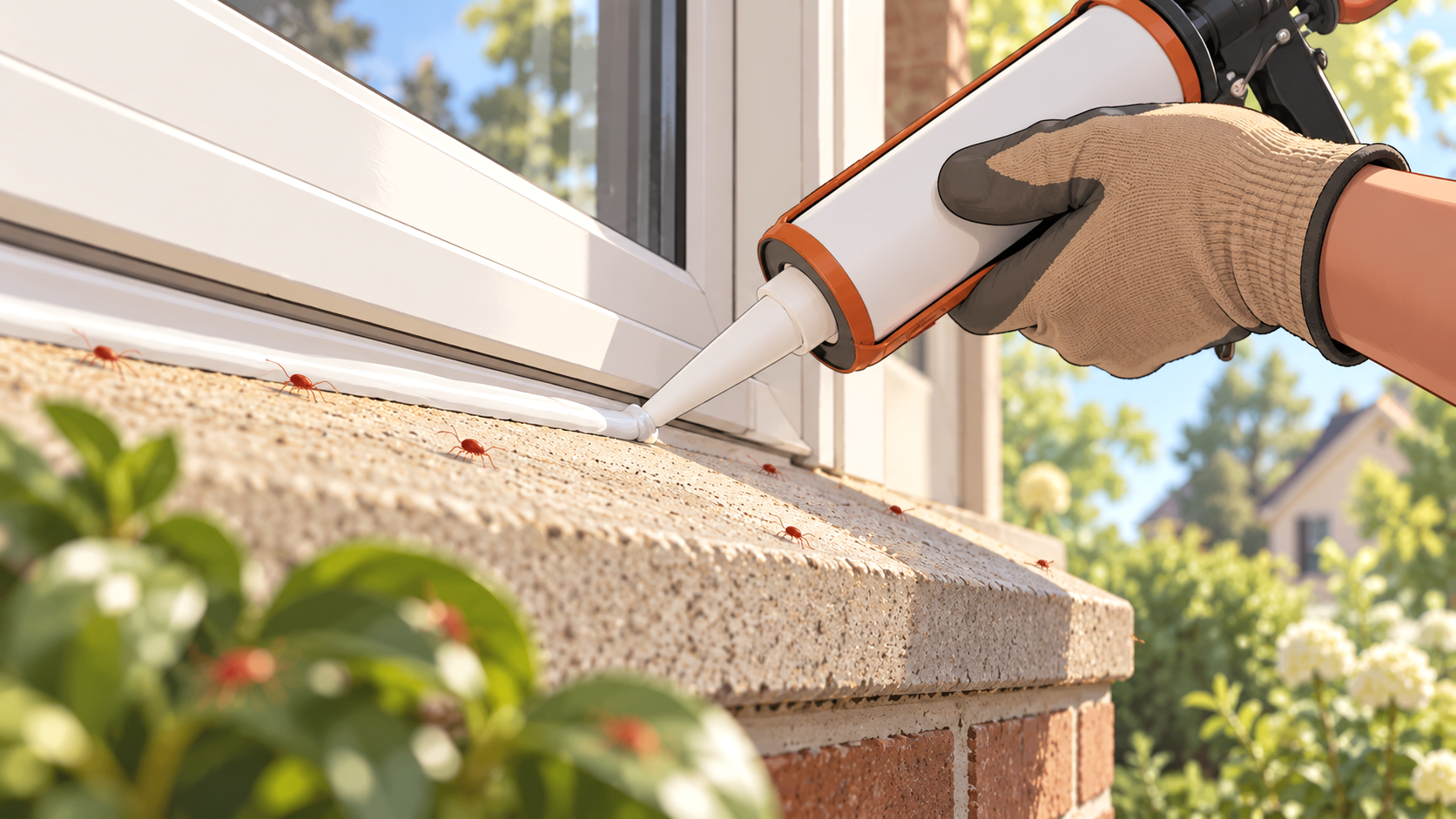
Clover mite prevention starts before the first red specks appear indoors. These mites feed outside, then exploit tiny openings in foundations, walls, windows, doors, and siding when they move toward buildings. The most reliable prevention combines a vegetation break around the foundation with sealed exterior openings and restrained lawn fertilization near the house. None of those measures requires waiting for an invasion to begin.
Build a Break Between the Lawn and the House
Grass touching the foundation gives clover mites a feeding site immediately beside the structure. Replace that contact zone with a strip that contains no turf or weeds. A width of about 18 to 24 inches can help, while some IPM programs recommend a 3-to-5-foot turf- and weed-free boundary for stronger separation. Gravel or pea gravel can occupy the strip, and the barrier deserves particular attention on sunny exposures where mite activity is concentrated.
You do not need to turn the entire perimeter into bare ground. Where plants are wanted close to the house, less attractive species can preserve landscaping without recreating a dense strip of clover mite food. Plants commonly recommended for this purpose include zinnia, marigold, salvia, rose, chrysanthemum, petunia, barberry, juniper, and yew. The objective is to interrupt the direct route between the plants clover mites feed on and the structure they may enter.
Keep Foundation-Edge Growth From Becoming Too Lush
Heavily fertilized grass beside a house can support unusually large clover mite populations. Well-fertilized lawns are associated with greater clover mite abundance, so apply fertilizer according to the actual needs of the turf rather than trying to maximize growth along the foundation. Newly established lawns can also be favorable.
Water management requires a different balance. Hot, drought-stressed turf can encourage migration, and supplemental irrigation in dry problem areas can suppress clover mite movement. Water only as the turf requires rather than keeping the foundation edge continuously saturated. Prevention is easier when the immediate landscape is neither heavily fertilized into dense succulent growth nor allowed to become severely drought-stressed.
Close Openings Smaller Than You Might Expect
Inspect the exterior closely because clover mites can pass through very small gaps. Caulk suitable cracks in the foundation and around window and door frames, repair deteriorated seals and weather stripping, and close openings where pipes, cables, vents, or other utilities penetrate exterior walls. Sealing structural entry points is a primary exclusion measure, not merely a repair to make after mites have already entered.
Windows deserve particular attention because clover mites frequently gather on window sills after climbing the building. Check the junction between the frame and wall, damaged screens, weep areas that should remain functional, and deteriorated exterior caulk. Do not block drainage openings designed as part of the window system. Door thresholds, siding joints, foundation cracks, and penetrations deserve the same inspection wherever outdoor mite activity is concentrated.
Make Repairs Before Seasonal Movement Begins
Clover mites are most active during cooler parts of the year, with household invasions commonly associated with spring and fall. Eggs and other stages can survive protected periods when visible activity is low, so a quiet stretch does not necessarily mean the property will remain mite-free. Completing caulking, weather-stripping repairs, and landscape changes before the main clover mite season gives the barrier time to be in place before migration starts.
Seasonal timing also makes exterior inspection more useful. If previous invasions repeatedly occurred on one side of the house, inspect that elevation before the next active period rather than waiting until mites reappear indoors. Their tendency to use protected structural spaces during unfavorable weather means clover mite overwintering behavior can connect one season’s exterior population with later activity around the same structure.
Pay Attention to the Side of the House They Keep Using
Prevention does not have to be equally intensive everywhere. Clover mites frequently become conspicuous on warm, sun-exposed building surfaces, and recommendations often emphasize south, southwest, west, or east exposures depending on local conditions. A recurring concentration of clover mites on brick or siding identifies a useful place to inspect landscaping, seals, and structural joints more closely.
The same logic applies to hardscape. Numerous clover mites on concrete beside one section of the foundation can reveal the approach route before an indoor invasion develops. Record where previous activity occurred and concentrate preventive maintenance there while still closing obvious openings elsewhere.
Prevention Questions for Recurring Clover Mite Problems
Will mulch work as well as gravel around the foundation?
Not necessarily. Recommendations differ, but mineral materials such as pea gravel or stone are commonly used for clover mite barriers. Some guidance notes that bark mulch can also harbor other occasional invaders, making stone a more useful choice when the goal is a low-habitat perimeter.
Can plants remain near the foundation?
Yes. A prevention strip does not have to be completely ornamental-free if less attractive plants are used sparsely. Dense grass and weeds directly against the structure create a more favorable arrangement for clover mites.
Should old exterior caulk be covered with another layer?
Loose or failed material should generally be removed and the joint prepared according to the replacement sealant manufacturer’s instructions. Simply covering deteriorated caulk may leave gaps underneath and produce a poor seal.
Why can clover mites return after entry points were sealed?
A building can have multiple openings, and outdoor populations can continue developing even after one route is closed. Persistent recurrence can reflect conditions supporting clover mites around the property or an overlooked structural gap rather than failure of exclusion as a strategy.
11 thoughts on “How to Prevent Clover Mites From Getting Into Your Home”