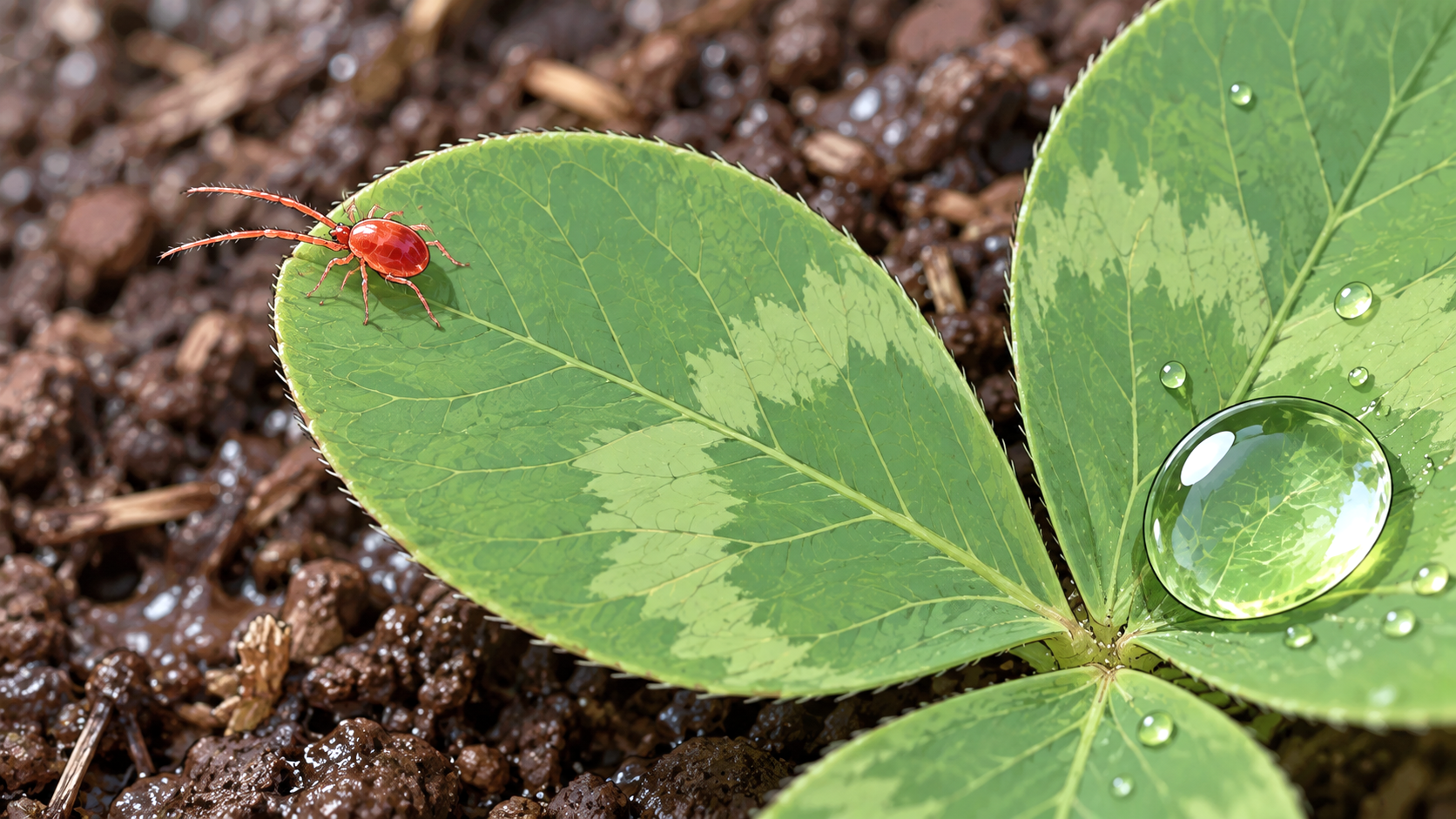
Clover mites do not appear to seek out water as an attractant. A wet patio, dripping faucet, puddle, or damp bathroom is not comparable to food or shelter for these plant-feeding mites. Moisture can influence the outdoor conditions in which they live, but finding clover mites near water does not mean they came there to drink or because they prefer wet surfaces.
Water becomes relevant indirectly. Clover mites depend on living vegetation, and the condition of that vegetation changes with irrigation, drought, temperature, and rainfall. A well-watered landscape can contain clover mites because it contains suitable plants, while watering dry turf can sometimes reduce the mite movement that sends them toward buildings.
Water Can Change the Plants Without Attracting the Mites
Clover mites feed on plant material rather than moisture. They are particularly associated with grasses, clover, weeds, and other vegetation, and populations can become especially numerous in lawns with dense, succulent, well-fertilized grass. Irrigation can contribute to vigorous plant growth, so mites may prosper in an irrigated landscape when abundant host plants are available. The water itself should not be mistaken for the food source.
This also explains why a sprinkler system cannot be classified automatically as something that attracts clover mites. Fertilization, vegetation next to the foundation, suitable temperatures, and the condition of the turf can all influence where populations develop. Those broader property conditions determine what attracts or supports clover mites around a home more accurately than the presence of water alone.
Dry Turf Can Produce More Mite Movement
The relationship becomes almost the reverse when turf is drought-stressed. Clover mite injury is frequently concentrated in warm, dry portions of lawns, and populations in those areas can be greatly reduced with supplemental watering. Irrigation during hot or drought-stressed conditions is also used to suppress migration from turf.
A homeowner might therefore water a dry strip of lawn and see fewer mites leaving it, not more. This does not make water a pesticide. Adequate irrigation improves the condition of drought-stressed turf and changes an environment associated with mite development and migration. Excessive watering is unnecessary and can create unrelated lawn, drainage, or building-moisture problems.
A Damp Room Is Not Clover Mite Habitat
Indoor moisture does not provide what clover mites need to establish themselves. A bathroom, basement, or kitchen may contain water while offering none of the living plant material required for feeding. Clover mites cannot maintain an indoor population simply because a room is damp.
When mites appear in a bathroom or basement, their presence should therefore not be interpreted in the same way as a moisture-dependent household pest. Clover mites normally live and reproduce outdoors and enter buildings accidentally, often through tiny openings around windows, doors, and foundations.
Standing Water Is Not a Clover Mite Control Tool Either
If clover mites do not particularly seek water, flooding an infested area is not a useful way to lure or control them. Outdoor populations occupy turf, plants, cracks, bark, structural crevices, and other locations that cannot be treated meaningfully by creating puddles. Their eggs are placed in protected sites, further limiting what surface water can accomplish.
Normal irrigation has a narrower role: keeping drought-stressed turf healthy enough to reduce favorable conditions for heavy mite activity and migration. When mites are already moving toward a building in large numbers, managing the outdoor population and reducing plant contact with the foundation are more useful than adding extra water.
Moisture Questions Around Clover Mites
Do clover mites need to drink water?
There is little reason to think of clover mites visiting exposed water sources to drink in the way larger animals do. They are plant-feeding mites, and their relationship with moisture is primarily tied to their host plants and surrounding environmental conditions.
Will a leaking pipe attract clover mites?
A leak by itself is not a recognized clover mite attractant. If tiny arthropods repeatedly gather around persistent indoor moisture, identification becomes important because many organisms associated with damp buildings are not clover mites.
Why are clover mites near my swimming pool?
Mites found around a pool may have migrated from nearby turf or landscaping onto the surrounding hardscape. Their presence beside water does not establish attraction to the pool, and clover mites around swimming pools are better approached by examining the surrounding vegetation and migration routes.
Does high humidity attract clover mites?
There is not good evidence that atmospheric humidity acts as a direct lure that draws clover mites toward a location. Temperature, host vegetation, seasonal activity, and the condition of outdoor habitat provide more useful explanations for where they occur.