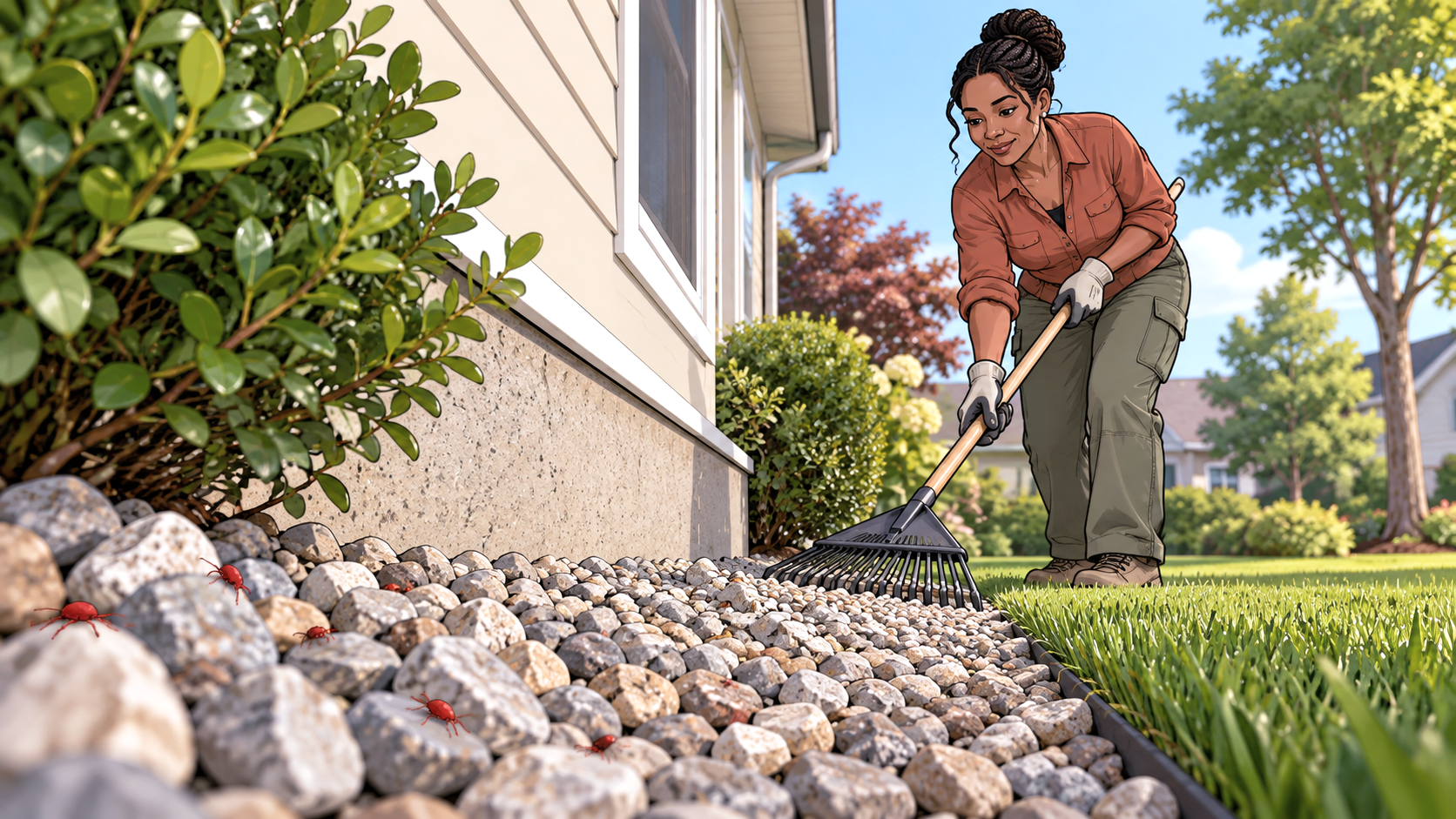
Getting rid of clover mites outside does not require treating every place where a red speck appears. The mites develop on vegetation, especially turfgrass, and often become conspicuous only after moving onto foundations, siding, patios, or other hard surfaces. Outdoor control works best when you concentrate on the infested vegetation and the narrow zone beside the building where clover mites develop, lay eggs, and begin their migrations. Changing that perimeter can provide longer-lasting relief than repeatedly spraying mites after they reach the wall.
Start Where the Mites Are Coming From
Inspect the lawn and vegetation immediately beside the affected structure, with extra attention to warm, sunny exposures. Clover mite populations can become concentrated near foundations, trees, and other upright surfaces, and feeding injury may appear as small silvery streaks followed by irregular brown turf when numbers are high. Seeing mites on the foundation does not automatically mean the wall itself needs treatment. Follow their movement back toward grass, weeds, groundcover, or ornamental plants and determine whether the population is developing there.
The inspection is easier when you know what clover mites eat and how clover mite damage appears on plants. Their plant-feeding biology also explains why outdoor populations can become abundant around vigorous lawns. Clover mites may reach very high numbers in dense, succulent, heavily fertilized grass, so adding fertilizer to an already lush problem area can work against control.
Break the Connection Between Lawn and Foundation
Grass and weeds growing directly against a building give clover mites food close to the surfaces they later climb. Removing suitable vegetation from a strip along the foundation interrupts that arrangement. Recommendations vary with local conditions, but a roughly 18-inch to 3-foot plant-free strip is commonly advised, while some IPM programs recommend an even wider 3-to-5-foot boundary where infestations are persistent. Gravel, stone, or another non-host ground treatment can occupy the strip without providing the same feeding habitat.
Prioritize the sides of the property where mites are actually active rather than stripping landscaping indiscriminately. Sun-exposed walls are common trouble spots, and the same outdoor movement can put clover mites on brick and siding or leave concentrations crawling across concrete. Keeping host vegetation away from those migration routes can also reduce the number that eventually reaches structural openings.
Dry, Stressed Turf May Need Water Rather Than More Pesticide
Clover mite problems are often associated with warm, dry turf near foundations. Supplemental irrigation of drought-stressed areas can reduce populations and migration from these hot spots, provided watering is appropriate for the turf and does not create drainage or moisture problems around the building. The goal is not to saturate the lawn. Correcting unusually dry conditions removes one factor associated with heavy activity.
Lawn management should remain proportional to the damage. Clover mites can injure turf under some conditions, but large numbers do not automatically mean an entire lawn requires treatment. Inspect the affected patches first and avoid assuming every brown area is mite damage, since drought, winter injury, disease, and other turf problems can produce similar symptoms. A problem limited to the foundation edge is better handled as a localized infestation than as a reason to treat the entire property.
Remove Mites From Outdoor Surfaces Without Crushing Them
Visible mites on siding, foundations, patio furniture, and similar surfaces can be removed with a vacuum when practical. Avoid smearing or crushing them because their pigments can leave rusty-red marks. A garden hose may also dislodge mites from suitable exterior surfaces, but spraying the wall only removes individuals currently present and does not reduce a population continuing to arrive from vegetation.
Surface location can still help direct the rest of the work. Heavy activity around a patio calls for checking the surrounding plant material and perimeter rather than repeatedly washing the paving. Mites gathering around a pool require the same source-focused approach while keeping pesticide use away from water unless a current product label explicitly permits the intended application.
Reserve Pesticides for Active Outdoor Problem Areas
If habitat changes and physical removal are insufficient, a pesticide labeled for clover mites and the specific outdoor site can be considered. Spot treatment of infested turf or vegetation and targeted perimeter treatment are preferable to automatically spraying an entire lawn. Some current clover mite IPM guidance lists appropriately labeled acaricides, insecticidal soaps, or pyrethroid products for active outdoor populations, but product registrations and permitted uses change. The label on the product you actually purchase determines whether it can be applied to turf, ornamental plants, foundations, or another site.
Impervious surfaces need particular care. Current pesticide labels can restrict applications to driveways, sidewalks, patios, and similar surfaces to spot or crack-and-crevice treatments, depending on the product, while runoff restrictions may apply near drains and surface water. Never increase the concentration or treatment area beyond the label directions. The EPA specifically warns that using more pesticide than directed can increase risk without improving pest control. Persistent outdoor populations that remain severe after habitat correction and properly targeted treatment may warrant professional clover mite control.
Outdoor Clover Mite Questions
Should you remove every plant beside the house?
No. The useful change is reducing suitable host vegetation immediately beside problem areas, not eliminating landscaping indiscriminately. Some ornamental plants are less favorable to clover mites than turf and common host plants.
Does mowing the lawn get rid of clover mites?
Mowing can alter vegetation but is not a complete treatment for an established population. The mites can remain near the soil surface, plant bases, protected crevices, and other suitable sites after the grass is cut.
Can clover mite eggs survive outdoor treatment?
Yes. Eggs are placed in protected locations and can persist through unfavorable periods, so eliminating visible active mites does not guarantee that no later generation will appear. Their seasonal life cycle can produce periods when activity drops without the population having permanently disappeared.
When should outdoor treatment be timed?
Treatments aimed at active mites make the most sense when mites are actually present, commonly during their cool-season periods of activity. Applying pesticides when no active population can be found adds exposure without a clear target.
3 thoughts on “How to Get Rid of Clover Mites Outside”