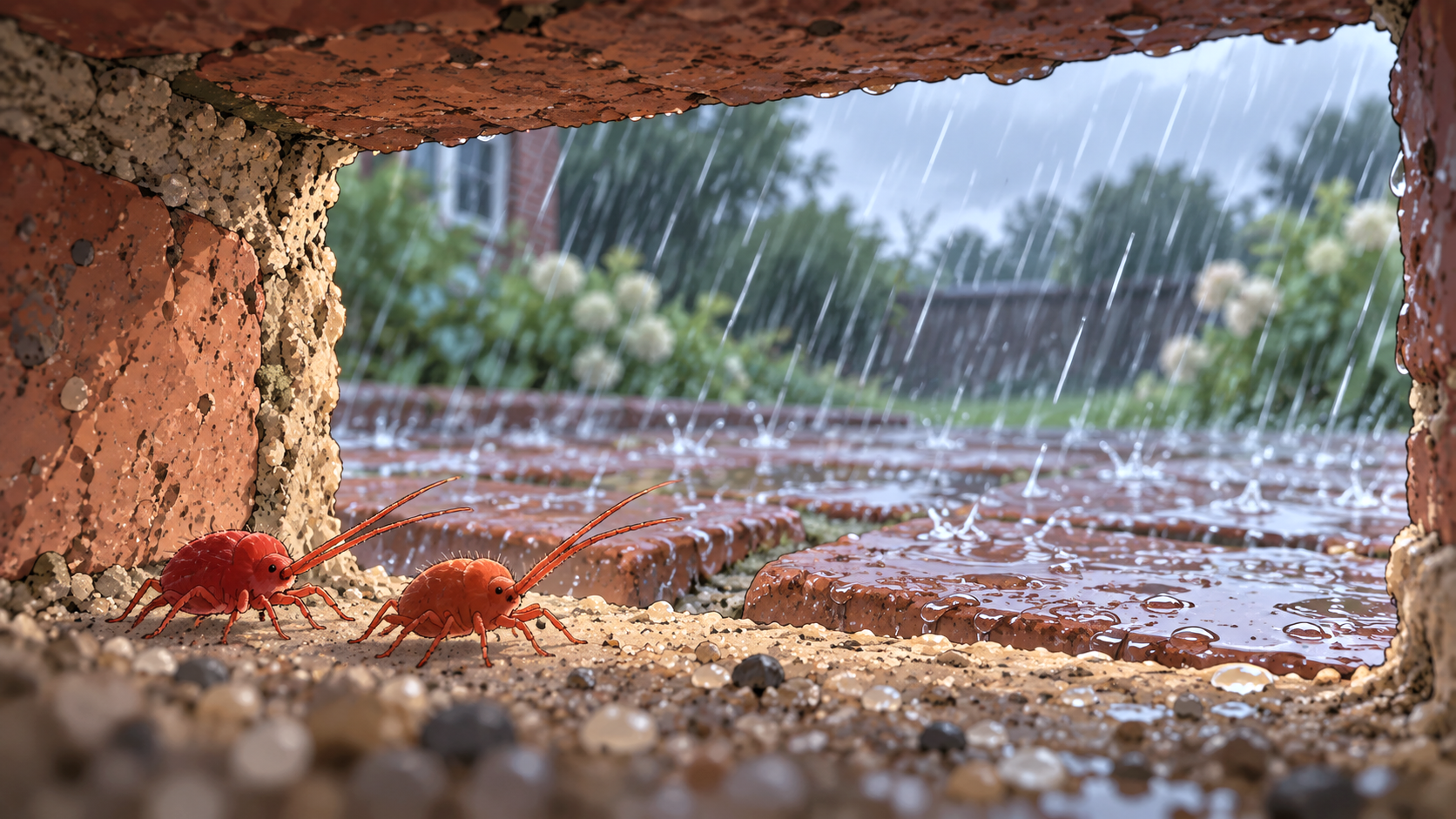
A rainy day does not normally wipe out a clover mite population. Clover mites can survive rain, although heavy rainfall can disrupt where active mites are feeding and trigger large numbers to leave exposed areas. Their response to wet weather is visible enough that mass movement into buildings has been recorded after heavy rain. Rain also affects different life stages differently. Active mites can move to sheltered locations, while eggs remain tucked into cracks, crevices, bark, and other protected sites. A storm may therefore change where the mites are seen without eliminating the population living around the property.
Heavy Rain Can Send Clover Mites Looking for Shelter
Clover mites normally occupy turf and other vegetation, but severe weather can make those exposed sites temporarily unsuitable. Heavy rain is one of the conditions known to stimulate clover mites to enter buildings in large numbers. The same response has been documented when rain or damage to their host plants causes mites to wander indoors.
A sudden appearance after a storm can consequently look like a new infestation even when the mites were already outside. They may cross the lawn, foundation, siding, and other surfaces while seeking shelter, eventually appearing around window sills or elsewhere indoors. The rain changed their location rather than creating the population.
Eggs Have Protection That Exposed Mites Do Not
Clover mite eggs are not scattered openly across a lawn. Females deposit them in sheltered locations, and overwintering eggs can occur inside sidewalk cracks, beneath tree bark, and within building crevices. Those sites provide physical protection from direct weather exposure.
Rain can even be followed by increased hatching. Clover mite eggs have been observed to hatch after rainfall, so seeing more active mites after wet weather should not be interpreted as evidence that rain destroyed the eggs. Their egg stage is naturally adapted to protected outdoor locations, including sites that persist through seasonal weather changes.
Flooding and Ordinary Rain Are Not Equivalent
A mite surviving a rain shower does not mean it is immune to water. Forceful water can physically dislodge tiny arthropods from vegetation, and prolonged inundation creates very different conditions from leaves simply becoming wet. There is not enough clover-mite-specific evidence to assign a reliable rainfall amount or duration at which exposed mites die.
Their behavior provides stronger guidance than trying to invent such a threshold. Clover mites remain established in outdoor environments that receive rain, reproduce across suitable seasons, and can respond to heavy precipitation by relocating. They also survive other substantial weather changes, with adults becoming active at temperatures only slightly above freezing and populations entering dormancy during unfavorable heat. Their seasonal activity is governed strongly by temperature rather than by a simple wet-equals-dead rule.
Dry Weather Can Be Hard on Clover Mites Too
Rain should not automatically be viewed as the unfavorable side of the weather equation. Clover mites are cool-season mites, and warm, dry summer conditions can drive them into inactivity. Drought can also increase movement as host vegetation deteriorates, while supplemental irrigation of dry turf can reduce clover mite populations and migration.
Those responses explain why both very wet and very dry conditions can be associated with mites leaving their usual feeding areas. They do not mean moisture itself should be treated as an attractant. Clover mites primarily occupy outdoor areas because their food comes from living plants, and weather alters how suitable those habitats remain.
A Storm Does Not Reset a Clover Mite Problem
Waiting for rain is unreliable when large numbers are already established around a building. Some exposed mites may be displaced, yet survivors and protected life stages can remain, and heavy rainfall may actually coincide with more mites approaching the structure. A recurring population can continue producing waves of mites around the house after the weather improves.
Properties with repeated post-rain invasions benefit more from closing likely entry routes than from expecting another storm to remove the mites. Individuals that have already reached rooms can be vacuumed from indoor surfaces without waiting for outdoor conditions to change.
Rain and Clover Mite Questions
Can clover mites drown in puddles?
Individual mites trapped under water may die, but there is no useful clover-mite-specific drowning time that can be applied to an outdoor infestation. A puddle also reaches only a tiny portion of the population and its protected eggs.
Why are clover mites sometimes easier to notice after rain?
Heavy rain can stimulate migration away from exposed outdoor habitat, putting mites onto walls, foundations, windows, and other surfaces where their movement becomes much easier to see.
Can clover mites survive several rainy days?
A population can persist through periods of wet weather because not every mite or egg receives the same exposure. Clover mites occupy vegetation and numerous protected outdoor sites rather than remaining continuously exposed on a flat surface.