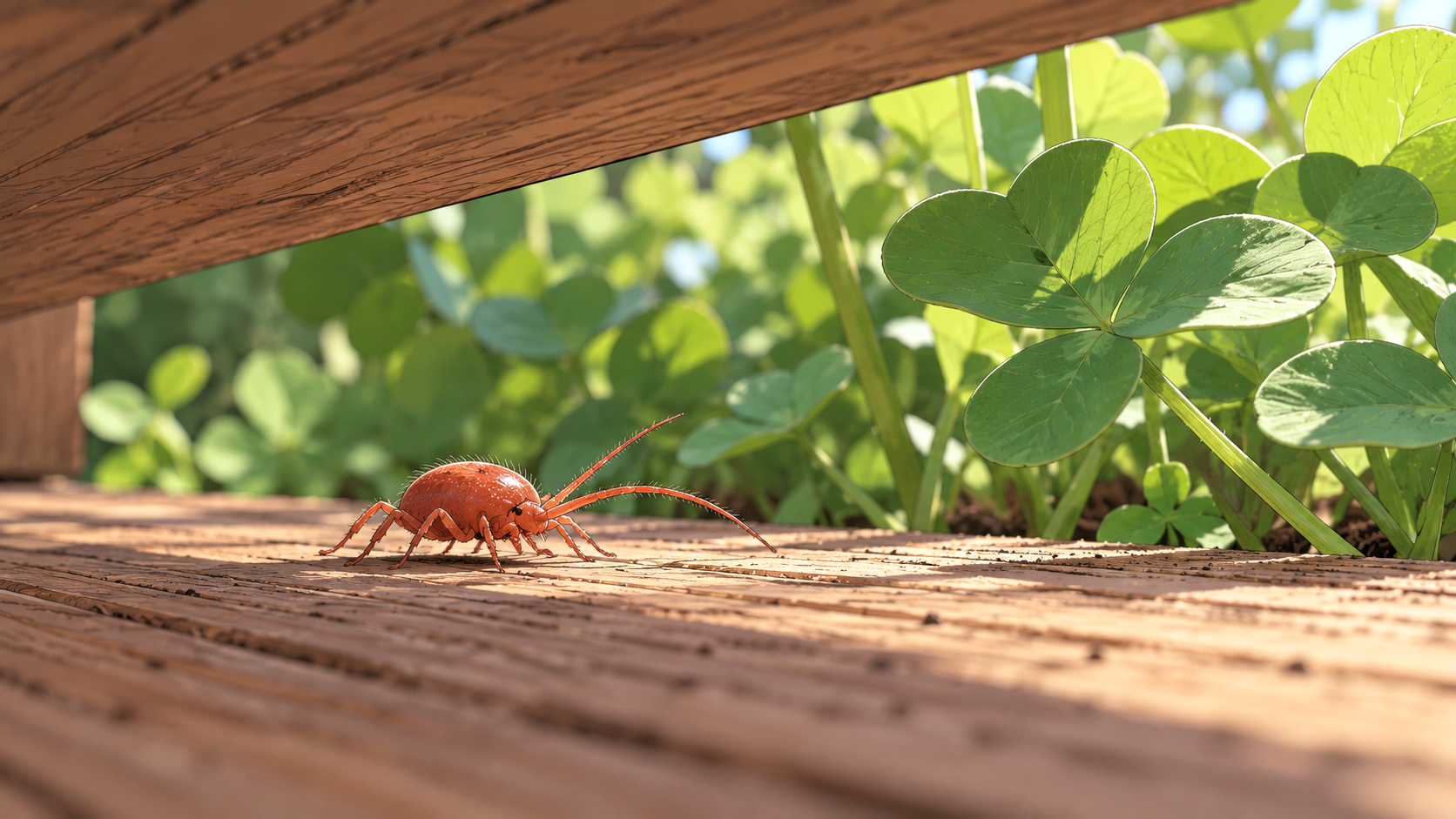
Seeing dozens of tiny red mites crawling over a wooden window frame can make the wood itself look like the obvious food source. It is not. Clover mites do not eat wood. They feed on living plant material, and they are specifically classified as plant feeders that cannot attack the structure or furnishings of a house. Wood can still become a busy clover mite highway. Exterior trim, siding, decks, fences, window frames, and other wooden surfaces may lie directly between the mites’ outdoor habitat and the sheltered cracks they seek. Their presence on those materials indicates movement or sheltering, not wood consumption.
A Wooden Surface Can Hold Mites Without Feeding Them
Clover mites commonly climb buildings after leaving turf and other vegetation. They may travel beneath siding and shingles or enter cracks around windows and foundation walls. Eggs can also be deposited around siding, door frames, window frames, tree bark, and other protected crevices. Finding mites repeatedly on a wooden component can therefore create the appearance of an infestation inside the material even though the mites are simply using its surfaces and gaps.
This behavior is especially easy to misread when mites are crawling across exterior siding or gathering around window sills. Clover mites are tiny enough to exploit extremely small openings, and large outdoor populations can send hundreds or thousands across the same section of a building. They remain nuisance invaders rather than structural pests, and current identification guidance confirms that they do not cause structural damage.
Feeding on a Tree Is Not the Same as Eating Its Wood
Clover mites can occur on woody plants, including trees and shrubs, without consuming bark, branches, or structural wood. Some members of the Bryobia complex feed on woody ornamentals, but their feeding injury appears on living plant tissue as bronzing or silvering of leaves. Their mouthparts are used to obtain plant contents, not to chew through lumber.
That feeding biology matches the damage found in turf, where clover mite activity can produce silvery streaks or specks on grass blades. The same type of plant-feeding relationship explains why clover mites eat grasses and numerous other plants while wooden floors, framing, furniture, and siding provide no comparable food source.
Clover Mites Do Not Make Holes, Tunnels, or Sawdust
Wood damaged by an organism should show evidence appropriate to that organism’s feeding or nesting behavior. Clover mites do not excavate galleries, bore exit holes, hollow timber, or produce piles of frass from wood. Even when enormous numbers enter a building, they are described as non-structural pests that eventually die indoors rather than feeding on the building.
Tiny red mites beside deteriorating wood therefore should not be blamed automatically for the deterioration. The mites may simply be using an existing crack as a route or shelter. Because clover mites cannot maintain a reproducing indoor population, discovering them around wooden framing also does not indicate a hidden colony consuming the structure from within.
The Damage Clover Mites Can Leave on Wood Is Superficial
Wood can still acquire a visible mark from clover mites without being eaten. Crushing one releases reddish body pigment, which can leave a conspicuous smear on pale painted trim, finished furniture, or other surfaces. Clover mite stains appear when their bodies are crushed, not because they have removed or digested part of the wood.
Avoid wiping across groups of live mites for that reason. Indoor individuals can be vacuumed without crushing them, while existing marks should be treated according to the finish or material rather than interpreted as feeding damage.
When Mites Keep Appearing on the Same Wood
Repeated activity on a wooden door frame, siding board, deck edge, or window does not change the mites’ diet. It usually points to a convenient migration route, a protected gap, or nearby vegetation supporting the outdoor population. Clover mites often become numerous beside buildings where suitable turf or other plants grow close to the structure.
Inspect the surrounding area rather than the wood for signs of feeding. Clover mite plant damage appears on living vegetation, while recurring movement onto a house can be reduced by closing entry points and changing vegetation immediately beside the foundation. Wood repair is warranted when the material itself is damaged, but clover mites should not be assigned responsibility without evidence of the actual cause.
Wood and Clover Mite Questions
Can clover mites eat wooden furniture?
No. Furniture is not a food source for clover mites. Mites found on a table, chair, cabinet, or other wooden furnishing have wandered there rather than feeding on it.
Can clover mites live under wood siding?
They can enter protected spaces beneath siding and use cracks around buildings for shelter. Occupying such a space does not mean they are eating the siding, and clover mites found around houses ultimately depend on outdoor vegetation for food.
Do clover mites eat tree bark?
Clover mites may occur on tree bark and use bark crevices as protected sites, including places where eggs can be laid. Their feeding is associated with living plant tissues rather than consumption of bark as structural material.