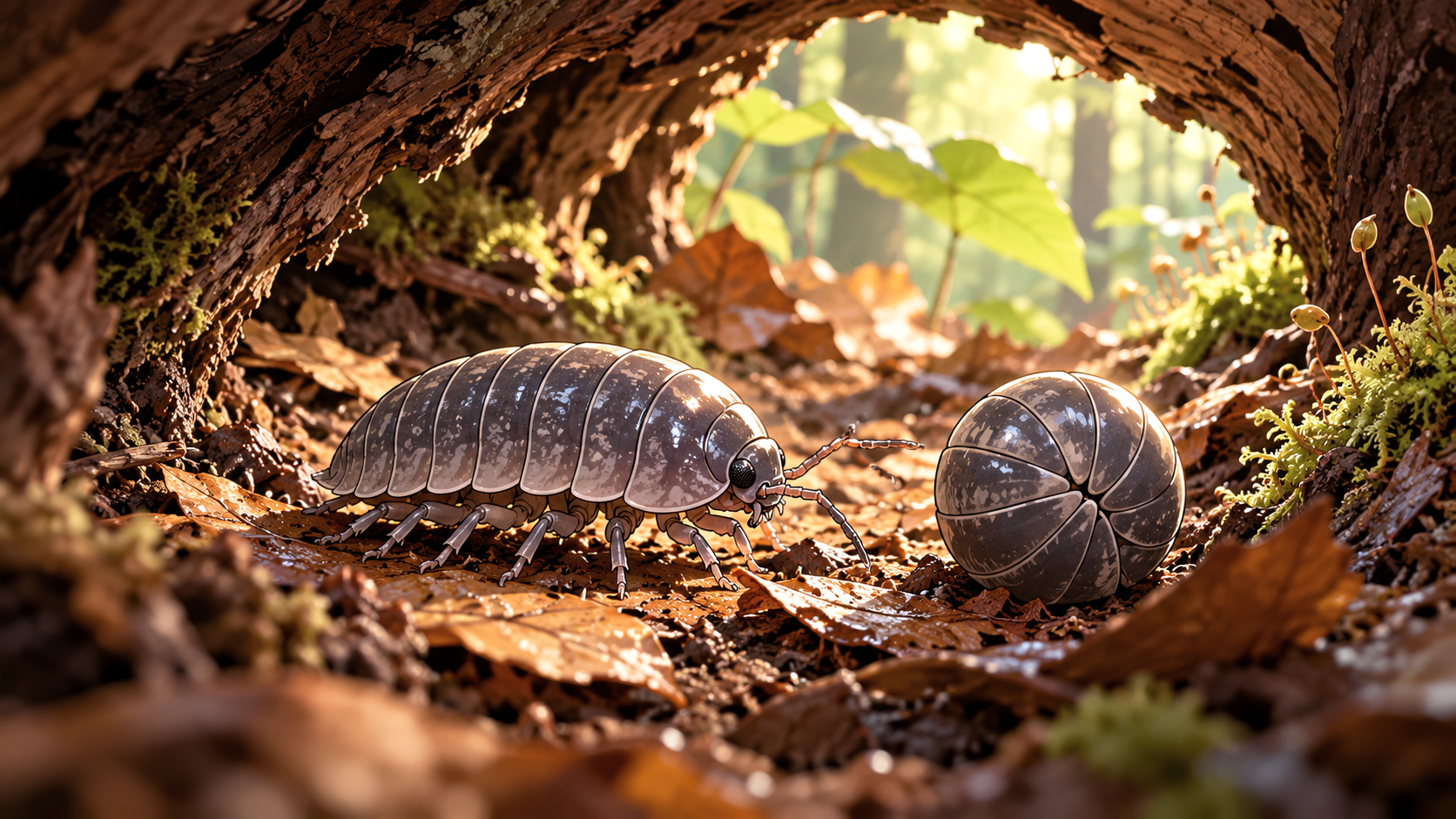
A roly-poly is a small land-dwelling isopod best known for curling its segmented body into a tight ball when disturbed. It is commonly called a pillbug and belongs to a group of crustaceans that adapted to life on land. Roly-polies usually occupy damp, sheltered places and feed largely on decomposing organic material.
The name often brings to mind Armadillidium vulgare, the common pillbug, although “roly-poly” can be applied more broadly to pillbugs capable of rolling themselves into a ball. Despite the word “bug,” a roly-poly is not an insect.
Roly-Poly, Pillbug and Woodlouse Do Not Always Mean Exactly the Same Thing
“Roly-poly” and “pillbug” are commonly used for terrestrial isopods whose bodies can curl into a compact ball. The familiar Armadillidium vulgare is one of the best-known examples and is itself commonly called a roly-poly, pillbug and woodlouse. Its rolling response also explains the pillbug name because the closed animal resembles a small pill.
“Woodlouse” is broader. It is a common name for terrestrial isopods that includes pillbugs as well as related animals such as sowbugs. A sowbug therefore can be a woodlouse without being the particular kind of woodlouse normally meant by “roly-poly.” The practical differences become especially useful when comparing a roly-poly with a sowbug, since many sowbugs cannot form the same tight defensive ball.
“Potato bug” is less precise because the name changes meaning geographically. It has been used for pillbugs, but elsewhere it can refer to entirely different animals, including the Colorado potato beetle or Jerusalem crickets. “Doodlebug” has the same problem. Some regional usage applies the name to pillbugs, and “doodlebug” is listed as an alternative name for pillbugs in dictionaries, but in much of the United States it is strongly associated with antlion larvae. The safest approach is to identify the animal itself rather than assuming either nickname always means a roly-poly. The overall appearance of a roly-poly provides much better identification evidence than a regional common name.
Roly-Polies Are Land-Dwelling Crustaceans
A roly-poly may look insect-like because it is small, segmented and commonly encountered alongside insects in gardens, but its biological relationships lie elsewhere. Pillbugs are terrestrial isopods, and Armadillidium vulgare is described as a non-insect arthropod and terrestrial crustacean. The familiar body therefore represents a branch of crustacean life that successfully occupies terrestrial environments rather than an unusual type of beetle or other insect.
Life on land has not eliminated their dependence on moisture. Terrestrial isopods lose water readily and are strongly associated with humid microhabitats. Their respiratory structures also differ from the tracheal system characteristic of insects. Those adaptations help explain why the body structure of a roly-poly and its environmental requirements make more sense when viewed as those of a terrestrial crustacean.
There are numerous terrestrial isopod species rather than one universal “roly-poly” found everywhere. A. vulgare is widespread and well studied, but different roly-poly species have their own identifying features and distributions. A broad description of roly-polies therefore cannot be assumed to apply identically to every species.
Damp, Protected Ground Is Typical Roly-Poly Habitat
Turn over a moist log, stone, flowerpot or layer of leaf litter and the conditions underneath are much closer to what a roly-poly needs than an exposed patch of dry ground. A. vulgare thrives in environments with damp soil, decomposing organic matter, low light and moderate to high humidity. Gardens, forests, hedgerows and similar places can provide these conditions in small sheltered pockets even when the surrounding environment is considerably drier.
Moisture is especially important because terrestrial isopods remain vulnerable to water loss. They consequently spend much of their time beneath material that protects them from dry air and direct sunlight. Their natural habitat and geographic distribution vary among species, but the association with humid shelter is widespread.
This preference also explains why roly-polies can appear around human structures without being animals adapted to ordinary dry indoor rooms. Damp organic debris, mulch, foundation edges and other protected outdoor areas can support them close to buildings. Household entry has its own causes, however, and should not be confused with their normal outdoor habitat.
Most of Their Food Is Already Decaying
Roly-polies are primarily detritus feeders. Decaying leaves and other dead plant material make up an important part of the diet of A. vulgare, and terrestrial isopods contribute to the processing of organic material by consuming and fragmenting it. Their feeding is one reason they are frequently encountered directly within leaf litter rather than merely hiding underneath it.
Their diet is not restricted absolutely to dead leaves. A. vulgare has also been observed consuming fruit, roots, seeds, dung and other organic materials, while living plant tissue can sometimes be eaten under suitable conditions. The complete range of foods eaten by roly-polies is therefore broader than the simple description “decomposer” might suggest.
That flexibility does not make every roly-poly in a garden a plant pest. Feeding on decomposing material and occasionally feeding on living plants are different ecological situations. Whether their presence is beneficial, neutral or damaging depends on what they are actually consuming and the condition of the plants involved.
Rolling Into a Ball Is a Defensive Response
The behavior behind the name “roly-poly” is called conglobation. When threatened or disturbed, pillbugs in groups capable of this response curl their segmented bodies inward until the harder outer surfaces form a protective enclosure. The behavior can reduce exposed vulnerable areas and helps explain why rolling into a ball functions as a defense.
Rolling is not something every woodlouse can do. Pillbugs are particularly associated with complete conglobation, whereas sowbugs have a flatter body form and cannot close themselves into the same compact sphere. A motionless ball on the ground may open and begin walking again once the disturbance has passed.
Roly-polies are also more active under conditions that limit drying. A. vulgare is generally nocturnal and commonly remains under soil or debris during daylight, although individuals can certainly be uncovered during the day. Their nighttime activity pattern fits the same dependence on protected, humid conditions that shapes where they spend much of their lives.
Questions About Roly-Polies
Are “roly-poly” and “rollie pollie” different animals?
No. Spellings such as roly-poly, roly poly, rollie pollie and rolly-polly are informal variations of the same common name rather than biological categories. “Pillbug” is the more standardized common name for the familiar ball-forming terrestrial isopods.
Are all woodlice roly-polies?
No. “Woodlouse” covers a wider collection of terrestrial isopods. Pillbugs are woodlice, but other woodlice, including sowbugs, do not have the tightly closing body form associated with roly-polies.
Are roly-polies bugs?
They can be called bugs in everyday language, particularly in names such as “pillbug,” but they are not true bugs in the biological sense. Their classification places them among crustaceans rather than insects.
Why are roly-polies usually found together?
Suitable shelter is patchy. A single damp space beneath a log, stone or pot can provide several individuals with the humidity, darkness and organic material they need, so finding a group does not necessarily indicate the kind of social colony formed by ants or termites.