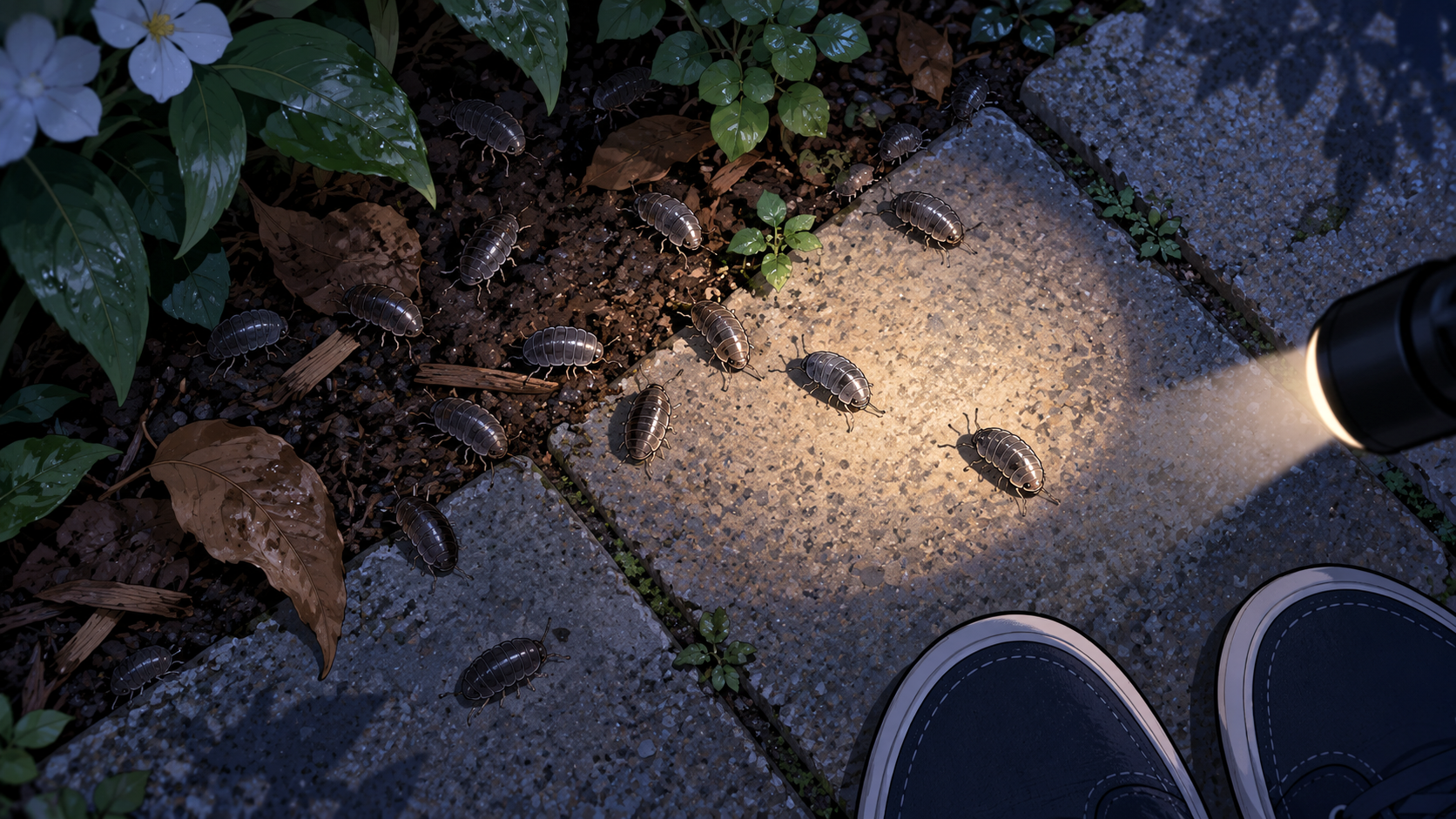
Roly-polies are primarily nocturnal, with much of their surface activity occurring after dark. Common pillbugs often remain beneath leaves, wood, stones and other shelters during daylight, then become more active when conditions are darker and often more humid. However, daytime hiding or immobility is not enough to establish that they are sleeping. Night activity is not absolute. Roly-polies can move during the day when conditions are favorable or when their shelter is disturbed, and different terrestrial isopod species do not show identical daily activity patterns.
Darkness Changes When Roly-Polies Move
The common pillbug, Armadillidium vulgare, has been tested under controlled light-dark cycles rather than merely observed disappearing beneath objects during daylight. In one experiment, pillbugs given a dark, moist refuge and access to a running wheel showed locomotor activity during part of each night. Activity continued rhythmically under constant experimental conditions, providing evidence that the pattern involves an internal circadian component.
Later experiments produced a more complicated picture. A. vulgare displayed clear daily rhythmicity under a normal 24-hour light-dark cycle, but its rhythm became weak in constant darkness. The investigators concluded that the animals possess an endogenous circadian pacemaker, while much of the visible locomotor pattern is strongly affected by light directly suppressing activity.
Calling roly-polies nocturnal is therefore useful, but it should not imply a rigid schedule controlled only by an internal clock. Light, humidity, temperature and immediate shelter conditions can all alter when an individual moves.
Daylight Often Finds Them Under Cover
During daylight, pillbugs commonly occupy dark spaces beneath fallen leaves, logs, stones and other objects resting close to damp ground. A recent field experiment examining several terrestrial isopods found substantial nocturnal activity and described daytime sheltering as a means of avoiding unfavorable conditions, including low humidity. In that study, approximately 60% of observed A. vulgare individuals were active at night, while some other woodlouse species showed considerably greater nocturnal activity.
Darkness and shelter are closely connected in the animal’s environment. Roly-polies tend to avoid strongly illuminated locations, while contact with surrounding surfaces can reduce movement and encourage sheltering. Experiments involving A. vulgare and A. nasatum have documented both sheltering and aggregation under different light conditions. These behaviors help explain why turning over a board or rock during the day can suddenly reveal animals that were not visible on the surrounding surface.
The same small refuges provide the humid conditions that define much of where roly-polies live. Their absence from an exposed patch of ground at noon does not necessarily mean the area lacks roly-polies; many may simply be concealed a few centimeters away.
Nighttime Reduces the Risk of Drying Out
A roly-poly’s activity schedule is closely tied to water balance. Terrestrial isopods lose water through their body surface, with their pleopodal respiratory structures contributing to their sensitivity to dry air. Darkness itself does not provide water, but nighttime commonly brings lower temperatures and higher relative humidity than exposed daytime conditions.
Experiments on terrestrial isopods have shown that humidity can directly alter locomotion. A. vulgare, Porcellio scaber and Oniscus asellus change their movement in response to moisture conditions, although the strength of the response differs among species. Classic experimental work found that combinations of humidity responses and avoidance of light retain woodlice in damp, dark environments.
Water conservation also shapes other behavior. A. vulgare can reduce evaporative water loss by rolling into a ball, and experimental measurements show that conglobated individuals lose water more slowly under dry conditions. The same research notes that terrestrial isopods emerge primarily at night, or when falling temperatures and rising humidity produce more favorable conditions for surface activity.
Roly-Polies Can Still Appear During the Day
Nocturnal does not mean exclusively active after sunset. A pillbug exposed when a stone is lifted may immediately begin walking in daylight. Cloudy weather, wet ground, dense shade and high humidity can also produce conditions that permit activity outside the usual nighttime period.
Movement under unfavorable conditions can actually help the animal locate a better microhabitat. Experiments comparing temperature, humidity and light responses found that terrestrial isopods alter their locomotion as environmental conditions change, helping them remain within favorable combinations of temperature, moisture and illumination. Seeing one cross a patio during daylight therefore does not contradict the species’ predominantly nocturnal activity pattern.
Feeding is likewise not restricted by an absolute clock. Roly-polies often forage when surface conditions permit, encountering the decaying vegetation and other materials that make up much of their normal diet. Darkness frequently provides favorable conditions for that movement, but environmental conditions can shift the opportunity.
Species differences further weaken any universal rule. Research comparing terrestrial isopods found 60% nocturnal activity in A. vulgare but 92% in Philoscia muscorum under the same field study. Animals grouped under the common name roly-poly can include different pill-forming isopod species, so observations from one species should not automatically define the activity of every other one.
Being Motionless During the Day Does Not Prove a Roly-Poly Is Asleep
A sheltered roly-poly may remain almost motionless for long periods, but inactivity is not by itself evidence of sleep. Researchers studying sleep in animals generally require behavioral and physiological criteria beyond simply observing an animal at rest, such as a reversible state of reduced responsiveness and evidence that sleep regulation changes after deprivation.
The available evidence for A. vulgare clearly supports daily rhythms in locomotor activity, nighttime movement and daytime shelter use. Those findings describe activity and rest patterns, not a demonstrated sleep state comparable to sleep that has been experimentally characterized in better-studied animals.
Several other behaviors can also make a pillbug temporarily motionless. Physical contact with surrounding surfaces can suppress movement, unfavorable humidity can promote sheltering, and disturbance can cause an animal to stop moving after curling its body into a defensive ball. None of those observations alone establishes sleep.
Questions About Roly-Poly Nighttime Activity
Why do roly-polies sometimes gather together during the day?
Aggregation can reduce exposed surface area and help individuals maintain favorable moisture conditions inside a shelter. Experimental work has also found aggregation responses associated with light exposure, so a daytime cluster beneath an object can reflect both shelter selection and group behavior.
Are roly-polies attracted to darkness?
They commonly select dark refuges and show light-avoidance behavior, but darkness usually occurs alongside other favorable properties such as shade, lower temperature and greater humidity. Their location reflects several environmental cues rather than darkness operating alone.
Can roly-polies see in the dark?
Their eyes are relatively simple compared with vertebrate eyes, and their nighttime activity does not depend on detailed vision. Chemical, tactile, humidity and light cues all contribute to navigation, while the eyes and sensory structures of roly-polies provide only part of the information they use.
Will outdoor lights stop roly-polies from moving?
Bright light can suppress locomotor activity in A. vulgare, but outdoor lighting does not create an absolute barrier. Moisture, temperature, shelter and the intensity and duration of illumination can alter the response.
One thought on “Are Roly-Polies Nocturnal?”