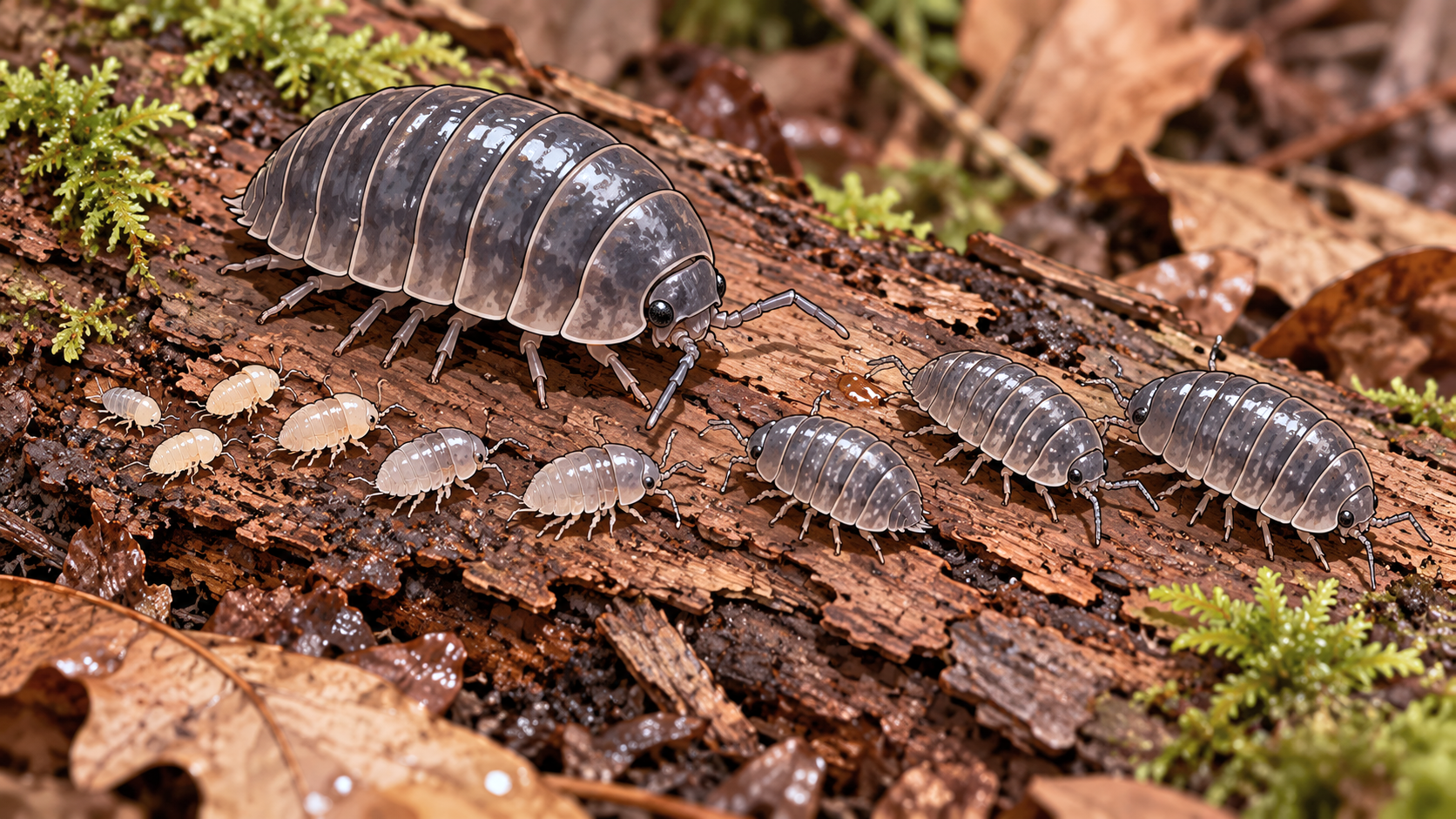
A roly-poly develops through egg, manca, juvenile and adult stages. The eggs and earliest manca stage are protected inside the female’s fluid-filled brood pouch. After emerging, the young molt repeatedly, develop their final pair of walking legs, grow through successive juvenile stages and eventually reach reproductive maturity. Lifespan varies by species, population and environmental conditions.
There is no single timetable that applies to every animal called a roly-poly. Even closely related terrestrial isopods differ in developmental rates, and temperature, moisture, food and other conditions can change growth and survival. The common pillbug, Armadillidium vulgare, is one of the best-studied species and provides much of what is known about the sequence.
Development Begins Inside a Fluid-Filled Brood Pouch
A female terrestrial isopod carries developing eggs in a marsupium on the underside of her body. The pouch contains fluid, allowing embryos to develop in a protected aquatic-like environment even though the adults live on land. Studies of A. vulgare divide embryonic development into two major stages separated by molts, followed by the manca stage before the young leave the marsupium.
The transformation inside the pouch is substantial. During the first embryonic stage, body segmentation becomes apparent. In laboratory observations of A. vulgare, embryos shed the outer chorion after about 10 to 12 days and enter the second embryonic stage. Roughly another five to six days later, development includes blastokinesis, which reorients the embryo, followed eventually by shedding of the vitelline membrane. At that point the animal has entered its first manca stage. These intervals come from controlled observations of A. vulgare and are stage-specific measurements rather than universal pillbug incubation times.
Mancae remain inside the marsupium for several additional days. During this period, they take in marsupial fluid and undergo major physiological changes before entering terrestrial life. Measurements of developing A. vulgare found particularly rapid calcium accumulation after the second embryonic molt, supporting mineralization of the developing cuticle. The number of eggs, formation of the marsupium and reproductive events that precede this developmental sequence are part of how roly-polies reproduce rather than the post-fertilization life cycle itself.
Leaving the Marsupium Does Not Produce a Miniature Adult
The young that emerge from the female are mancae, a crustacean developmental stage with an important structural difference from adults: the final pair of walking legs has not yet become fully developed and functional. An adult roly-poly has seven pairs, or 14 walking legs arranged along the pereon.
The change happens through subsequent molts rather than immediately upon release. Detailed observations of the related pillbug Armadillidium granulatum identified three postmarsupial manca stages before the first juvenile stage. Under the conditions of that study, the first stage averaged about six hours, the second 15 days and the third 32 days; the juvenile stage began once the seventh pair of pereopods was fully developed. Those figures illustrate the developmental sequence but cannot be assigned to every roly-poly species.
The transition out of the marsupium also changes how the young function physiologically. Experiments with A. vulgare found that newly emerged juveniles experienced a more than twofold rise in metabolic rate compared with marsupial mancae as they shifted from the brood-pouch environment to aerial respiration. Within 48 hours of emergence, their nitrogen-excretion physiology also changed markedly. The appearance of baby roly-polies therefore accompanies a genuine developmental transition rather than simply a reduction in adult body size.
Growth Happens Through a Long Series of Molts
Once free-living, a young roly-poly cannot enlarge its rigid exoskeleton continuously. Growth is divided into increments separated by molts. Terrestrial isopods have an unusual biphasic molt in which the rear half of the exoskeleton is shed before the front half, so molting can temporarily change the animal’s appearance even though it remains within the same developmental period.
Early growth can involve frequent molts. Published accounts for A. vulgare describe molts occurring approximately every one to two weeks during the first 18 weeks of postmarsupial development. Molt frequency does not remain fixed throughout life, however, and growth rates cannot be converted into a dependable age estimate from body size alone.
Development continues internally as well. Gonadal differentiation occurs across multiple postembryonic stages in A. vulgare, and experimental work has demonstrated that sexual differentiation continues during juvenile development. Visible sex-related structures consequently emerge as the animal matures rather than being equally developed at every juvenile stage. Once those structures are established, male and female roly-polies can sometimes be distinguished anatomically.
Sexual Maturity Can Take Months
The time required to become reproductively mature depends on species and conditions. A commonly cited estimate for A. vulgare places sexual maturity at around one year, but that figure should be treated as characteristic of the referenced populations and husbandry observations rather than a fixed biological deadline for every pillbug.
Temperature can alter the pace of terrestrial-isopod development because these animals are ectotherms. Moisture availability also affects activity and feeding opportunities. Roly-polies depend strongly on humid microhabitats because their respiratory surfaces and water balance make desiccation a persistent constraint, helping explain why natural roly-poly habitats are usually moist and sheltered. Conditions that alter feeding, activity or physiological stress can consequently influence how quickly an individual progresses through growth.
Season adds another layer in wild populations. Young born late in a favorable season may encounter falling temperatures before completing the same amount of growth as individuals released earlier. Winter conditions can suppress activity, so seasonal inactivity in roly-polies can interrupt the apparent pace of development without representing a separate life stage.
Adult Roly-Polies Continue Molting
Reaching adulthood does not end the molt cycle. Adult terrestrial isopods continue replacing their exoskeleton as they live and grow, although the relationship between molt frequency and growth changes with age. An adult is therefore defined by developmental and reproductive maturity rather than by having completed a final molt.
Adult size varies substantially among species. Mature common pillbugs can reach approximately 8.5 to 18 mm long, while other roly-poly species have their own characteristic size ranges. A large individual is not necessarily old, because genetics, sex, food availability and environmental conditions can all influence growth.
Lifespan Is Variable Rather Than a Fixed Number
Published lifespan estimates for A. vulgare do not all give the same upper limit. One compiled species account reports an average wild lifespan of about 1.5 years and records wild individuals reaching around two years. Other entomological references state that adults may live two to five years. Differences in population, environment, methodology and whether a figure describes adult longevity or total lifespan make a single universal number inappropriate.
Conditions experienced throughout life can affect survival. Terrestrial isopods lose water readily, so access to humid refuges is important; food quality, temperature, predation, pathogens and local habitat conditions can also alter mortality. Field research on A. vulgare in three Texas habitats found measurable differences in survivorship among populations occupying different environments. Lifespan figures are consequently most useful when the species and study conditions are known.
Questions About Roly-Poly Development
Can roly-polies keep growing after they become adults?
Yes. Adulthood does not bring a terminal molt. Adults continue molting, and some additional growth can occur after reproductive maturity.
Can you determine a roly-poly’s exact age from its size?
No. Size changes during development, but growth rate varies with species, sex and environmental conditions. Measurements can distinguish broad developmental stages more reliably than they can reveal an exact age.
When does a young roly-poly get all 14 walking legs?
The final pair develops during the postmarsupial manca period. Research on A. granulatum defines the first juvenile stage by the seventh pair of pereopods becoming fully developed, illustrating why an early manca has fewer functional walking legs than an adult.
Do roly-polies have a larval stage like a caterpillar or maggot?
They do not undergo the dramatic metamorphosis seen in butterflies, beetles or flies. Terrestrial isopods develop directly through embryo, manca and juvenile stages, progressively acquiring adult characteristics through successive molts.