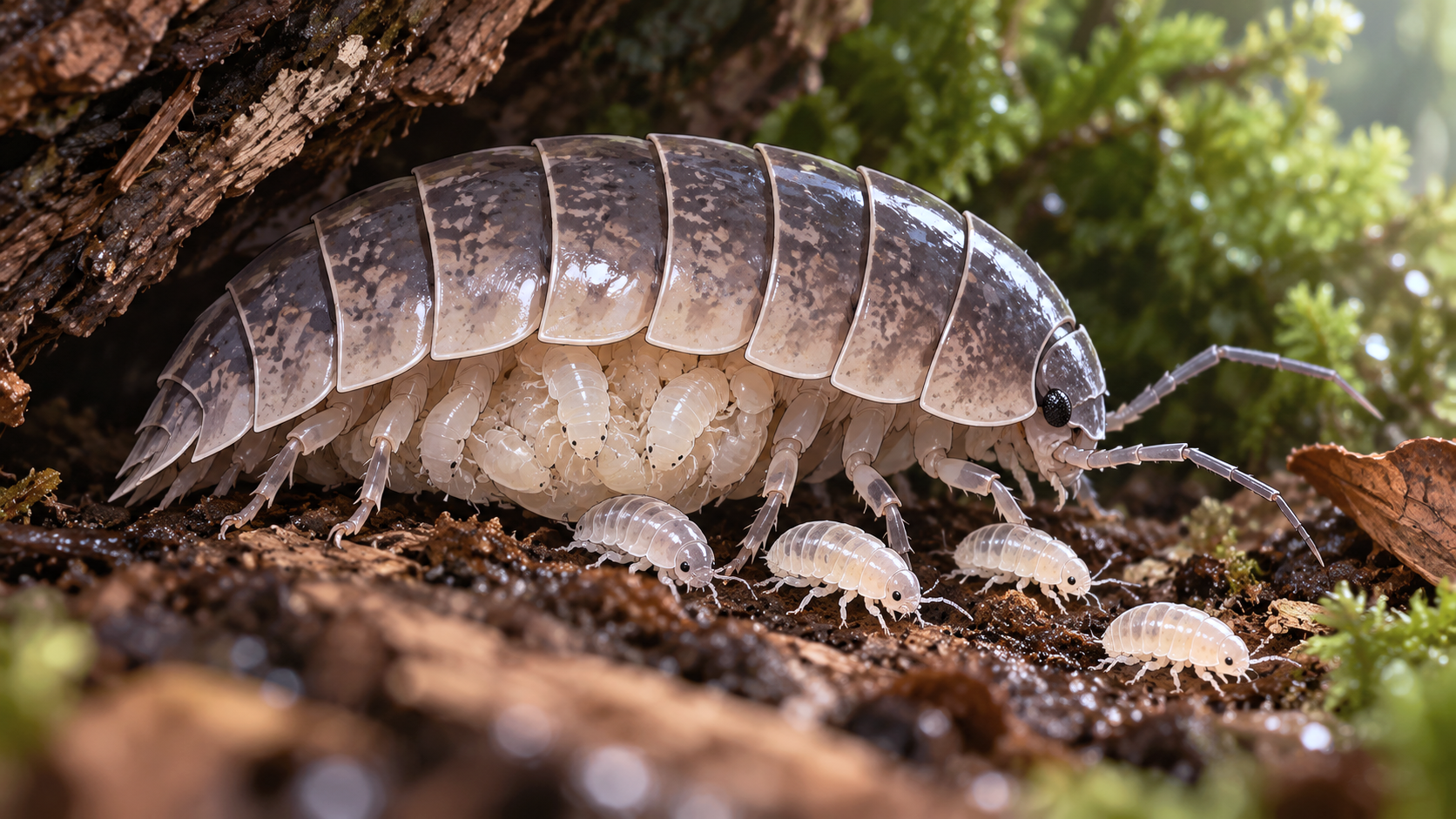
Roly-polies reproduce sexually through internal fertilization. A male transfers sperm to a female, which can retain viable sperm in specialized storage structures. Before laying her eggs, the female forms a fluid-filled brood pouch called a marsupium underneath her body. The eggs enter this protected pouch, where embryos develop and hatch before the young eventually emerge. This reproductive system is especially well documented in the common pillbug, Armadillidium vulgare. Timing, brood size and reproductive season can vary among terrestrial isopod species and populations, so figures measured for A. vulgare cannot automatically be applied to every animal called a roly-poly.
Mating Transfers Sperm to the Female
In A. vulgare, mating occurs around the reproductive molt cycle of a receptive female. A male mounts the female and positions the rear of his body against her underside, using specialized reproductive appendages to transfer sperm through her genital openings. Copulation itself can be brief, and both sexes can mate with multiple partners rather than forming permanent pairs.
The female reproductive tract includes paired ovaries and oviducts, while the male’s first two pairs of pleopods are modified for reproduction. These structures are specialized parts of the broader roly-poly body plan rather than additional walking appendages.
Transferred sperm does not necessarily fertilize eggs immediately. In A. vulgare, sperm first enters the female reproductive tract, and some is subsequently moved into a seminal receptacle near the junction of the oviduct and ovary. Detailed anatomical work has shown that sperm is bundled within this storage structure in a position that allows developing eggs to encounter it during oviposition.
A Female Can Store Sperm Long After Mating
Sperm storage gives female pillbugs considerable separation between mating and the production of a brood. Experiments with A. vulgare established decades ago that stored sperm can remain viable for at least a year. More recent genetic studies have confirmed that females can retain sperm from multiple partners, allowing a single brood to contain offspring fathered by more than one male.
Multiple paternity is not merely a laboratory possibility. Genetic analysis of a natural A. vulgare population found multiple fathers represented within individual broods. A female carrying eggs therefore cannot be assumed to have mated only once or to have mated recently.
Sperm storage also means that isolating an adult female from males does not guarantee that she will remain without fertilized eggs. Her previous mating history may continue to affect later broods. Conversely, brood-pouch formation by itself does not prove fertilization: historical experiments recorded isolated virgin females forming pouches and producing eggs that subsequently failed to develop.
The Brood Pouch Appears During a Specialized Molt
A female does not permanently carry an open pouch under her abdomen. Before reproduction, A. vulgare undergoes a parturial molt that changes structures along the underside of the first five walking-leg-bearing segments. Leaf-shaped plates called oostegites enlarge and overlap, forming the floor of the marsupium. Microscopic studies show that five pairs of oostegites enclose the terrestrial brood pouch.
The marsupium occupies the underside of the female and is filled with fluid. Formation of this chamber is linked to reproductive condition: females with developing ovaries produce reproductive oostegites during the specialized molt, whereas females outside that reproductive state lack a functional marsupium. Experimental work has also demonstrated ovarian control of oostegite development.
This reproductive molt uses the same two-part shedding pattern found in ordinary roly-poly molting, but its consequences are different because reproductive structures are being prepared for brooding. Research on A. vulgare found that marsupium formation can occur within two weeks after copulation and before the eggs are deposited.
Fertilization and Egg Laying Are Closely Linked
Internal fertilization does not mean that embryos begin developing at the moment of mating. Stored sperm remains available within the female until mature oocytes pass through the reproductive tract. Structural studies indicate that oocytes can encounter sperm positioned around the opening of the seminal receptacle as they travel through the oviduct, providing an opportunity for fertilization during oviposition.
The fertilized eggs then enter the marsupium rather than being deposited in soil, beneath stones or in a nest. This makes a roly-poly fundamentally different from many familiar land-dwelling arthropods that leave exposed or concealed egg masses in their environment. The female physically carries the brood.
Published brood counts vary. One frequently cited account of A. vulgare gives as many as 100 to 200 eggs per brood, whereas earlier field observations recorded considerably smaller typical broods in some populations. Female size, species and environmental conditions can influence reproductive output, so a fixed egg count is not a dependable expectation for every roly-poly. The full roly-poly life cycle begins with this protected egg stage but continues through several developmental stages after reproduction itself is complete.
The Marsupium Keeps the Eggs in a Fluid Environment
The pouch does more than hold eggs against the female’s body. Terrestrial isopod embryos retain an important connection to the aquatic ancestry of crustaceans because their early development takes place in marsupial fluid. Histological research shows that the terrestrial form of the marsupium is sealed ventrally and laterally and filled with fluid.
Embryos remain inside as development proceeds, and hatching also occurs within the pouch. The newly hatched stage is called a manca. The young remain protected there for an additional period before leaving their mother, rather than emerging directly from an externally deposited egg. This reproductive arrangement allows terrestrial isopods to brood delicate early stages while living on land.
Published incubation periods differ even among descriptions of A. vulgare. One entomological account places egg hatching at approximately three to four weeks, followed by another one to two weeks in the pouch, while other compiled biological accounts give longer retention periods. Such discrepancies make a single universal countdown inappropriate. Temperature, population, methodology and the point researchers use to define particular stages can affect reported timing.
A Brooding Female Has a Visible Pouch Underneath Her Body
The clearest external sign of a reproductive female is on the ventral surface. A developed marsupium forms a pouch across the underside of the front portion of the trunk. Depending on the stage and visibility, eggs or developing young may be discernible through or between the structures enclosing it.
A swollen underside should therefore be examined in context rather than interpreted from the animal’s overall size. Female and male pillbugs share most of the same general body form, while sex-specific structures provide better clues for telling males from females. A clearly developed marsupium provides much stronger evidence that the individual is a reproductive female.
Brooding also changes what the female can physically do. Experiments with A. vulgare found that egg-carrying females moved more slowly and could maintain their rolled posture for less time, increasing vulnerability to predators. The protective value of rolling into a ball can therefore be constrained while a female is carrying a brood.
Questions About Roly-Poly Reproduction
Can a roly-poly reproduce without a male present?
A previously mated female can produce fertilized offspring while no male is currently present because she can store sperm. Finding an isolated female with a developing brood therefore does not demonstrate reproduction without mating.
Do roly-polies lay their eggs in soil?
No. Terrestrial pillbugs retain their eggs in the marsupium underneath the female rather than depositing an egg mass into soil. A cluster of objects found loose in the ground should not automatically be identified as roly-poly eggs.
Can one brood have more than one father?
Yes. Female A. vulgare can store sperm from several males, and genetic studies have documented multiple paternity within individual broods.
Does every adult female constantly have a brood pouch?
No. The functional marsupium develops in association with the reproductive cycle and parturial molt. Females outside that state do not continuously carry the expanded brood pouch.
Can carrying eggs affect a female’s behavior?
Yes. Controlled experiments found that brooding A. vulgare females had reduced locomotor speed and shorter rolling duration, showing that carrying eggs imposes measurable behavioral costs.
2 thoughts on “How Do Roly-Polies Reproduce?”