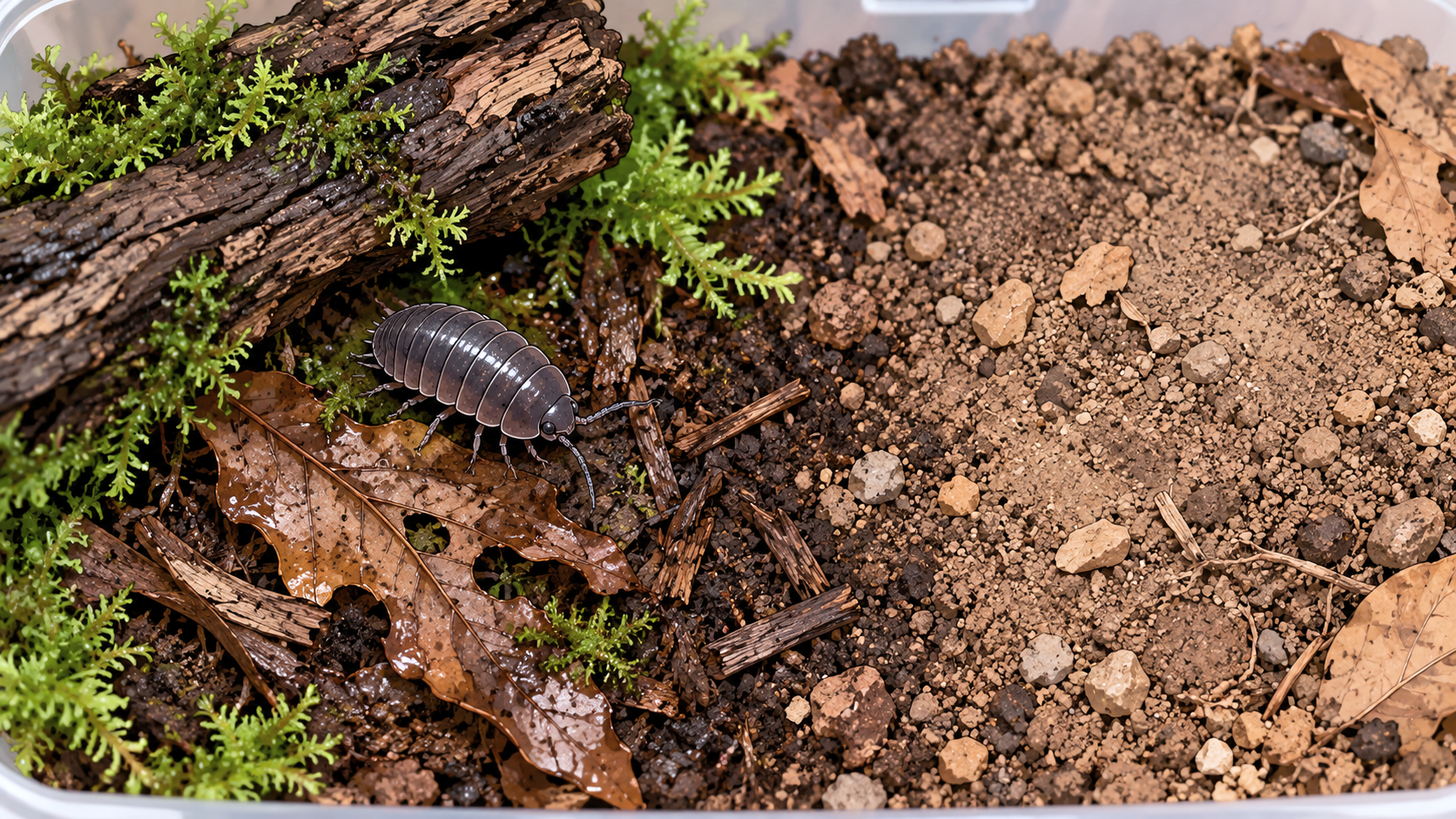
Roly-polies can survive food deprivation far longer than severe dehydration. Laboratory research has kept terrestrial isopods without food for weeks, while dry air can cause dangerous water loss within hours. There is no universal survival time: humidity, temperature, species, body size, access to moist surfaces and the animal’s starting condition all affect the outcome.
For perspective, Porcellio scaber has been maintained without food for six weeks under controlled conditions, while classic desiccation experiments with Armadillidium vulgare produced survival ranging from hours to many days as relative humidity changed. Those figures describe specific experiments, not countdowns that can be applied to a roly-poly found outdoors.
Food Can Be Absent for Weeks Without Immediately Killing a Roly-Poly
Starvation studies show that terrestrial isopods can endure surprisingly long periods without eating. In one experiment, P. scaber was deprived of food for six weeks at 19°C and 75% relative humidity before the animals entered a colder experimental period. During those six weeks, protein and lipid reserves declined while body-water content increased. The animals survived long enough for researchers to measure how prolonged starvation altered their body composition and subsequent cold tolerance.
That experiment involved P. scaber, not the common pillbug A. vulgare, so six weeks cannot be assigned to every roly-poly. Studies using A. vulgare nevertheless demonstrate substantial short-term tolerance. Modern feeding experiments routinely hold common pillbugs without food for several days before testing them. One study, for example, kept A. vulgare without food for 72 hours at 22°C under moist conditions before beginning a feeding assay.
Starvation affects the animal before it necessarily causes death. Restricted food can reduce growth and alter other measures of performance. Experiments with A. vulgare found that food quality influences growth, reproduction and survivorship, with poorly utilized diets producing lower growth and survival. What a roly-poly normally consumes, including decomposing plant material and other organic matter, belongs to its broader diet and feeding ecology; survival without food is instead a question of how long stored resources can support essential functions.
Dry Air Can Become Dangerous Within Hours
Water deprivation is harder to define because a roly-poly can obtain water without drinking from an obvious pool or droplet. Humid air, damp surfaces and water contained in food can all contribute to water balance. Removing a water dish while maintaining moist substrate is therefore very different from exposing the animal to genuinely dry conditions.
Controlled desiccation experiments illustrate how quickly water can be lost. At 18 ± 1°C, researchers exposed A. vulgare to relative humidities ranging from 6% to 75.4% for three hours. Even at 75% relative humidity, individuals lost as much as 5% of their initial body mass during the three-hour exposure. At lower humidities, water loss increased substantially.
The physiological consequences extend beyond a falling number on a scale. During dehydration, much of the lost water comes from the hemolymph. Measurements of A. vulgare found that hemolymph represented 52 ± 2.2% of hydrated body water but accounted for 71 ± 9.8% of water lost during desiccation. The animal can regulate some important ions as its fluid volume falls, but dehydration progressively changes its internal fluid balance.
Humidity Can Change Survival From Hours to Days
One of the clearest demonstrations comes from classic experiments that placed individual A. vulgare, P. scaber and Oniscus asellus at different relative humidities. The animals had first been starved for three days at 100% relative humidity and were then held individually at approximately 14–18°C, preventing aggregation from creating a more humid group microclimate.
Under those conditions, A. vulgare had the greatest desiccation resistance of the three species. At 0% relative humidity, individual A. vulgare survived about 6 to 10 hours. At 50% relative humidity, the recorded range increased to 16 to 44 hours, while at 93% relative humidity it extended from 49 to 240 hours. At saturated humidity, survival ranged from 76 hours to more than a month. The researchers explicitly warned that these values were relative laboratory measurements rather than exact predictions for animals in nature because the experimental setup exposed the entire body to uniform humidity instead of allowing the animal to press against a surface and preserve a humid microclimate.
That warning is essential when interpreting any claim that a roly-poly can live a specific number of hours “without water.” Natural roly-poly refuges beneath soil litter, stones and wood can hold considerably more moisture than the surrounding air. An animal beneath damp bark and one stranded on a dry concrete slab may technically have no free water to drink, yet their rates of dehydration can be completely different.
Roly-Polies Can Recover Water Without Drinking in the Usual Sense
A. vulgare has physiological abilities that complicate the idea of being “without water.” Experiments on several woodlouse species found that severely dehydrated Armadillidium could regain water from air at 98% relative humidity, while all tested species could recover water in saturated air. At lower humidity, recovery failed after sufficiently severe dehydration. The work demonstrated that water-vapor uptake depends strongly on relative humidity.
Access to liquid water can accelerate recovery. Terrestrial isopods can take up water through specialized structures at the rear of the body, and A. vulgare also uses behavioral responses to limit further loss. When it rolls tightly into a ball, less vulnerable surface area remains exposed. Measurements at 18°C found that conglobation reduced its water-loss rate by 34.8% in dry-air respirometry, although the protective effect became smaller as humidity increased.
Species differences are equally important. Comparative work on four Armadillidium species found variation in cuticle thickness and respiratory structures associated with different levels of desiccation resistance. A. vulgare was the most resistant species examined. A survival figure measured for the common pillbug consequently should not be presented as the limit for every species called a roly-poly.
Heat Can Make Lack of Moisture More Severe
Temperature alters water loss because evaporation and physiological activity respond to environmental conditions. Early comparative experiments with woodlice found that evaporation increased as temperature rose and that species differed considerably in both water loss and temperature tolerance. A. vulgare ranked among the more desiccation-resistant species tested. Temperature tolerance corresponded with differences in evaporative water loss.
Body size can alter the rate as well. Experiments on A. vulgare found increasing water-loss rates with increasing body mass under the conditions tested. Humidity and posture also changed those rates, demonstrating why size alone cannot predict survival.
Behavior helps roly-polies avoid reaching extreme dehydration in the first place. Their tendency to remain in humid refuges and to become more active under favorable conditions limits exposure to dry air. The predominantly nighttime activity of roly-polies often coincides with cooler, more humid conditions than those available on exposed ground during the day.
Food and Water Deprivation Should Not Be Treated as One Survival Test
A roly-poly deprived of food while kept cool and adequately hydrated can draw on stored energy for an extended period. An animal with food but insufficient moisture faces a different physiological problem: continuing water loss can impair essential functions long before its energy reserves are exhausted. Research on terrestrial isopods accordingly uses different experimental designs to investigate starvation and desiccation.
Food availability can still interact with other stresses. Long-term starvation reduced cold tolerance in P. scaber, showing that depleted energy reserves can influence the animal’s ability to cope with another environmental challenge. Seasonal temperature changes themselves affect activity, while cold-weather dormancy in roly-polies can greatly reduce the conditions under which they forage.
The most defensible answer is therefore conditional rather than a single number. Food deprivation can be tolerated for weeks under suitable laboratory conditions, while severe dry-air exposure can become lethal within hours. Exact survival depends on the species and the environmental conditions surrounding the individual.
Questions About Roly-Poly Survival
Can a roly-poly get water from its food?
Yes. Moist food can contribute water as well as nutrients, so an experiment that removes free drinking water while providing moist food is not equivalent to complete water deprivation.
Does a roly-poly die as soon as it dries out and stops moving?
Not necessarily. Dehydration can reduce performance before death occurs, and sufficiently dehydrated A. vulgare can recover when returned to appropriate moisture conditions. An unresponsive animal should not be assumed recoverable indefinitely, however, because severe water loss can become fatal.
Does molting increase the need for moisture?
Molting changes the animal’s cuticle and water balance, leaving newly exposed material less hardened than the established exterior. The unusual physical conditions surrounding the two-stage roly-poly molt make desiccation particularly undesirable during ecdysis.
Can several roly-polies survive dryness better together?
Aggregation can alter the immediate microclimate around terrestrial isopods and reduce exposed surface area within a group. Desiccation experiments commonly isolate individuals specifically because grouping can affect measured water loss, so survival data from solitary animals cannot automatically predict the result for a clustered group.