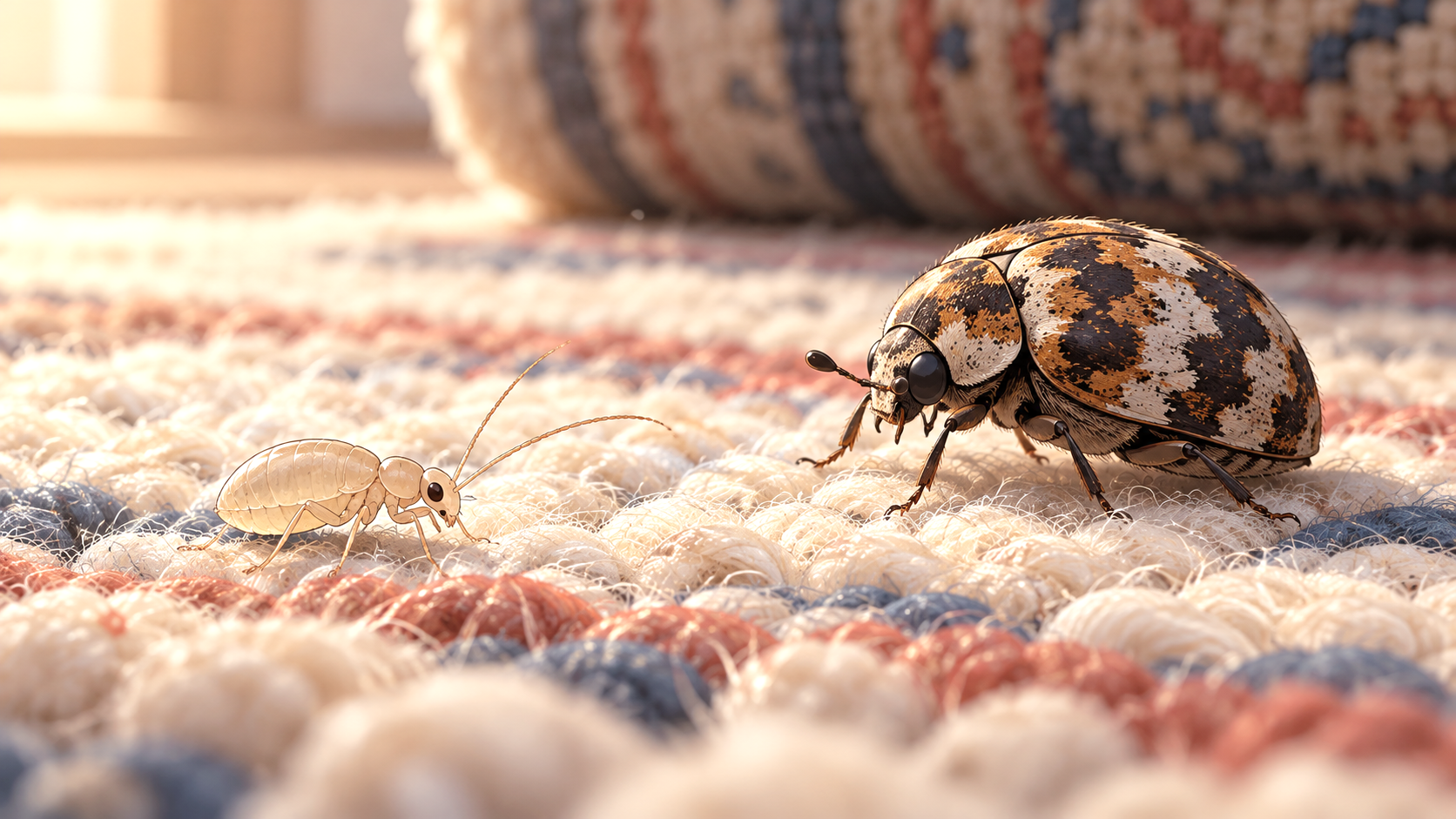
Booklice and carpet beetles are easy to separate once you know which life stage you are looking at. Booklice are tiny, soft-bodied insects with long antennae and a relatively large head. Adult carpet beetles are hard-bodied, oval beetles, while carpet beetle larvae are hairy or bristly and look nothing like adult booklice.
A Hard Beetle Shell or a Hairy Larva Rules Out Booklice
Adult carpet beetles have the compact, hardened body expected of a beetle. Depending on the species, adults may be rounded or elongated-oval and often show patterned scales or hairs. Common indoor booklice have a much softer, more delicate build, with long slender antennae and a head that looks disproportionately large beside the thorax. Those traits are much easier to appreciate in the broader appearance of household booklice, especially once the insect is viewed under magnification.
The difference becomes even greater with the immature stages. Carpet beetle larvae are elongated and covered with noticeable hairs or bristles, sometimes with longer tufts toward the rear. Canadian conservation guidance identifies carpet beetle larvae as important textile pests, and their hairy body is one of the most useful visual clues. Booklice nymphs do not become hairy grubs. They resemble miniature versions of the adult booklouse because the booklice life cycle develops through nymphal stages rather than a larval stage.
A very small, smooth insect with six visible legs, long antennae, and a broad head fits booklice far better than carpet beetle larvae. A fuzzy, segmented larva moving through lint or fabric points strongly toward a dermestid beetle instead.
Adult Carpet Beetles Are Usually More Substantial Than Booklice
Common indoor booklice are exceptionally small, often around 1 to 2 millimeters long. Utah State describes indoor psocids as minute insects that may look like small specks, which explains why a moving booklouse can be visible before its anatomy is obvious.
Carpet beetle adults vary by species, but many are several millimeters long and noticeably broader. Minnesota identification material describes some household carpet beetles at around 1/4 inch long, although smaller dermestid species also occur. Their hard wing covers, rounded outline, and compact proportions make them look like tiny beetles rather than moving specks with oversized heads.
Size should support the identification rather than control it. A very small beetle can still overlap the upper size range of larger psocids, especially in a photograph without a scale. The wider group of small insects that resemble booklice is better separated by body structure than by length alone.
The Damage Around Them Often Tells You Which Pest Is Present
Booklice and carpet beetles exploit very different food sources. Indoor booklice are strongly associated with microscopic fungi, mold spores, damp stored foods, and other suitable organic material. Their normal booklice diet does not make them major fabric-feeding pests.
Carpet beetle larvae can directly damage animal-based materials. Wool, fur, feathers, hair, hides, and similar keratin-rich materials are particularly vulnerable, and larvae may also attack soiled fabrics containing suitable food residues. Canadian museum-care guidance specifically warns that carpet beetle larvae can perforate and consume wool and other protein fibres.
A sweater with irregular holes, shed hairy larval skins, or damaged wool therefore creates a very different evidence pattern from booklice crawling around a damp cardboard box. Booklice near books are also often misunderstood. Their presence does not automatically mean they are chewing through pages; moisture and fungal growth are much more important to explaining why they are there.
Moisture Favors Booklice, While Carpet Beetles Follow Food
Repeated booklice sightings usually deserve an investigation for excess humidity, condensation, wet cardboard, leaks, or mold-prone materials. Psocids favor warm and damp environments capable of supporting fungal growth. A cluster beside a sweating pipe or damp storage box fits that ecology well.
Carpet beetles do not need a moisture problem to establish themselves. Their larvae can persist anywhere suitable animal-based material, dead insects, pet hair, feathers, wool, or related food accumulates. Adults may also turn up at windows because many feed outdoors on pollen and later enter buildings. Minnesota notes that adult carpet beetles may be seen outdoors on flowers, while the destructive stage inside homes is the larva.
Location can consequently narrow the comparison. Tiny insects concentrated around condensation and mold support booklice. Hairy larvae beneath rugs, along baseboards containing lint, inside closets, or around stored wool support carpet beetles. The surrounding signs of a booklice infestation should not be expected to match the fabric damage and shed larval skins associated with dermestids.
Carpet Beetle Larvae Leave Evidence That Booklice Do Not
A carpet beetle larva molts as it grows, leaving behind hairy cast skins that can remain in closets, drawers, beneath furniture, or around damaged materials. These empty skins can be easier to find than the living larva itself. Penn State describes dermestid larvae such as Trogoderma as covered with dense hairs and longer hairs toward the rear, creating a distinctive appearance even after molting.
Booklice also molt during development, but their shed skins are minute and do not resemble the brown, bristly larval casings produced by carpet beetles. Several visible hairy skins beside damaged wool should therefore move the identification away from booklice even if a tiny adult insect is also present somewhere nearby.
Mixed pest situations are possible. A humid storage room containing wool, cardboard, dust, and dead insects could support more than one pest, so one identified specimen should not automatically determine the identity of every insect in the room.
Questions About Booklice and Carpet Beetles
Can adult carpet beetles be mistaken for booklice?
Yes, particularly when the insect is tiny and viewed from a distance. A close image usually resolves the confusion because carpet beetles have a compact beetle body and hardened wing covers, while booklice have a softer body, long antennae, and a more prominent head.
Are carpet beetle larvae smaller than booklice?
Not typically once the larva has developed. Carpet beetle larvae can grow several millimeters long, while common household booklice usually remain extremely small. Very young larvae can be small, but their hairy body still provides a much stronger clue than size.
Do booklice damage carpets?
Booklice are not normal carpet-fibre feeders. Finding them around carpeting is more likely to reflect humidity, mold, dust, or another nearby food source. Damage to wool carpet accompanied by hairy larvae or shed larval skins is much more consistent with carpet beetles.
Can carpet beetles and booklice live in the same room?
Yes. They require different resources, so a damp storage room with fungal growth and suitable animal-based materials could support both. Identifying each specimen and examining the surrounding evidence prevents one pest from being blamed for the other’s activity.
Which pest should you suspect if the insects are around damp cardboard rather than fabric?
Booklice become much more plausible when numerous minute insects are concentrated on damp cardboard or other moisture-affected material. Their association with fungi and humidity is strong, while carpet beetle activity is more closely tied to suitable larval food such as wool, feathers, hair, dead insects, and similar material.