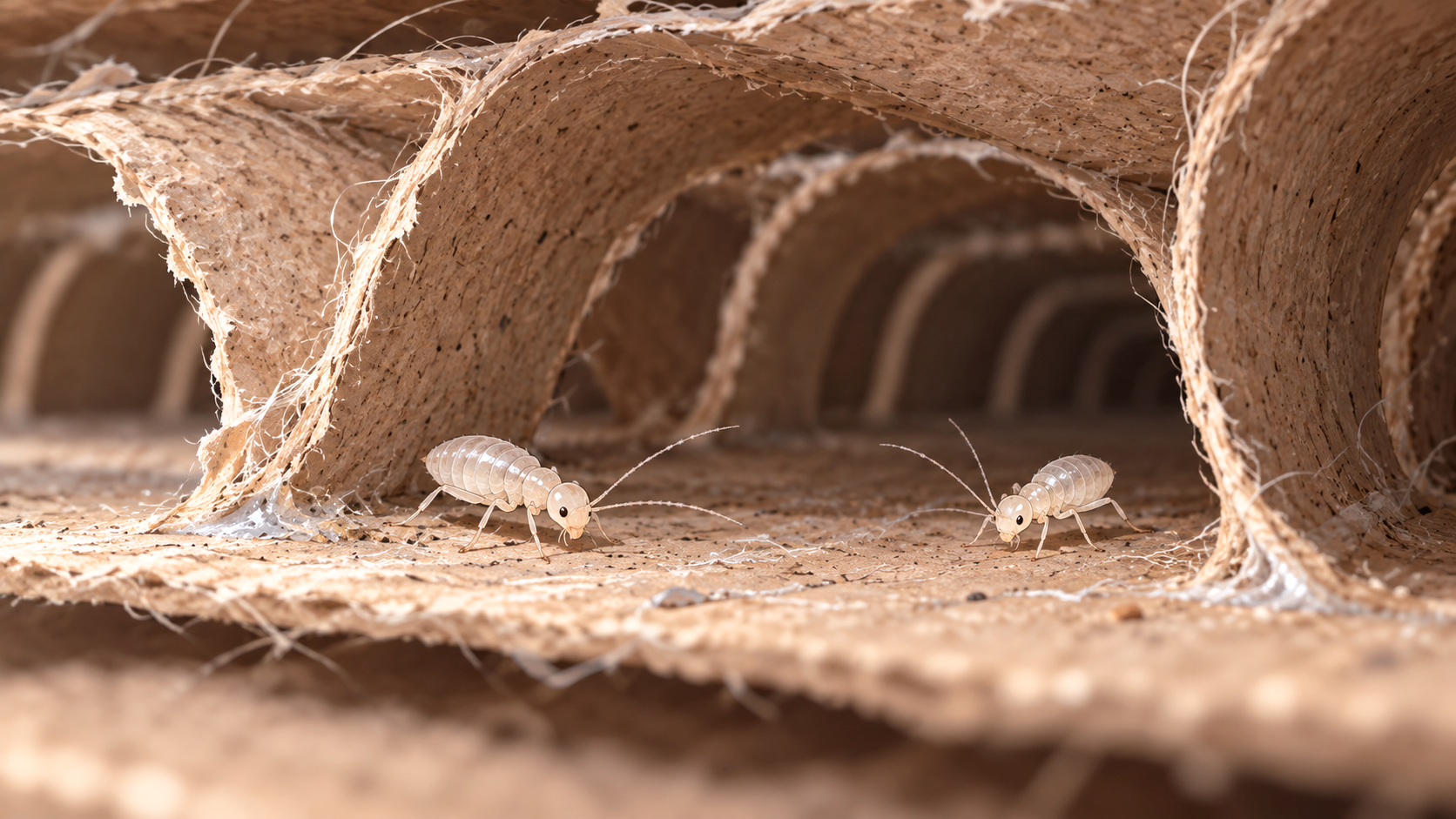
Booklice can live inside cardboard boxes, especially when the cardboard has absorbed moisture or is stored somewhere humid. The folds, seams, corrugated channels, and contents provide shelter, while damp cardboard can support microscopic fungi that booklice eat. A clean, dry box is far less suitable than one kept in a humid basement, garage, storage room, or warehouse.
Corrugated Cardboard Gives Booklice Plenty of Concealed Space
A cardboard box contains more hiding space than its flat exterior suggests. Corrugated board has internal channels, folded flaps, glued seams, overlapping edges, and narrow gaps where a 1-to-2-millimeter insect can disappear. Utah State specifically lists cardboard boxes among places where booklice can occur, along with cracks, voids, damp books, and other environments capable of supporting mold.
Those enclosed spaces also make infestations easy to miss. Adults can remain between layers or beneath flaps, while tiny booklice eggs may be hidden on protected surfaces. Opening a box and seeing nothing on top does not prove that insects are absent from the seams or contents.
Cardboard has even been deliberately used as a refuge for sampling stored-product psocids. USDA research found that cardboard refuges successfully collected Liposcelis psocids in stored wheat, demonstrating how readily these insects use narrow corrugated shelter.
Dry Cardboard and Damp Cardboard Are Very Different Habitats
Cardboard by itself does not make a box attractive enough to sustain booklice indefinitely. Moisture changes its value dramatically. Minnesota specifically notes that household psocids can become a problem when stored cardboard gets wet.
Cardboard is hygroscopic, so it can absorb water vapor from humid air as well as liquid moisture from damp floors, leaking walls, floods, or condensation. Once it remains moist, microscopic fungal growth can develop on the fibers, dust, adhesive, or material stored inside. Booklice can then exploit both the humid microclimate and the new food supply.
Their strong dependence on environmental humidity explains why an identical box can remain trouble-free in a dry closet but support a population after months on a basement floor. The cardboard has not suddenly become their preferred food; the conditions surrounding it have changed.
Mold Can Grow Before the Box Looks Moldy
A box does not need visible fuzzy patches before it can provide fungal food. Booklice consume mold spores and microscopic fungal material, so early growth may already be usable long before a person would describe the cardboard as moldy. Utah State lists mold spores as a primary psocid food.
The established relationship between booklice and mold is especially relevant to cardboard because the material readily holds moisture and organic debris. A musty smell, softening fibers, water staining, or prolonged storage against a damp surface can all indicate that a box has experienced conditions capable of supporting microbial growth even if obvious mold is absent.
A dry-looking exterior can also conceal a wetter underside. Boxes placed directly on concrete, basement flooring, or against exterior walls can absorb moisture at the contact points while the upper panels remain apparently normal.
The Contents Can Be More Important Than the Box
Sometimes the booklice are associated less with the cardboard shell than with what has been packed inside it. Old books, papers, cereal products, flour, pet food, photographs, documents, fabrics contaminated with organic debris, or other stored materials can introduce additional food and protected spaces.
Stored-product psocids in the genus Liposcelis are recognized pests of grain and food-storage environments. USDA identifies numerous species that infest stored grain and processing facilities, so a cardboard carton containing susceptible dry foods can hold insects both in the packaging and among the contents.
The broader foods booklice can consume include fungi, grains, starches, and insect fragments. Finding booklice inside a moving box full of books therefore suggests a different source than finding them in a carton of cereal products, even though the cardboard provides shelter in both cases.
Cardboard Boxes Can Transport Booklice to Another Room or Building
Boxes can function as vehicles as well as habitats. Warehouses, garages, basements, storage units, delivery vehicles, and moving facilities can expose cardboard to humid environments before it reaches its final destination. Booklice hidden in folds or among packed materials may travel unnoticed.
This is one ordinary route by which booklice can get into a house. Transport does not require a large visible infestation. A few adults, nymphs, or eggs can be moved inside with the box, after which their success depends on the environment they encounter.
Moving infested boxes can also help explain booklice spreading between rooms. Carrying a carton from a damp basement into a bedroom can relocate insects instantly, whereas leaving the same insects to crawl the entire distance would take much longer.
A Box Can Hold Booklice Without the Whole Room Being Infested
Finding insects in one cardboard box does not automatically mean every object in the room contains them. A box that became wet, arrived already infested, or contains susceptible food may create a small self-contained hotspot while nearby dry materials remain unaffected.
Inspect the pattern before assuming a room-wide problem. Booklice concentrated inside one carton and absent from adjacent surfaces point toward the box or its contents. Repeated insects across shelving, walls, other containers, and multiple life stages fit the broader signs of an established booklice infestation more closely.
The distinction becomes useful in storage areas containing dozens of boxes. One water-damaged carton touching a damp wall can have very different conditions from boxes stacked higher on dry shelving.
Plastic Storage Bins Remove the Cardboard Refuge but Not the Moisture Problem
Replacing vulnerable cardboard with sound plastic containers can remove absorbent fibers, folds, and corrugations that booklice use. Sealed containers can also make it harder for insects to move between stored belongings. The benefit is greatest when dry items are placed into dry containers.
Putting damp papers, books, or other materials into an airtight plastic tote can trap moisture instead. Mold can continue developing inside, preserving the same environmental conditions that supported booklice in the first place. EPA guidance recommends controlling indoor mold by controlling moisture rather than merely enclosing affected material.
For long-term storage, keeping boxes and papers off damp floors is also useful. Minnesota recommends storing boxes, bags, books, and papers above the floor to reduce their exposure to moisture.
Questions About Booklice in Cardboard
Do booklice eat the cardboard itself?
Cardboard is not generally their main food. They are more strongly associated with mold, fungal spores, starches, adhesives, and organic debris on or around the material.
Can booklice lay eggs inside a cardboard box?
Yes. A suitable humid box can provide protected places for reproduction, including seams, folds, corrugations, and material stored inside.
Should you throw away a cardboard box with booklice in it?
For an ordinary disposable box, discarding a damp or heavily infested carton can remove a useful harborage. Valuable contents should be inspected separately rather than automatically discarded with the box.
Can new delivery boxes have booklice?
They can, because cardboard passes through warehouses, vehicles, and storage areas before delivery. A single insect on a new box does not prove the home already contains an infestation.
Can booklice survive in an empty cardboard box?
They can persist if humidity remains favorable and microscopic fungi or other organic material is available. A perfectly clean, dry box is much less capable of sustaining them.
Why are booklice under the bottom of my boxes?
The underside may be the dampest part, especially when a carton sits directly on concrete, basement flooring, or against a cool wall. That protected contact area can also accumulate fungal growth and remain undisturbed.
Will drying the boxes get rid of booklice?
Sustained drying makes cardboard much less suitable by reducing both available moisture and fungal growth. If insects remain elsewhere in the room, the broader approach to getting rid of booklice still depends on finding and correcting the humid habitats supporting them.