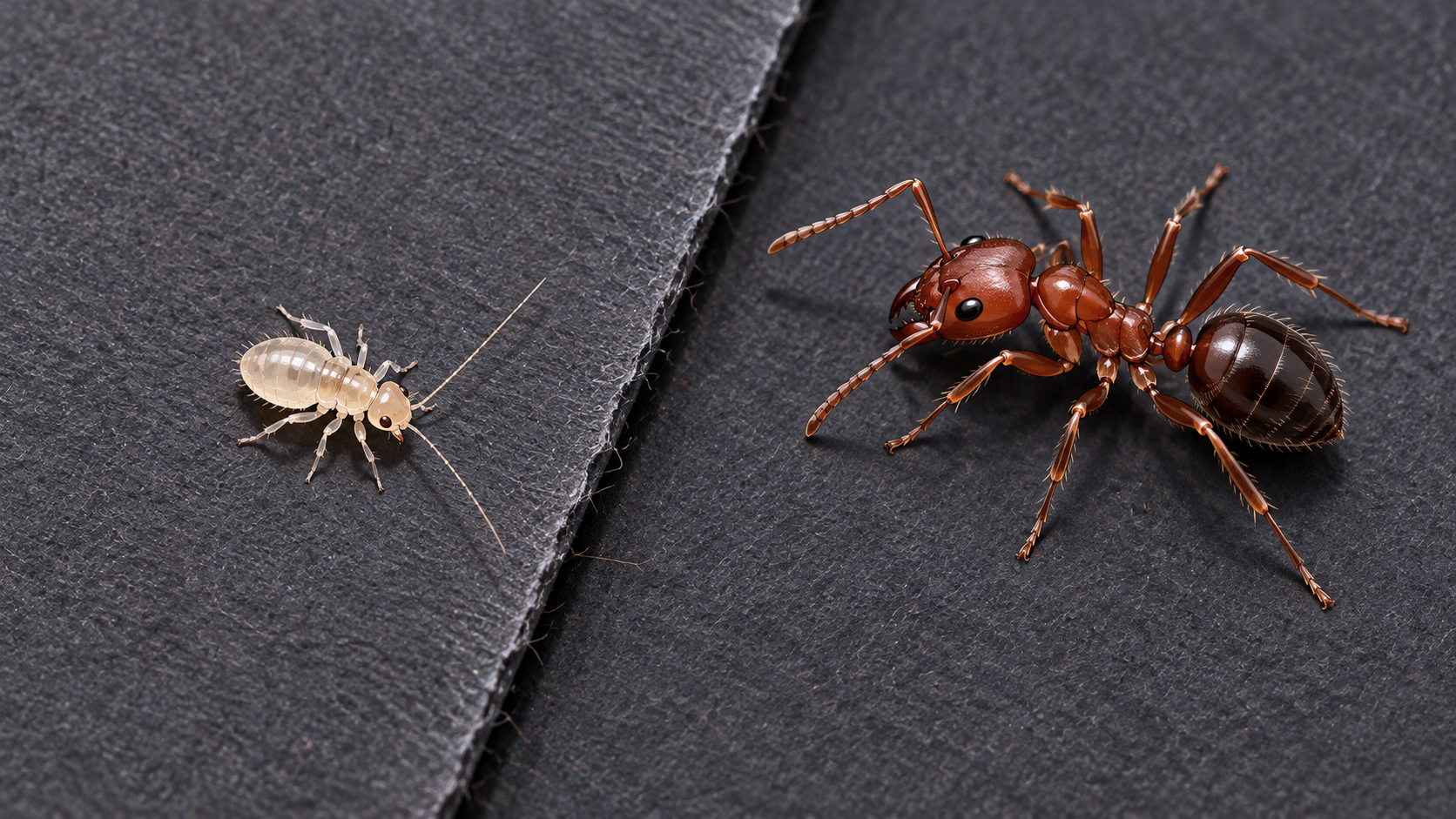
Booklice and ants are both small enough to appear as moving specks, especially when the ant species is tiny. Ants have elbowed antennae and a narrow waist between the thorax and abdomen. Booklice have long, threadlike antennae, no pinched waist, and a proportionally broad head. Those structural differences are more dependable than color or room location.
The Waist Is the Best Feature to Check First
Ants have a visibly constricted connection between the thorax and abdomen. This narrow section, called the petiole, contains one or two nodes depending on the species. Household ant identification guidance consistently uses the combination of a pinched waist and elbowed antennae as two of the most useful features for recognizing an ant.
Booklice lack that ant-like waist. Their small bodies taper more gradually, and the usual shape of a booklouse is dominated by a relatively broad head and slender antennae rather than a separated thorax and bulbous abdomen. Under magnification, the two silhouettes are markedly different even when the insects are similar in length.
A photograph taken directly from above is especially useful because the petiole can disappear visually when an ant is photographed from a poor angle. If the insect clearly has one or two narrow nodes between the middle and rear sections of the body, booklice can be ruled out.
Their Antennae Bend Differently
Ant antennae have a distinct bend. The long first segment extends from the head before the remaining segments change direction, producing the familiar elbowed shape. Penn State likewise uses elbowed antennae as a defining ant characteristic.
Booklice have much finer antennae that extend outward without the pronounced ant-style elbow. Their antennae can also look disproportionately long beside their tiny bodies. Canadian stored-product guidance describes psocids as soft-bodied insects with very long, threadlike antennae.
This feature becomes particularly useful with very small yellow or pale ants. Species such as thief ants and pharaoh ants can be tiny enough to overlap the apparent size of larger booklice. Color and size may therefore be inconclusive, while the antennae and waist still separate the two groups.
Tiny Ants Can Overlap the Size of Booklice
Common indoor booklice are often around 1 to 2 millimeters long, although exact size varies by species. Their small scale is why booklice can be difficult to recognize without magnification.
Some household ants are not much larger. Thief ant workers may measure about 1/20 inch, or roughly 1.3 millimeters, while pharaoh ant workers are about 1/16 inch, or roughly 1.6 millimeters. Minnesota’s ant guide documents both among the smallest common household species and notes that worker ants can range from about 1/20 inch to 1/2 inch.
A tiny yellow insect should therefore not be classified as booklice simply because it seems too small to be an ant. At this scale, a hand lens or macro photograph showing the petiole and antennae carries more identification value than a rough size estimate.
A Trail Across the Counter Favors Ants
Ant workers are social insects that forage for a colony. When one discovers a usable food source, other workers may follow chemical trails between that resource and the nest. Several ants moving repeatedly along the same route, particularly toward food, wall gaps, baseboards, or a structural opening, fit ant behavior well.
Booklice do not form organized foraging trails. They can certainly appear in large numbers, but their distribution usually follows a suitable microhabitat rather than a colony trail. Numerous booklice scattered across a damp cardboard box, humid cupboard, or condensation-prone wall may be concentrated in one area because that surface provides moisture and fungal food.
One or two insects do not provide enough behavior to use this clue confidently. When dozens are visible, however, an orderly line of workers traveling the same route looks very different from the more dispersed signs associated with a booklice infestation.
The Same Kitchen Can Attract Them for Completely Different Reasons
Ants enter kitchens for food and water. Depending on the species, they may prefer sugary substances, fats, proteins, dead insects, or other household foods. Different species also nest in soil, wall voids, rotting wood, under slabs, behind cabinets, or in other protected locations. Their colony biology means food found inside the kitchen may simply be drawing workers from a nest elsewhere.
Booklice are tied much more strongly to dampness and microscopic fungal growth. Indoor psocids commonly occupy warm, humid places around wet cardboard, stored food, leaking pipes, cupboards, cracks, and other areas capable of supporting mold. Utah State describes booklice as moisture-associated nuisance insects that feed heavily on mold spores.
Their normal diet includes fungi, mold, grains, and suitable organic material, so finding them in a pantry does not carry the same meaning as ants converging on spilled syrup or grease. Two pests can therefore occupy the same cupboard while responding to entirely different resources.
Moisture Can Create an Overlap That Makes Location Misleading
A damp bathroom, basement, kitchen, or window area can produce sightings of both ants and booklice. Certain ant species seek water or nest near moisture, while booklice depend heavily on humid conditions. The room alone cannot settle the identification.
Booklice are particularly sensitive to drying. Minnesota guidance notes that psocids do not survive when relative humidity remains below roughly 45% to 50%, and Canadian conservation material likewise treats booklice as a warning sign of damp conditions. The underlying humidity dependence of booklice makes persistent populations much more closely tied to moisture than ordinary indoor ant traffic.
Seeing ants near a leaking sink does not mean moisture created the colony, however. They may simply be foraging there for water while nesting elsewhere. The insect’s anatomy should decide the identification before its location is interpreted.
Their Young Look Completely Different
Booklice undergo incomplete metamorphosis. Their eggs hatch into nymphs that already resemble smaller, paler versions of adults. The booklice life cycle contains no larval or pupal stage.
Ants undergo complete metamorphosis. Eggs develop into soft, legless larvae, then pupae, before becoming adult workers, queens, or males. The immature stages remain inside the nest and do not normally forage across countertops alongside workers.
A tiny pale insect independently crawling across a wall is therefore not an ant larva. If it already has six legs, long antennae, and the general appearance of a miniature adult, booklice become much more plausible.
Questions About Ants and Booklice
Can booklice march in a line like ants?
Not in the organized colony-foraging pattern typical of ants. Booklice may gather densely where conditions are favorable, but they do not use ant-style recruitment trails between food and a nest.
Can ants be as pale as booklice?
Yes. Some household ants are yellow or light brown, so pale color does not rule out ants. The pinched waist and elbowed antennae remain more reliable.
Do booklice have queens like ants?
No. Booklice do not live in eusocial colonies organized around queens and workers. Their reproduction and population structure are fundamentally different from ant colonies.
Can both pests be found inside cardboard boxes?
Yes. Ants may forage through or occasionally nest around stored materials, while damp cardboard can provide favorable conditions for booklice and fungal growth. The fact that both are inside a box does not make them biologically related.
What should you photograph if the insect is too small to identify?
Get the sharpest possible image from directly above and from the side. Focus on the antennae, the connection between the thorax and abdomen, and the head. A pinched waist with elbowed antennae indicates an ant, while long threadlike antennae and no petiole support booklice. If neither fits, compare the specimen with other household insects that resemble booklice.