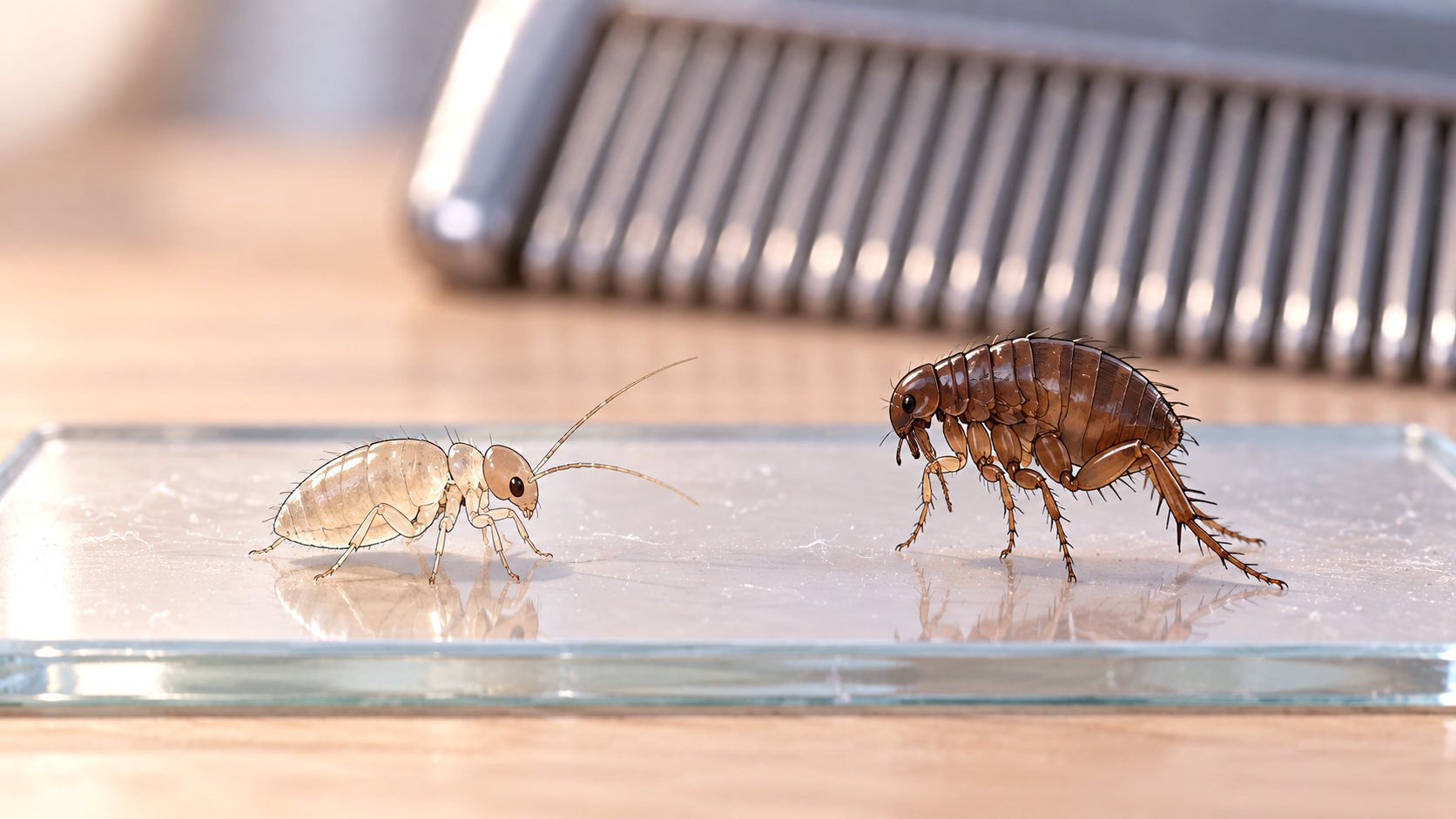
Booklice and fleas are both tiny enough to look like dark or pale specks, but their bodies and behavior are very different. Booklice have long antennae, a broad head, and a soft body built for crawling. Fleas are laterally flattened blood-feeders with powerful hind legs built for jumping.
Jumping Is the Fastest Way to Separate Them
A flea can leap repeatedly when disturbed. Its enlarged hind legs are specialized for that movement, and adult fleas can travel quickly between hosts and surrounding surfaces. CDC guidance on flea biology and transmission describes fleas as blood-feeding insects adapted for jumping between animals and their environment.
Booklice do not have that jumping machinery. Common indoor psocids crawl across paper, walls, cupboards, cardboard, and other surfaces. If a tiny insect repeatedly springs away when you approach it, a flea becomes more plausible than booklice, although springtails also deserve consideration. The separate comparison between springtails and fleas is useful because both of those pests can jump, unlike ordinary household booklice.
Movement should still be combined with appearance. A dead or injured flea cannot demonstrate its normal jumping behavior, while a booklouse hidden in a crack may move too little to be useful diagnostically.
Their Body Shapes Point in Opposite Directions
Booklice are delicate insects with long, threadlike antennae and a head that appears large relative to the thorax. Their typical household appearance is easier to recognize under magnification because many are only around 1 to 2 millimeters long.
Fleas are compressed from side to side rather than flattened from top to bottom. Their narrow profile helps them move through animal fur, and their legs appear much heavier than those of booklice. Merck Veterinary Manual describes fleas as laterally compressed, wingless insects with powerful legs, which creates a compact, armored silhouette unlike the softer build of a psocid.
A close side view is especially useful. A flea can look extremely narrow from above because of its lateral compression, while a booklouse retains the more conventional flattened insect form. The exaggerated hind legs on a flea are another strong clue that does not fit booklice.
Similar Size Does Not Mean Similar Biology
Common indoor booklice are often about 1 to 2 millimeters long. Adult cat fleas are also small, generally a few millimeters long, so size alone can create confusion when an insect is photographed without a scale.
The overlap ends quickly once feeding behavior is considered. Fleas are external parasites that take blood meals from mammals and birds. CDC information on flea bites and flea-borne disease reflects that parasitic relationship. Booklice do not feed on blood. Their normal foods include microscopic fungi, mold spores, grains, insect fragments, and other suitable organic material, which explains the very different environments described in what booklice eat.
That feeding difference also changes what repeated sightings mean. Fleas around a pet, bedding, rugs, or upholstered furniture point toward an animal-associated life cycle. Booklice clustering around damp cardboard, mold-prone shelving, stored foods, or condensation point toward moisture and fungal growth instead.
Bites Strongly Favor Fleas, but Skin Marks Alone Are Not Identification
Booklice are not normal biting parasites. Penn State describes booklice as non-biting household insects that do not transmit disease. Their presence near a bed, sofa, or pet does not make them a plausible explanation for recurring blood-feeding bites.
Fleas do bite people. The marks often develop around ankles or lower legs because fleas commonly emerge from floors, rugs, pet bedding, or furniture and reach the nearest exposed skin. They can also bite elsewhere. A history of pets scratching, visible fleas, or repeated jumping insects provides stronger evidence than the bite pattern alone.
Skin marks should not replace insect identification. Mosquitoes, bed bugs, mites, and other causes can produce overlapping reactions, and some people respond more strongly than others. If the insect itself has already been captured, its anatomy will settle the booklice-versus-flea question far more reliably than the appearance of a welt.
Pet Activity Changes the Odds Considerably
Fleas are strongly associated with animal hosts. Dogs, cats, wildlife, and other mammals can support adult fleas, while eggs, larvae, and pupae develop in the surrounding environment rather than remaining permanently on the animal. CAPC notes that adult cat fleas live on hosts while immature stages develop in the environment, which is why an infestation can persist in pet bedding, carpets, and floor cracks.
Booklice have no comparable host relationship. They may accidentally crawl onto people or pets, but they do not live in fur, drink blood, or use animals as their normal habitat. The biological difference between booklice and true parasitic lice also helps explain why the word “lice” in their name causes unnecessary confusion.
A tiny insect repeatedly found on a dog or cat should therefore be examined carefully for flea characteristics. A tiny insect concentrated on damp walls or stored materials points in a different direction.
The Immature Stages Look Nothing Alike
Booklice develop through nymphal stages. Young booklice already resemble small adults, with six legs, antennae, and the same basic body plan. The appearance of baby booklice therefore remains recognizably insect-like even at an early age.
Fleas undergo complete metamorphosis. Their larvae are small, pale, legless, wormlike organisms that live in the environment and feed on organic debris, including material associated with adult flea feces. CDC describes the flea life cycle as egg, larva, pupa, and adult. A wormlike immature insect is therefore not a booklouse nymph.
This difference can be especially useful when investigating carpets, pet bedding, or floor cracks. A moving larva without legs does not fit the booklice life cycle, while tiny crawling nymphs with visible antennae do.
What You Find Around the Insect Usually Supports the Identification
Booklice infestations often track persistent humidity. Indoor psocids thrive where dampness supports microscopic fungal growth, so repeated activity around leaks, condensation, wet cardboard, humid cupboards, or recently damp construction material fits the usual signs of booklice.
Flea evidence follows animals and resting areas instead. You may find adult fleas, flea dirt, eggs, larvae, or increased pet scratching around bedding and carpets. The flea life cycle can continue away from the host, so seeing few insects on the pet does not necessarily mean the environment is clear.
The room itself is not enough to decide. A humid bedroom with a pet could support both pests for unrelated reasons. The specimen’s body shape and movement remain more useful than location alone.
Questions About Fleas and Booklice
Can booklice jump like fleas?
No. Common household booklice crawl. Repeated jumping strongly favors fleas or another jumping arthropod such as a springtail.
Can fleas be white like some booklice?
Adult fleas are usually brown to reddish-brown rather than pale or translucent. Their immature larvae are pale, but those larvae are wormlike and legless, not miniature fleas.
Can booklice live on cats or dogs?
No. A booklouse may accidentally crawl onto fur, but pets are not their normal hosts. Fleas are adapted to live on animals and feed on blood.
Can both pests be found in carpet?
Yes, but for different reasons. Fleas may develop in carpet because immature stages occupy the surrounding environment. Booklice may wander through carpet if the room is humid, but they do not depend on carpet fibres as a blood-feeding or host habitat.
Which clue is most reliable if the insect is too small to identify by eye?
Use a sharp close-up or hand lens and look for the hind legs and body compression. Large jumping legs and a laterally flattened body support a flea, while long antennae and a broad-headed, delicate body support booklice.