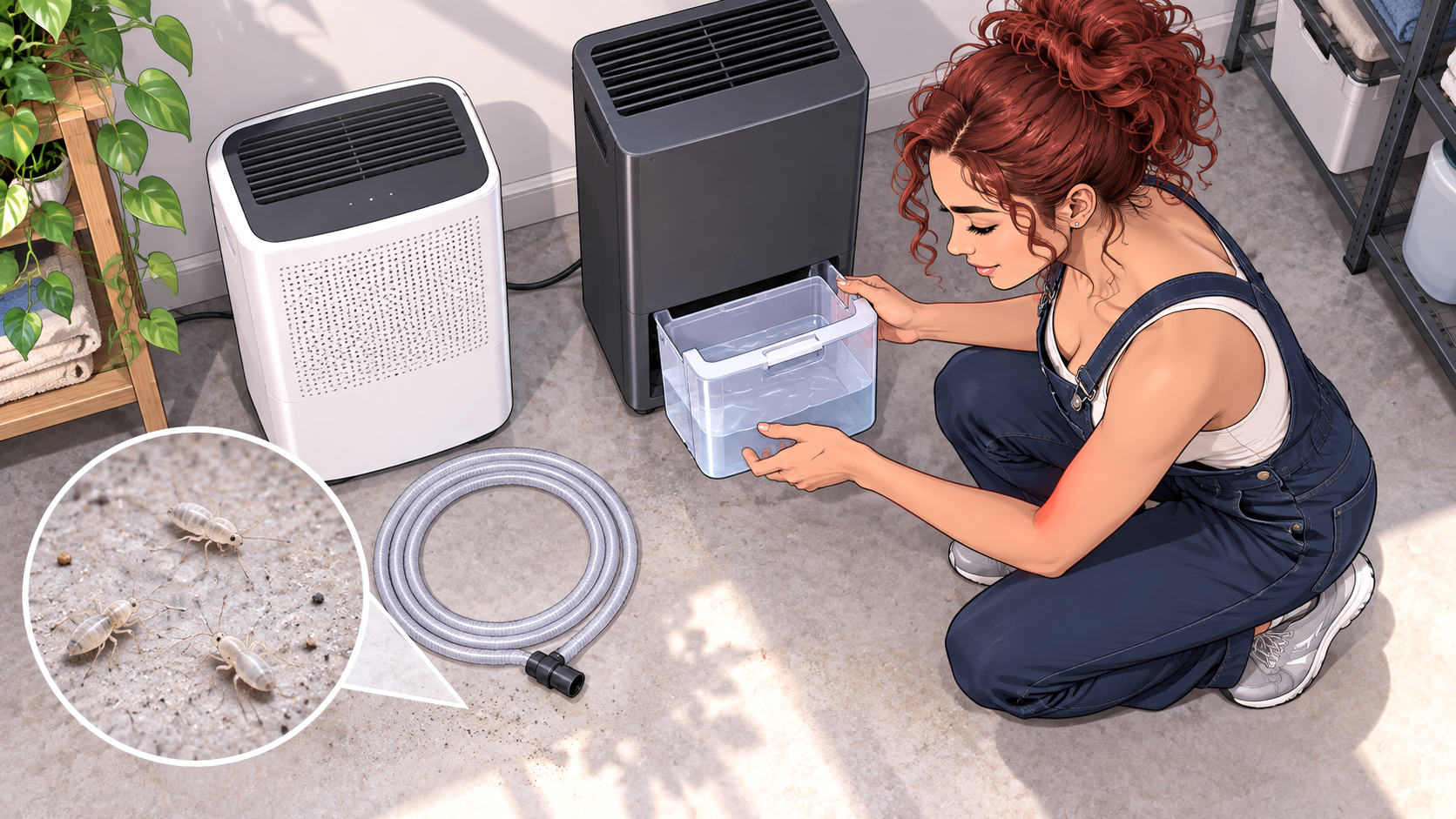
The best dehumidifier for booklice is one that can hold the affected space near 45% to 50% relative humidity continuously, not simply produce the lowest humidity reading for a few hours. For most damp basements and larger rooms, a current 50-pint compressor model is the strongest choice. Smaller rooms with moderate humidity can often use a 20- to 35-pint unit instead.
Best Overall: Midea Cube 50-Pint Dehumidifier
The Midea Cube 50-Pint MAD50S1QWT is the strongest all-around choice for a substantial booklice problem because it combines high moisture-removal capacity with unusually flexible water handling. The current model is rated at 50 pints per day, offers smart humidity control, uses a large removable reservoir, and can be configured for continuous gravity drainage. Its lift-and-twist design also allows the compressor section to sit above its large tank when extended or nest inside it for storage. The Midea Cube 50-Pint specifications make it particularly well suited to basements, storage areas, large bedrooms, libraries, and other spaces where the machine may need to run for long periods.
For booklice, the large tank is more important than it initially appears. A dehumidifier stops removing moisture when its bucket fills unless it has been connected to a drain. Longer unattended operation makes it easier to maintain the sustained dry conditions that booklice require to eventually die out. The Cube is also ENERGY STAR certified, which matters when a machine may need to operate continuously for days or weeks rather than only during occasional humid afternoons.
The main reason to skip this model is size of the problem rather than performance. A 50-pint unit is unnecessary for a small dry bedroom containing two wandering booklice, while a wet basement or repeatedly humid storage room can justify its additional capacity.
Best for Automatic Drainage: Midea Cube 50-Pint With Built-In Pump
Where there is no floor drain below the dehumidifier, the Midea MAD50PS1QWT with built-in pump is the more useful version of the Cube. It retains the 50-pint daily rating and smart controls but adds a pump capable of moving collected water to a higher drain point rather than relying entirely on gravity. The built-in-pump Cube is designed for continuous pumped drainage, which is particularly valuable in basements where the available sink or drain sits above floor level.
Continuous drainage can materially improve booklice control because humidity needs to remain low after everyone goes to bed, leaves for work, or stops checking the appliance. A machine whose bucket fills overnight may spend several hours switched off while humidity rises again. Booklice do not require the entire house to be damp; a persistent humid pocket can preserve the population even after other areas dry. The broader locations where booklice hide and reproduce include cracks, stored materials, wall cavities, and other spaces that respond best to steady rather than intermittent moisture removal.
Choose the pump version when drainage convenience determines whether the unit can operate continuously. If a gravity drain is already available, paying extra for a pump provides little benefit.
Best Straightforward 50-Pint Option: Frigidaire FHDD5033Y1
The Frigidaire FHDD5033Y1 is a conventional upright 50-pint model and a good alternative for someone who prefers a familiar bucket-style dehumidifier rather than the Cube format. The current model combines a 50-pint capacity with caster wheels, electronic humidity controls, a washable filter, and continuous drainage capability. Frigidaire currently lists the FHDD5033Y1 as a 50-pint model in its dehumidifier range.
Its strongest use case is a medium-to-large room where there is enough humidity load to justify 50-pint capacity but no need for a built-in pump. Continuous gravity drainage is preferable if the machine will be running for extended periods. If a hose cannot be used, check the bucket frequently during the first several days because a severely damp room can fill it much faster than expected.
A dehumidifier does not need special “pest control” technology to work against booklice. It needs sufficient extraction capacity, an accurate humidistat, and enough uninterrupted runtime to move the room into an unfavorable humidity range. The relationship between sustained drying and how long booklice take to disappear is more important than extra air-purification or fragrance features.
Best for Smaller Rooms: Midea Cube 20-Pint
A 50-pint unit is not automatically the best purchase for every infestation. A 20-pint Midea Cube makes more sense in a smaller bedroom, office, book room, closet-adjacent space, or modest storage room where humidity is elevated but there is no significant seepage or standing moisture. ENERGY STAR sizing guidance places roughly 20 to 30 pints per day in the appropriate range for many small-to-medium spaces that feel slightly or moderately damp, while very wet rooms require substantially more capacity. The current ENERGY STAR dehumidifier sizing ranges are more useful than manufacturer square-foot claims alone because they consider the severity of the moisture load.
A smaller compressor dehumidifier can also be easier to place close to shelving, furniture, or the part of a room where booklice are appearing. Do not put it inside a closed wardrobe or other restricted enclosure unless the manufacturer specifically permits that setup. Dehumidifiers need adequate airflow around their intake and exhaust to remove moisture efficiently.
Small thermoelectric desktop dehumidifiers are a different category. They may collect some condensation in a tiny enclosure, but they should not be substituted for a properly rated compressor unit when booklice are reproducing throughout an actual room.
20, 35, or 50 Pints: Choose by Moisture Load, Not the Number of Booklice
The number of insects on a wall does not tell you which dehumidifier capacity to buy. Room area and moisture load do. A 500-square-foot basement with seepage may require more capacity than a 1,000-square-foot upstairs room that is only mildly humid.
Current ENERGY STAR guidance recommends roughly 20 to 30 pints per day for a small-to-medium space that is slightly or moderately damp, 25 to 40 pints for a very damp space, and 30 to 50 pints when a small-to-medium room is wet enough for surfaces to sweat or seepage to occur. Larger rooms move toward the upper end of those ranges. Modern pint ratings also use newer Department of Energy test conditions, so an old “70-pint” machine can correspond roughly to a current 40- to 45-pint unit. The change in dehumidifier capacity testing is worth knowing when replacing an older appliance.
Booklice themselves do not require a special capacity calculation. Their dependence on atmospheric moisture means the correct machine is simply the one capable of keeping their actual habitat consistently dry.
Continuous Drainage Is More Valuable Than Wi-Fi
Smart controls are convenient, but continuous drainage usually has more practical value for booklice. A full bucket causes most portable dehumidifiers to shut down automatically. If that happens every night, the room can repeatedly return to a higher humidity level before someone empties it.
A gravity-drain hose is ideal when the unit can sit above a suitable drain. A built-in pump is useful when water must travel upward to a sink, window, or elevated drain. A large bucket is the next-best option when neither is available. Wi-Fi monitoring can still help by showing whether humidity is drifting upward, but app control cannot compensate for a machine sitting idle with a full tank.
The same principle explains why a dehumidifier can get rid of booklice only when drying is sustained. Intermittent operation can improve comfort without fully changing the microclimate that supports the insects.
An Adjustable Humidistat Should Reach About 45% to 50%
For booklice control, avoid a machine that only offers vague settings such as low, medium, and high. A numerical humidistat allows the unit to cycle around a target rather than operating blindly. Household booklice generally become difficult to sustain once humidity remains around the high-40s or lower, although species and microclimates vary.
EPA indoor-moisture guidance recommends keeping relative humidity below 60% and ideally around 30% to 50% to limit mold and other moisture-related problems. The 30% to 50% indoor humidity range is also compatible with the range normally used to make household environments unfavorable to booklice.
There is no need to aim for extraordinarily dry air. Setting a powerful machine to 30% simply because it can reach that number may increase energy use and produce unnecessarily dry indoor conditions. Around 45% to 50% is a sensible starting target for booklice, followed by actual monitoring of the affected area.
Use a Separate Hygrometer to Check the Machine
Built-in humidistats are useful for automatic operation, but the sensor sits inside or immediately beside the dehumidifier. It may not represent the humidity behind a bookshelf, beside an exterior wall, or across the opposite side of a large basement. A separate digital hygrometer placed near the infestation provides a second measurement.
If the dehumidifier reports 45% while a hygrometer beside the affected shelves remains at 60%, airflow or machine placement may be limiting performance. The same issue occurs when furniture or boxes isolate damp pockets from the room’s circulating air.
Repeated booklice after room humidity has fallen can also point toward concealed water. Their distribution around a home can reveal localized infestation sites that are not represented by a sensor several meters away.
Low-Temperature Operation Matters in Basements
Compressor dehumidifiers become less effective as room temperature drops, and frost can form on their coils. Automatic defrost is therefore useful in cool basements, garages, and storage rooms. Frigidaire specifies low-temperature operation down to approximately 41°F on some of its current 50-pint models, while Midea’s Cube line includes automatic defrost control.
Do not choose a basement unit using capacity alone if the space becomes consistently cold. A machine that performs well in a warm bedroom may cycle frequently through defrost in a colder basement and remove less moisture than expected.
Booklice can still occupy protected humid areas in cool spaces, so persistent activity after dehumidification can justify checking both temperature and concealed moisture rather than automatically buying a larger machine.
Energy Efficiency Matters When the Unit Runs for Weeks
Eliminating a booklice population is rarely a one-afternoon task. A dehumidifier may run heavily during the initial drying period and then cycle regularly to maintain the target humidity. ENERGY STAR certification therefore has practical value because energy use accumulates quickly when a compressor operates for long periods.
The Midea Cube models discussed above and several current Frigidaire units carry ENERGY STAR certification. The certification does not make one model a better booklice killer than another with the same effective capacity; it indicates that the machine meets energy-efficiency requirements while performing its dehumidification job.
Drying the room can also reduce the fungal growth associated with booklice. EPA recommends fixing water sources and maintaining low indoor humidity rather than trying to manage mold solely through surface cleaning, which aligns with the environmental conditions needed for long-term booklice control.
Skip Tiny USB and Thermoelectric Units for Room-Wide Infestations
Very small dehumidifiers are attractive because they are inexpensive, quiet, and compact, but their moisture-removal capacity can be tiny compared with compressor models rated in pints per day. They may be suitable for a small cabinet or similarly confined application, yet they are poor substitutes for a 20-, 35-, or 50-pint appliance in a humid bedroom or basement.
A booklice infestation that persists across walls, shelving, stored cardboard, or multiple pieces of furniture usually indicates a room-scale moisture issue or a concentrated water source. Buying several miniature units instead of one correctly sized compressor dehumidifier often adds complexity without enough water-removal capacity.
The natural methods that actually help control booklice depend on substantial moisture reduction rather than the presence of a device marketed as compact or silent.
Do Not Buy a Bigger Dehumidifier to Compensate for an Active Leak
A 50-pint machine can remove a substantial amount of water vapor, but it cannot repair a pipe, stop groundwater seepage, waterproof a wall, or prevent rain from entering a roof. EPA moisture guidance prioritizes repairing leaks and drying wet materials promptly, with dehumidification serving as part of moisture management rather than a substitute for repairs.
If booklice remain concentrated around one wall, cabinet, window, or plumbing penetration after the room has reached 45% to 50% RH, investigate that location. Purchasing a second dehumidifier may lower the open-air humidity further while leaving the saturated material that supports the insects untouched.
The broader process for eliminating booklice still starts with identifying what is supplying moisture. The dehumidifier is most effective once that distinction has been made.
Which Dehumidifier Should You Buy for Booklice?
For a large or very damp space, the Midea Cube 50-Pint is the strongest overall choice because its high capacity, oversized reservoir, smart controls, and drainage flexibility make sustained operation straightforward. Choose the Midea Cube 50-Pint with pump when condensate must be lifted to an elevated drain.
For a conventional 50-pint upright unit, the Frigidaire FHDD5033Y1 offers the capacity and continuous-drain capability needed for many basements and larger rooms without requiring the Cube format.
For a smaller room with moderate humidity, a 20- to 35-pint ENERGY STAR compressor dehumidifier is usually more appropriate. Capacity should rise with actual dampness rather than simply because booklice are present.
Whichever unit you choose, verify humidity independently, keep it near 45% to 50% throughout the affected space, use continuous drainage where possible, and investigate any area that remains damp despite the room reading. Those features determine whether a dehumidifier changes the habitat enough to stop booklice reproduction.