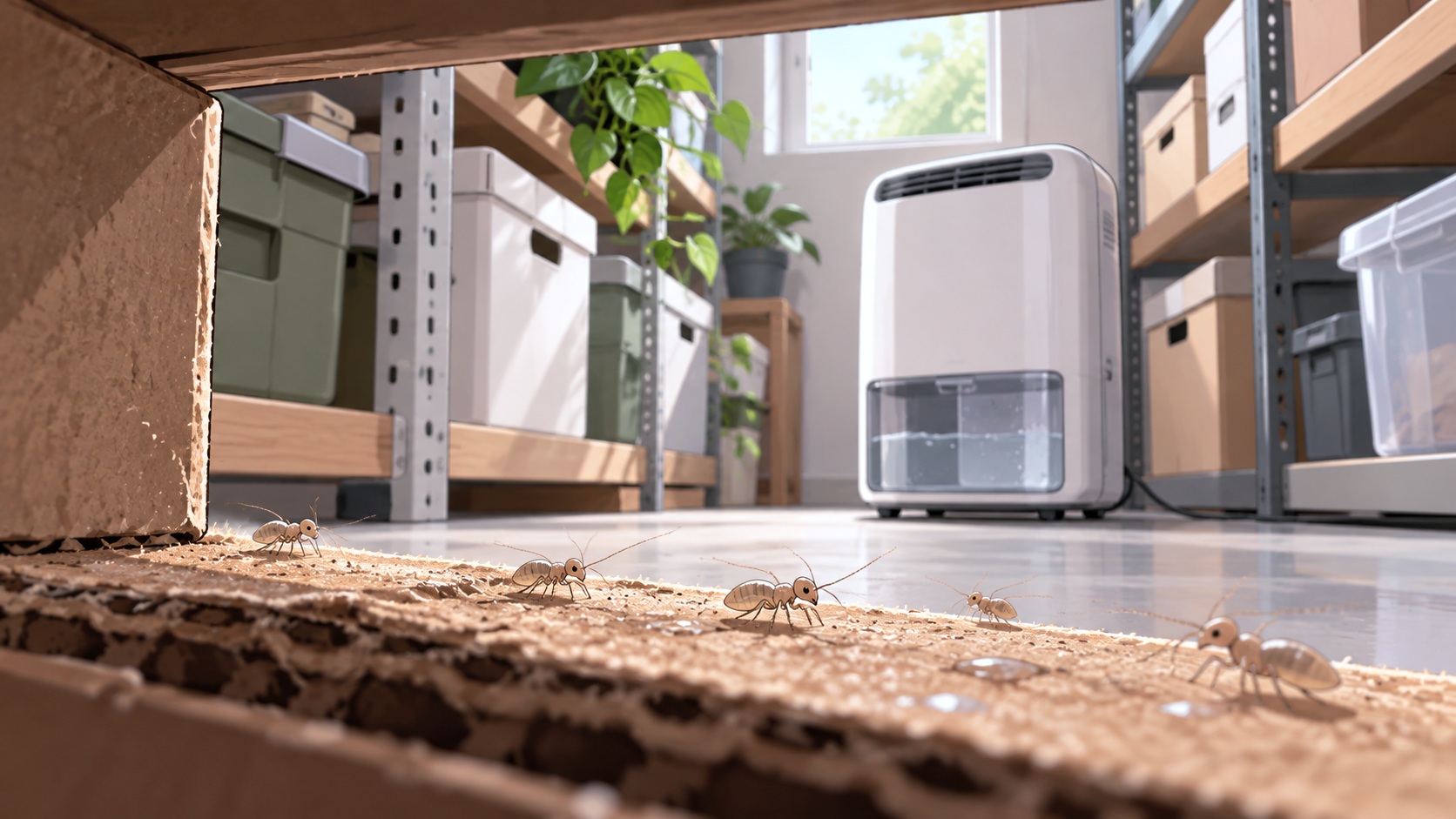
A dehumidifier can get rid of booklice when high indoor humidity is the condition supporting the infestation. It does not poison or trap them. Instead, sustained dehumidification removes atmospheric moisture they need to survive and reproduce while also making the environment less favorable for the fungi they commonly eat. It will not fix a leak, wet wall, or other localized source that stays damp.
Dehumidification Can Kill Every Life Stage Under Sufficiently Dry Conditions
Booklice are unusually dependent on atmospheric moisture, and controlled research has measured what happens when several Liposcelis species are kept at low relative humidity. In experiments at 43% and 50% RH, all adults of four species died within 8 to 12 days, depending on species and humidity. When eggs, nymphs, and adults were considered together, complete mortality occurred within 8 to 16 days. At 75% RH, populations continued to grow. The dehumidification study tested four booklouse species across multiple life stages, making it particularly relevant to the question of whether drying alone can eliminate them.
Those laboratory durations should not be treated as a guaranteed household schedule. Temperature, species, initial moisture, airflow, and concealed humid spaces all influence what happens in a building. They do establish that dehumidification is capable of doing more than merely discouraging booklice. When sufficiently low humidity actually reaches the population and remains there, survival eventually stops.
The biology behind booklice depending on humidity explains why this physical control can affect an entire population without directly treating every insect.
Around 50% Relative Humidity Is a Practical Control Target
For household management, keeping relative humidity below roughly 50% is commonly recommended. Booklice control guidance notes that relative humidity below 50% prevents mold growth and booklouse development, while other household recommendations place the unfavorable range around 45% to 50% RH.
There is no precise household threshold at which every species suddenly dies. Experimental work demonstrates species differences, and Liposcelis fusciceps, for example, has been shown to survive and reproduce at 55% RH under some laboratory temperatures. A dehumidifier set around 50% therefore makes more biological sense than maintaining a room near 60% and expecting dependable booklice control.
Measure the room with a separate hygrometer if possible rather than assuming the number selected on the appliance exactly matches conditions throughout the space. Shelving, cupboards, wall corners, and areas behind furniture can retain more humidity than the open center of a room.
A Dehumidifier Works Best Against General Room Humidity
Dehumidifiers are particularly useful when the moisture source is the air itself. A humid basement, poorly ventilated storage room, damp spare room, or seasonally muggy living area can expose books, cardboard, furniture, walls, and other surfaces to consistently high relative humidity. Lowering the moisture content of the room air changes conditions across a much larger area than wiping or spraying the places where insects happen to be visible.
Booklice exploit humid environments partly because certain Liposcelis species can absorb water vapor directly from the atmosphere. Classic physiological work found that they could maintain their water balance above a critical relative humidity, while continued water loss below that level eventually becomes lethal.
A whole-room moisture problem is therefore a strong use case for a dehumidifier. The same situation often supports microscopic fungi, so lowering humidity also reduces an important part of the food available to booklice.
A Dehumidifier Cannot Repair a Plumbing or Building Leak
A machine that removes water vapor from room air cannot stop water from entering a structure. A leaking pipe behind a cabinet, roof leak, groundwater seepage, wet drywall, condensation inside a wall, or chronically damp material can preserve a booklice refuge while the visible room becomes substantially drier.
EPA moisture-control guidance recommends stopping water intrusion and drying wet materials rather than relying solely on indoor humidity control. A dehumidifier can support the drying process after the source has been corrected, but running it continuously beside an active leak does not solve the source.
This limitation becomes especially relevant when insects repeatedly emerge from one baseboard, outlet, cabinet joint, or section of wall. The distribution of the signs of a booklice infestation may reveal a localized moisture source that a room-level humidity reading misses.
Damp Materials Can Stay Humid Even When the Hygrometer Looks Good
A hygrometer showing 45% RH in the open room does not prove that every booklouse is experiencing 45% RH. Corrugated cardboard sitting against a damp floor, books packed tightly against an exterior wall, wet wood, or moisture trapped behind drywall can create sheltered microclimates. Air exchange in those spaces may be slow enough that the dehumidifier takes much longer to affect them.
Canadian conservation information notes that indoor Liposcelis can use stored body water to survive dry atmospheric conditions for up to roughly three weeks, although continued dry exposure eventually kills them. Rehydration is also possible if they regain access to a damp location before dehydration becomes fatal.
Moving stored items away from wet walls, raising boxes from damp floors, improving airflow where appropriate, and removing unsalvageable wet materials can therefore make dehumidification more effective without turning the article into a separate treatment protocol.
Drying Also Reduces the Fungal Food Associated With Booklice
The effect of a dehumidifier is not limited to insect water balance. Booklice commonly graze on molds and microscopic fungi, which themselves depend on moisture. EPA guidance recommends maintaining indoor relative humidity below 60%, ideally between about 30% and 50%, to discourage mold growth.
Reducing fungal growth removes an environmental food supply at the same time that dry air stresses the insects. The close relationship between booklice and mold makes dehumidification more useful than a treatment that kills exposed adults while leaving the damp fungal habitat intact.
Cleaning visible mold without drying the material can produce the opposite situation. Fungal growth can return, and surviving booklice still have a humid refuge.
New Construction May Need More Than a Small Portable Unit
Recently completed buildings can contain moisture in concrete, plaster, joint compound, lumber, and other materials long after surfaces appear finished. A portable dehumidifier may help lower room humidity during drying, but the amount of moisture and its location determine whether one appliance is sufficient.
The temporary connection between construction moisture and booklice in newly built homes can produce infestations that gradually decline as the structure dries. Activity that remains concentrated around one section of wall despite otherwise low indoor humidity deserves investigation for trapped moisture rather than simply adding another dehumidifier.
Penn State notes that moisture trapped inside a wall void may require the cavity itself to be opened sufficiently to permit drying. Air in the occupied room can be dry while concealed building material remains suitable for booklice.
Dehumidifier Capacity Affects Whether It Can Hold the Target Humidity
A dehumidifier only helps if it can remove moisture at least as quickly as the room gains it. A small unit in a large basement may run continuously without bringing the space below the target RH. Open doors to wetter areas, frequent shower steam, unvented laundry, groundwater moisture, or warm humid outdoor air entering the building can add water faster than an undersized appliance removes it.
Choose equipment according to the manufacturer’s coverage and operating guidance rather than buying solely by the booklice problem. Allow airflow around the appliance, keep filters and drainage systems maintained, and avoid constantly switching it off as soon as the display first reaches the target. Booklice control depends on sustained environmental change rather than a brief dip in humidity.
Booklice Should Decline Progressively Rather Than Disappear the Moment the Machine Starts
A dehumidifier is not comparable to a contact insecticide. Adults already present may remain visible for a while, concealed individuals can emerge from drying materials, and immature stages may still be present. Controlled dehumidification experiments required days rather than minutes for complete mortality.
A useful response is a continuing reduction in activity after low humidity has been maintained throughout the affected area. Stable or increasing numbers after sustained dehumidification suggest either that the actual breeding site is still damp, the machine is not maintaining sufficiently low humidity, or another source has not been found.
The wider process of getting rid of booklice combines environmental correction with removal of accessible insects and affected disposable materials rather than expecting one appliance to solve every possible infestation.
Questions About Using a Dehumidifier for Booklice
What humidity should I set a dehumidifier to for booklice?
Around 45% to 50% RH is a reasonable household target when the building and occupants can comfortably tolerate it. There is no need to force a home to extremely low humidity.
How long should I run a dehumidifier for booklice?
Run it long enough to maintain the target humidity continuously while affected materials dry. Depending on the infestation and hidden moisture, measurable improvement can take days and complete clearance can take longer.
Should I leave the dehumidifier on overnight?
If the appliance manufacturer permits continuous operation and it is set up correctly for drainage and airflow, maintaining steady humidity is more useful than allowing the room to become humid again every night.
Why are booklice still appearing at 45% humidity?
They may be emerging from a wetter microhabitat that the room hygrometer does not measure. Inspect areas around leaks, condensation, wet cardboard, walls, cupboards, and other recurring hotspots.
Will a dehumidifier kill booklice eggs?
Sustained low humidity can kill eggs and early nymphs. Controlled research found complete mortality of combined eggs and early life stages within days to weeks at 43% to 50% RH, depending on species.
Can a dehumidifier get rid of booklice in a bathroom?
It may help if general bathroom humidity remains excessive, but repeated shower moisture, inadequate exhaust ventilation, leaks, or condensation must also be addressed. The specific conditions behind booklice in bathrooms can persist despite running a portable unit intermittently.
Can you stop using the dehumidifier once the booklice disappear?
Yes, if the room can remain at an appropriate humidity without it. If humidity rises again and recreates the previous environment, booklice can return. Maintaining conditions that discourage another infestation is more important than permanently operating a particular appliance.