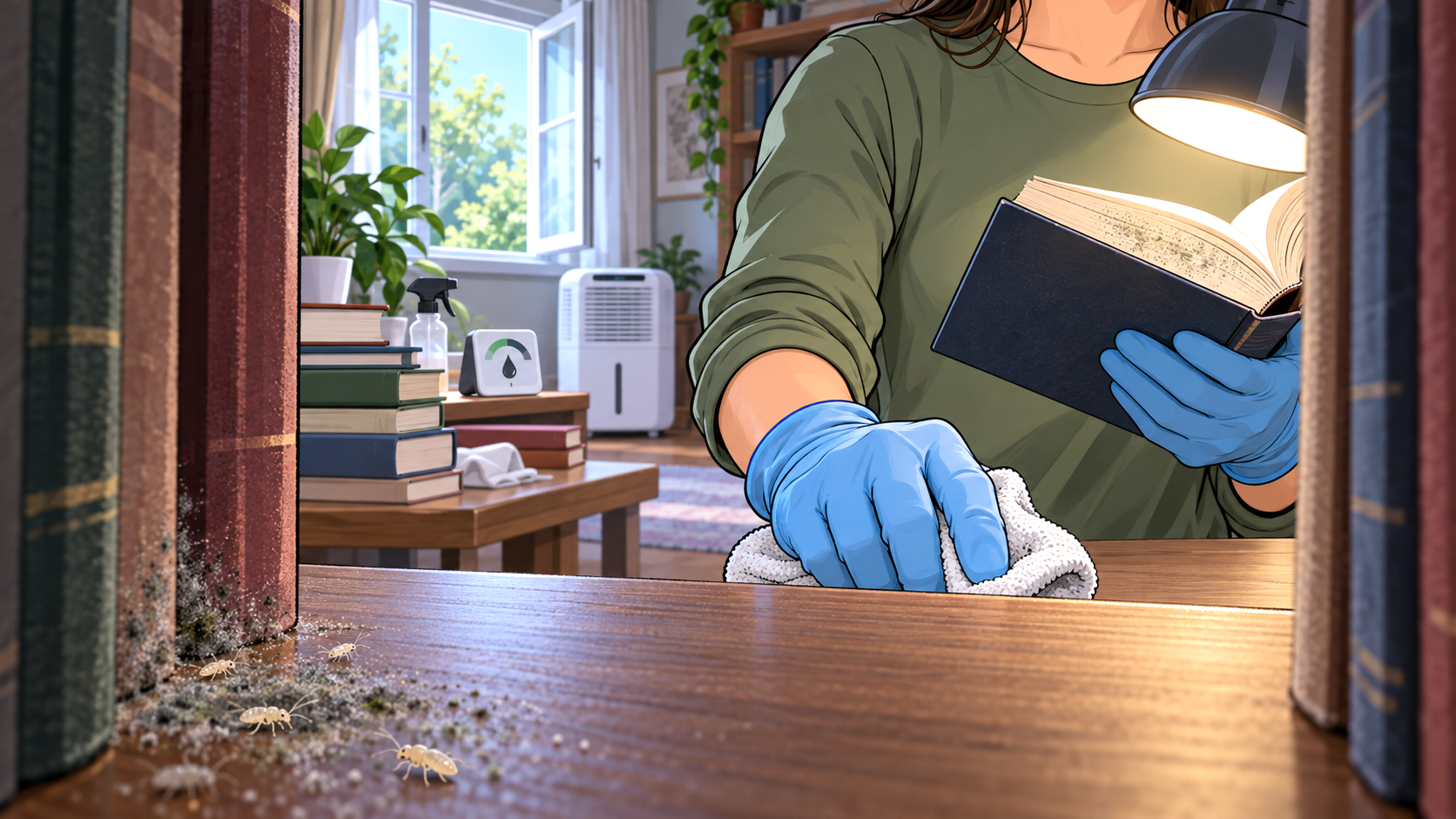
Getting rid of booklice is less about finding something strong enough to kill them and more about making your home unsuitable for them. You can vacuum every booklouse you see and still have them return if a damp wall, humid cupboard, moldy cardboard box, or another moisture problem continues supporting the population.
To get rid of booklice, reduce indoor humidity, correct leaks and other moisture problems, remove moldy or contaminated materials, vacuum visible insects, and keep susceptible items dry. Aim for relative humidity below about 50%. In most homes, pesticides are unnecessary because sustained moisture control removes the conditions booklice need to survive and reproduce.
That approach may seem almost too simple for an insect infestation, but booklice are unusually dependent on moisture. Instead of treating every surface where one appears, the better strategy is to find out why the environment is supporting them.
First, Make Sure They Really Are Booklice
Before changing the humidity or treating belongings, confirm that the insects actually look like booklice. Common indoor booklice are extremely small, soft-bodied insects, often around 1 to 2 millimeters long, although size varies among psocids. They commonly have long slender antennae, a relatively broad head, and pale, grayish, tan, brown, or nearly translucent bodies.
Their size makes misidentification easy. Springtails are another moisture-associated household pest, but their characteristic jumping behavior helps distinguish springtails from booklice. Bed bug nymphs, mites, termites, and other tiny household arthropods can also be mistaken for them.
Correct identification matters because a moisture-control program will not solve an unrelated infestation. Booklice themselves are primarily nuisance pests. They do not bite people, do not transmit disease, and usually cause little or no direct damage in homes.
The Most Effective Way to Get Rid of Booklice Is to Reduce Moisture
Booklice are strongly dependent on humid environments. Indoors, they are commonly found in warm, damp, undisturbed places where mold and fungi are available as food. This connection is so strong that finding a substantial population can serve as a warning that a moisture problem exists somewhere nearby.
For most household infestations, reducing relative humidity to below about 50% is a practical target. Booklice do not persist well when humidity remains around 45% to 50% or lower, and reducing moisture also suppresses the fungal growth that provides much of their food. A dehumidifier, fan, or improved ventilation can therefore accomplish more than repeatedly killing individual insects.
The important word is remains. Lowering humidity for one afternoon and allowing it to rise again overnight will not correct a persistent moisture problem. Use a hygrometer to see what the relative humidity is actually doing throughout the day, especially in basements, bathrooms, closets, kitchens, storage rooms, and other areas where booklice keep appearing.
Our deeper look at booklice and humidity explains why moisture affects them so strongly. For control purposes, however, the practical lesson is straightforward: keep the affected environment consistently dry.
Find the Moisture Source Instead of Treating Random Surfaces
A dehumidifier can reduce moisture in the air, but it should not become a substitute for repairing an actual water problem. Check for leaking plumbing, roof leaks, condensation around windows or pipes, damp basements, poorly ventilated rooms, wet cardboard, water beneath sinks, moisture around potted plants, and building materials that have not dried properly.
Booklice can become especially noticeable in newly constructed or recently renovated buildings because damp plaster, drywall, concrete, and other building materials can temporarily create favorable conditions. In these situations, drying the building may gradually eliminate the population without extensive insect treatment. Persistent moisture trapped inside a wall may require the wall cavity itself to be dried rather than simply running a dehumidifier in the room.
This is why understanding where booklice come from can change the way you approach an infestation. The insects did not spontaneously appear because the room became humid, but moisture can allow a small introduced population to survive, reproduce, and become noticeable.
Vacuum the Booklice You Can See
Once you are addressing the moisture problem, physically remove visible booklice. Vacuuming is a simple way to reduce the population without introducing unnecessary chemicals into the home. Pay particular attention to cracks, shelf edges, baseboards, window areas, cupboards, storage spaces, and surfaces where the insects repeatedly appear.
Physical removal is a recognized part of pest management for collections and other sensitive materials, with vacuuming generally more effective than simple sweeping. Vacuuming will not correct the underlying infestation by itself, however. Hidden booklice and eggs can remain in protected spaces, and another generation can develop while environmental conditions remain favorable.
Cleaning should therefore support moisture control rather than replace it. If you vacuum the same shelf every morning and find another group the next day, stop treating the shelf as the source. Inspect the wall behind it, nearby cardboard, books, food, plumbing, windows, and the humidity of the room.
Remove Mold and Damp Materials That Are Feeding the Population
Booklice feed heavily on fungi and mold, although their diet can also include grains, insect fragments, starches, and other suitable organic material. Removing contaminated material can therefore eliminate both insects and food.
Throw away ordinary disposable materials that are badly moldy or water damaged, particularly damp cardboard and other low-value items that are not worth restoring. Dry salvageable belongings appropriately and clean mold according to methods suitable for the material involved. If extensive mold growth is present, the mold and moisture problem deserves attention independently of the booklice.
You may not see obvious fuzzy mold. Booklice can graze fungal growth on surfaces before a homeowner recognizes a major visible mold problem. Their close relationship with dampness is one reason the presence of psocids is treated as a warning of unsuitable moisture conditions.
Understanding whether mold attracts booklice is useful here. Mold does not create the insects, but a damp, fungus-rich environment can provide exactly what an introduced booklouse population needs.
How to Get Rid of Booklice in Books
Do not automatically throw away books because you find a few booklice on them. Booklice are associated with books partly because damp books can support microscopic fungi and because some psocids can feed on starchy materials in bindings and along page edges. Their presence does not mean the insects are consuming entire pages like a stereotypical “bookworm.”
Move affected books away from the damp environment and inspect the shelves and surrounding wall. Dry conditions are central to control because small numbers of psocids on objects can often be controlled by airing and drying the affected material. Vacuuming nearby shelving can also remove wandering insects.
Be more conservative with rare, fragile, antique, or otherwise valuable books. Do not spray them with bleach, rubbing alcohol, insecticide, essential oils, or homemade mixtures. The treatment can harm the object even when the insects would have caused little damage. Our dedicated instructions for getting rid of booklice in books cover this situation without turning the main control process into a preservation manual.
What to Do When Booklice Are in Stored Food
Booklice are not restricted to books. Some species are important stored-product pests and can occur in flour, cereals, grains, and other dry foods, particularly where moisture and fungal growth are present.
If booklice are established in a food product, discard the contaminated food rather than trying to separate the insects from it. Clean the cupboard, vacuum cracks and spilled material, inspect nearby packages, and correct any moisture problem. Dry uncontaminated foods should be stored in tightly closing glass or plastic containers, which helps protect them from both moisture and pest entry.
This situation deserves more attention than a few booklice wandering across a wall because contaminated food can contain insects, fungal growth, and booklouse waste. Infested stored food should be discarded, while unaffected food should be kept dry and securely contained.
What to Do About Booklice on Walls and Windows
Booklice crawling across painted walls are often wanderers rather than insects feeding on the paint. Look closely at where they are concentrated. A recurring cluster around a window can point toward condensation, while insects around a bathroom wall, plumbing chase, or basement foundation can coincide with persistent moisture.
Vacuum visible insects and inspect the affected surface for dampness. Also check behind furniture and along the opposite side of the wall when accessible. Painting over a damp surface will not eliminate a population living in favorable conditions behind it.
The same principle applies to booklice on walls. Killing what you can see may provide an immediate reduction, but drying the environment is what interrupts the conditions allowing the infestation to continue.
Do Dehumidifiers Get Rid of Booklice?
A dehumidifier can be one of the most useful tools for a booklice problem when excessive indoor humidity is responsible. It lowers the amount of moisture available to the insects while also making the environment less favorable for the molds and fungi they commonly eat.
For a humid room without an active leak, maintaining relative humidity below about 50% can be highly effective. Low humidity both suppresses mold and negatively affects booklice, so the effect is not simply that the insects decide to move somewhere else.
Placement and capacity matter. A small dehumidifier struggling in a large damp basement may never reach the desired humidity. Measure the actual relative humidity rather than assuming the machine is doing enough.
Do You Need Insecticide for Booklice?
Usually, no.
Several household-pest authorities recommend moisture reduction as the primary control method, and insecticides are normally unnecessary. Chemical treatment is particularly poor as a stand-alone solution because killing exposed booklice does nothing to correct the damp conditions that allowed them to multiply.
Booklice also occupy tiny cracks and protected spaces that can be difficult to reach with a surface treatment. Even when an insecticide kills insects it contacts, the environmental source remains capable of supporting the population.
If an infestation remains extensive after the building has been properly dried and the insects have been correctly identified, a licensed pest-management professional can investigate hidden breeding areas and determine whether any pesticide treatment is appropriate. Any pesticide used should be registered for the intended site and applied strictly according to its current label.
What About Vinegar, Bleach, Borax, Baking Soda and Rubbing Alcohol?
The internet offers a long list of household substances for booklice, but the fact that a liquid can kill or disturb an exposed insect does not make it a useful infestation treatment.
The central weakness is the same for most contact remedies. They reach only the insects you manage to hit, while booklice and eggs may remain in cracks and protected locations. They also leave the underlying humidity and fungal food unchanged. Some substances can stain or damage books, furniture, painted surfaces, electronics, or other belongings.
We treat these methods separately because they involve different evidence and different limitations. There are dedicated pages examining whether vinegar kills booklice, whether bleach kills booklice, and whether rubbing alcohol kills booklice. None should distract from fixing the moisture conditions that sustain an indoor population.
Can You Freeze Booklice?
Freezing can be relevant when the infestation is confined to a movable object, but it is not a practical treatment for booklice distributed throughout a room or building. Successful low-temperature pest treatment depends on the temperature reached throughout the object and how long that temperature is maintained, not simply placing something somewhere cold for an arbitrary period.
That distinction matters for books and other belongings because the center of an object takes time to reach the surrounding temperature. Some materials may also be unsuitable for freezing because of their construction, condition, or sensitivity to changes in temperature and moisture.
Our dedicated page on whether freezing kills booklice is the better place for that method. For a general household infestation, humidity control remains much more practical because it changes the environment supporting the entire population rather than treating objects one at a time.
How Long Does It Take to Get Rid of Booklice?
Do not expect every booklouse to disappear the moment the humidity drops.
Booklice and their eggs may occupy protected microenvironments, and objects or building materials can retain moisture after the surrounding air becomes drier. Psocids can also survive periods of unfavorable humidity rather than dying immediately. The Canadian Conservation Institute notes that some indoor psocids can survive in dry atmospheres for a period before prolonged dryness becomes fatal.
That means the trend matters. Once the moisture source has been corrected and humidity remains low, you should see fewer booklice rather than a continuously expanding population. Vacuuming the remaining insects can accelerate the visible decline.
If numbers remain high despite sustained dry conditions, reconsider the diagnosis and look for a localized moisture source you missed. A damp wall cavity, leaking pipe, wet cardboard box, stored-food problem, or another humid microenvironment can support insects even when a hygrometer on the opposite side of the room shows acceptable humidity.
Why Booklice Sometimes Keep Coming Back
Recurring booklice usually mean that one part of the control process has not been completed. Perhaps the insects were vacuumed but the room stayed humid. A dehumidifier may have been installed while a slow plumbing leak continued. Moldy cardboard may have been discarded while another damp storage area remained untouched.
Another possibility is repeated introduction. Booklice can arrive with cardboard boxes, books, stored foods, packaging, and other belongings. Introduction alone does not guarantee an infestation, however. A dry home is much less accommodating than one that continuously provides favorable moisture and fungal food.
This is why we would not judge success by whether you spot one stray insect several weeks later. Look instead for the signs of an established booklice infestation and whether numbers are declining. A persistent or growing population tells you more than an isolated booklouse.
When Professional Pest Control Makes Sense
Most booklice problems can be resolved without professional pesticide treatment, but outside help becomes reasonable when the infestation remains widespread after humidity has been controlled, when you cannot locate the moisture source, or when insects appear to be emerging from inaccessible structural areas.
A professional can also help confirm identification. That becomes particularly valuable when the insects do not behave or look like booklice, because treating a misidentified pest as a moisture-dependent psocid can waste weeks.
For severe infestations, the most useful professional may not always be an exterminator alone. A plumber, building contractor, waterproofing specialist, mold professional, or heating, ventilation, and air-conditioning technician may be necessary if the underlying problem is water intrusion or persistent humidity. Booklice control succeeds when the environment stops supporting them, not merely when the insects currently visible have been killed.
Questions About Getting Rid of Booklice
Should I throw away everything that has booklice on it?
No. A booklouse walking across an object does not make the object permanently infested or ruined. Disposable moldy materials and contaminated stored food may need to be discarded, but many books, household items, and other belongings can simply be dried, cleaned appropriately, and kept in a less humid environment.
Will opening windows get rid of booklice?
It depends on the outdoor conditions. Ventilation can help when outside air is drier than the indoor air, but opening windows during very humid weather may accomplish little or even raise indoor humidity. A hygrometer provides a better basis for deciding whether ventilation or mechanical dehumidification is working.
Why do I still see booklice after using a dehumidifier?
Existing insects do not necessarily disappear immediately, and damp materials or hidden spaces may take longer to dry than the room air. Confirm that relative humidity is actually staying below about 50%, continue physically removing visible insects, and investigate localized moisture if numbers are not declining.
Can I get rid of booklice permanently?
You cannot guarantee that another booklouse will never enter a home, but you can make it difficult for an indoor population to become established. Keeping the building dry, repairing leaks promptly, preventing prolonged condensation, storing vulnerable materials properly, and dealing with mold or water damage removes the conditions that allow booklice to multiply.
What is the biggest mistake people make when treating booklice?
Focusing entirely on killing visible insects. Booklice are easy to vacuum from a surface, but a persistent population is fundamentally an environmental problem. If the dampness and fungal food remain, repeatedly killing the insects you can see addresses the symptom while leaving the conditions that produced it intact.
11 thoughts on “How to Get Rid of Booklice: The Complete Guide”