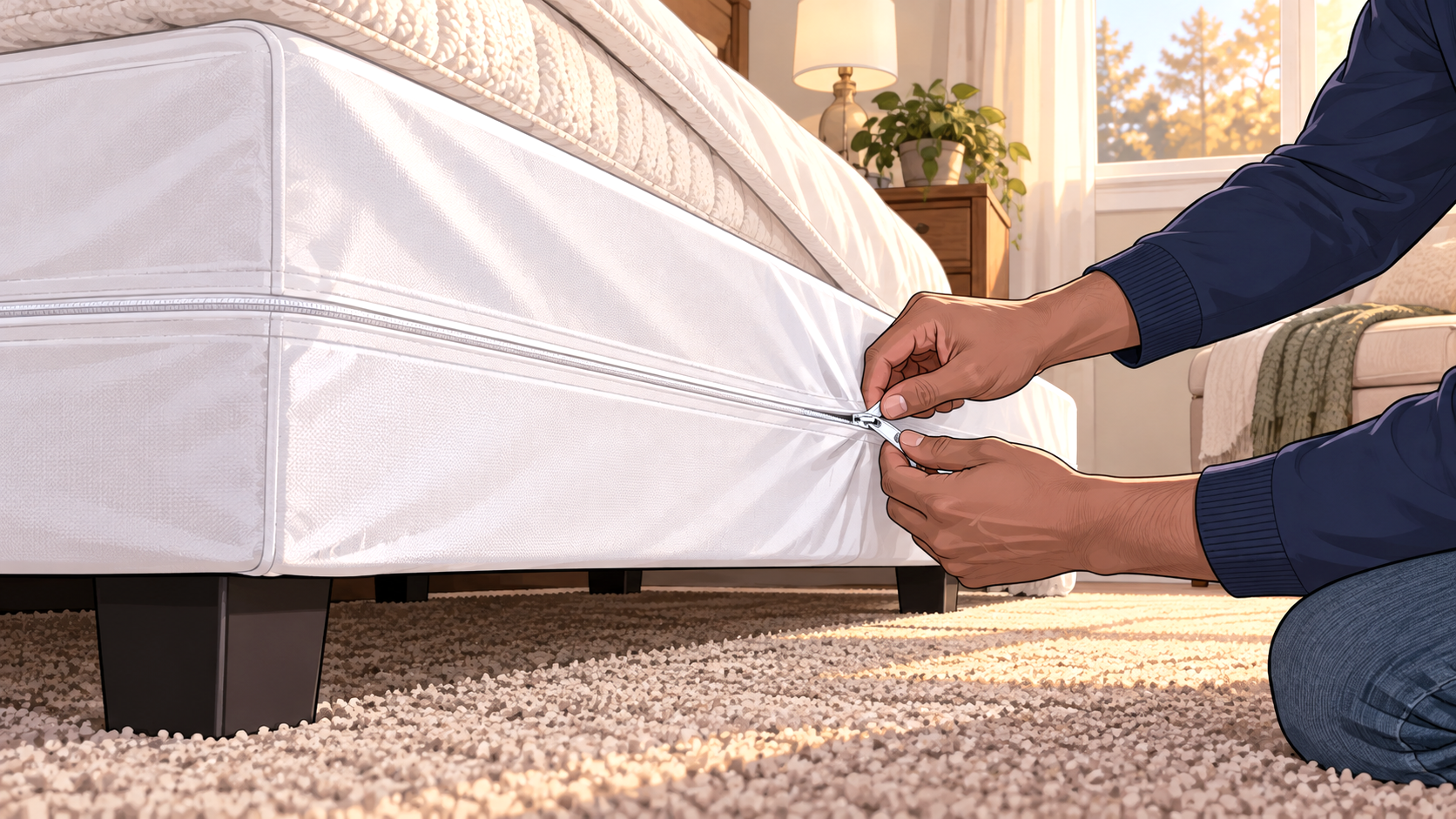
If you are dealing with bed bugs and use a traditional box spring, encasing it is usually worthwhile. A proper bed bug-proof encasement traps insects already inside and blocks new bugs from entering the complex interior. It does not eliminate bed bugs elsewhere in the room, so it should be one part of treatment rather than the entire strategy.
The Box Spring Often Deserves an Encasement More Than the Mattress
A traditional box spring offers bed bugs a complicated network of fabric folds, wooden framing, staples, nail holes, springs, joints, and an enclosed underside. Some of those spaces are difficult to inspect without removing or cutting the thin dust cover on the bottom. Rutgers identifies box springs as common bed bug harborages, including areas around staples, nails, cracks, and the bottom fabric.
A mattress has seams and piping too, but most of its exterior remains relatively accessible. Once an infestation enters a box spring’s interior framework, visual inspection and direct treatment become harder. Bed bugs’ ability to use very small cracks and protected furniture spaces makes that internal structure particularly useful to them.
If you can afford only one encasement initially, the box spring is therefore not the component to overlook.
Encasement Turns a Complicated Harborage Into a Simple Surface
A bed bug-proof cover completely surrounds the box spring and closes with a protected zipper. Bugs sealed inside lose access to the sleeper, while bugs outside can no longer disappear into the interior framework. EPA treatment preparation recommends encasements on both mattresses and box springs because they trap existing bugs and eliminate many places where new ones could hide.
The smooth exterior also changes future inspection. Instead of checking dozens of internal joints and folds, you can inspect the surface, zipper area, seams, and nearby bed frame. Light-colored material makes live insects and dark spotting easier to notice, which is one reason protective encasements are useful for simplifying bed bug detection.
Encasement does not repel bed bugs. Bugs elsewhere in the bedroom can still crawl onto its exterior and hide in the bed frame, headboard, nearby furniture, or other cracks.
A Mattress Protector Is Not Automatically a Bed Bug Encasement
Ordinary mattress pads and waterproof protectors may cover only the top and sides or close with zippers that leave openings around the slider. They are designed for spills, allergens, or wear rather than pest containment.
A suitable bed bug encasement should surround the entire box spring, use fabric that bed bugs cannot pass through, have a zipper that closes completely, and prevent escape around the zipper end. Cornell recommends tightly fitting, zippered, bed bug-proof covers, with regular checks for tears after installation.
Fit also matters. An undersized cover can place excessive strain on seams and corners, while excess loose material can create folds on the exterior where insects can shelter. Measure the box spring’s width, length, and depth rather than choosing only by mattress size.
Do Not Remove the Encasement as Soon as the Room Looks Clear
A box spring cover is not intended to trap bugs for a few nights. Bed bugs can survive prolonged periods without feeding, so opening an encasement too early can release insects that were still alive inside. EPA recommends choosing an encasement durable enough to remain in place for at least a year, while Cornell advises leaving bed bug-proof mattress and box-spring encasements on for a full year and a half.
That long interval reflects their starvation tolerance rather than slow action by the cover. The limits described in how long bed bugs can survive without feeding make premature removal unnecessary risk.
Once installed successfully, there is usually little reason to remove a durable encasement during treatment. Bedding goes over it normally.
A Torn Encasement Can Defeat the Purpose
Box springs often have sharp corners, exposed staples, rough wood, or metal hardware capable of puncturing a cover. Bed frames can also have projecting brackets or bolts that rub against the fabric whenever the bed moves.
Inspect the encasement regularly, particularly around corners, the zipper, and any place that touches the frame. Small tears must be completely sealed with durable tape or the cover replaced. Cornell housing guidance recommends padding sharp bed-frame edges that could tear an encasement because even a small opening can compromise containment.
Choose durability over the thinnest available material when the box spring has rough construction. A cheap cover that tears immediately offers little value.
You Still Need to Inspect and Treat the Bed Frame
Encasing the box spring does not seal the headboard, side rails, slats, screw holes, brackets, or joints of the bed frame. Those areas can remain occupied even when the mattress and box spring are completely enclosed.
Integrated bed bug programs therefore combine encasements with other controls. A field study that used encasements alongside steam, monitoring, and additional treatments achieved substantial population reductions, illustrating why encasement functions best as one component of an integrated plan rather than a standalone cure.
Inspect the frame before or during installation so bugs are not simply left undisturbed a few centimeters outside the new cover. The wider process for getting rid of bed bugs must still address every occupied harborage around the sleeping area.
Encasements Can Save a Box Spring That Might Otherwise Be Thrown Away
A structurally sound box spring does not automatically need disposal because bed bugs have entered it. Encasement can preserve an item that would otherwise be difficult to inspect or treat internally by permanently separating the insects inside from the sleeper.
Rutgers specifically includes mattress and box-spring encasements among cost-effective bed bug control methods because they reduce harborages and make later inspections easier. Replacing an infested box spring without treating the surrounding infestation can simply expose the new one to the same bugs.
Disposal becomes more reasonable when the box spring is damaged, badly torn, structurally failing, or impossible to encase securely. A sound box spring with a correctly fitted cover can remain in use during treatment.
Encasement Can Make Monitoring More Accurate
Bed bug evidence is easier to interpret when the box spring no longer contains hundreds of inaccessible hiding points. New insects seen on the outside of an intact encasement must have come from somewhere else rather than from the sealed interior.
That information helps when deciding whether treatment is progressing. A continuing bug on the outer surface may direct attention toward the frame, headboard, wall, nearby furniture, or another untreated harborage. Monitoring those changes is part of determining whether bed bug treatment has worked rather than relying only on whether bites have stopped.
Rutgers likewise recommends encasing mattresses and box springs while using interceptors and visual inspection, creating a bed that is easier to monitor during control.
Encase Both the Mattress and Box Spring When Both Offer Hiding Places
If you have a conventional mattress sitting on a box spring, encasing both generally provides the cleanest setup. The mattress cover removes seams, piping, labels, and folds as accessible harborages, while the box-spring cover seals the more complicated internal structure below.
A mattress already enclosed in a suitable intact bed bug encasement does not need a second cover. Likewise, a bed base made from a solid platform without an enclosed box-spring structure may require inspection and treatment rather than a conventional box-spring encasement.
The existing behavior of bed bugs inside mattress covers depends heavily on whether the cover is truly bed bug-proof and remains completely closed.
Encasement Does Not Mean You Can Skip Interceptors or Room Treatment
A fully covered bed can still be reached by bugs living elsewhere. If the bed touches a wall, blankets trail onto the floor, or furniture bridges the bed to surrounding objects, insects have routes to the sleeper.
EPA’s bed-isolation approach combines encasements with interceptor traps under bed legs and separation of the bed from walls. Those measures can reduce access to the sleeper while also revealing continuing activity outside the encasement.
A cover works best when the rest of the room is being treated simultaneously. The severity of a small versus established bed bug infestation determines how many additional harborages are likely to require attention.
Questions About Box Spring Encasements
Do you need an encasement if no bed bugs are visible on the box spring?
It can still be useful during a confirmed bedroom infestation because the interior is difficult to inspect completely. Absence of visible bugs on the exterior does not prove the internal framing is clear.
Can bed bugs bite through a box spring encasement?
A properly designed bed bug-proof encasement prevents trapped bugs from reaching you through the material. Damage, open zippers, or unsuitable fabric can compromise that protection.
Should you treat the box spring before encasing it?
Follow the treatment plan being used. Vacuuming or other appropriate treatment may reduce the population first, but an encasement can also trap insects that inspection misses. Do not apply pesticides to the box spring unless the product label permits that use.
Can you put an encasement over the thin fabric on the bottom of the box spring?
Yes. The encasement surrounds the entire box spring, including the existing dust cover. A torn or loose dust cover inside does not prevent the outer encasement from working if the new cover remains intact.
Should the zipper be taped shut?
Securing the zipper pull can reduce the chance of accidental opening. Some purpose-built encasements already include zipper locks or closures designed to prevent a gap at the endpoint.
Can you sleep on the bed immediately after encasing the box spring?
Yes, provided any pesticide or other treatment applied beforehand has met its label-directed drying and reentry requirements. The encasement itself does not require a waiting period.
Do you ever need to replace the box spring instead of encasing it?
Replacement may make sense when the box spring is structurally damaged or cannot be enclosed without tearing the cover. Replacing it solely because bed bugs are present is usually unnecessary if the item remains sound and can be securely encased.
Will encasing only the box spring stop bed bug bites?
Not necessarily. Bugs living in the mattress, frame, headboard, baseboards, or nearby furniture can still reach the sleeper. Encasement reduces one important group of harborages but does not isolate the entire bed by itself.