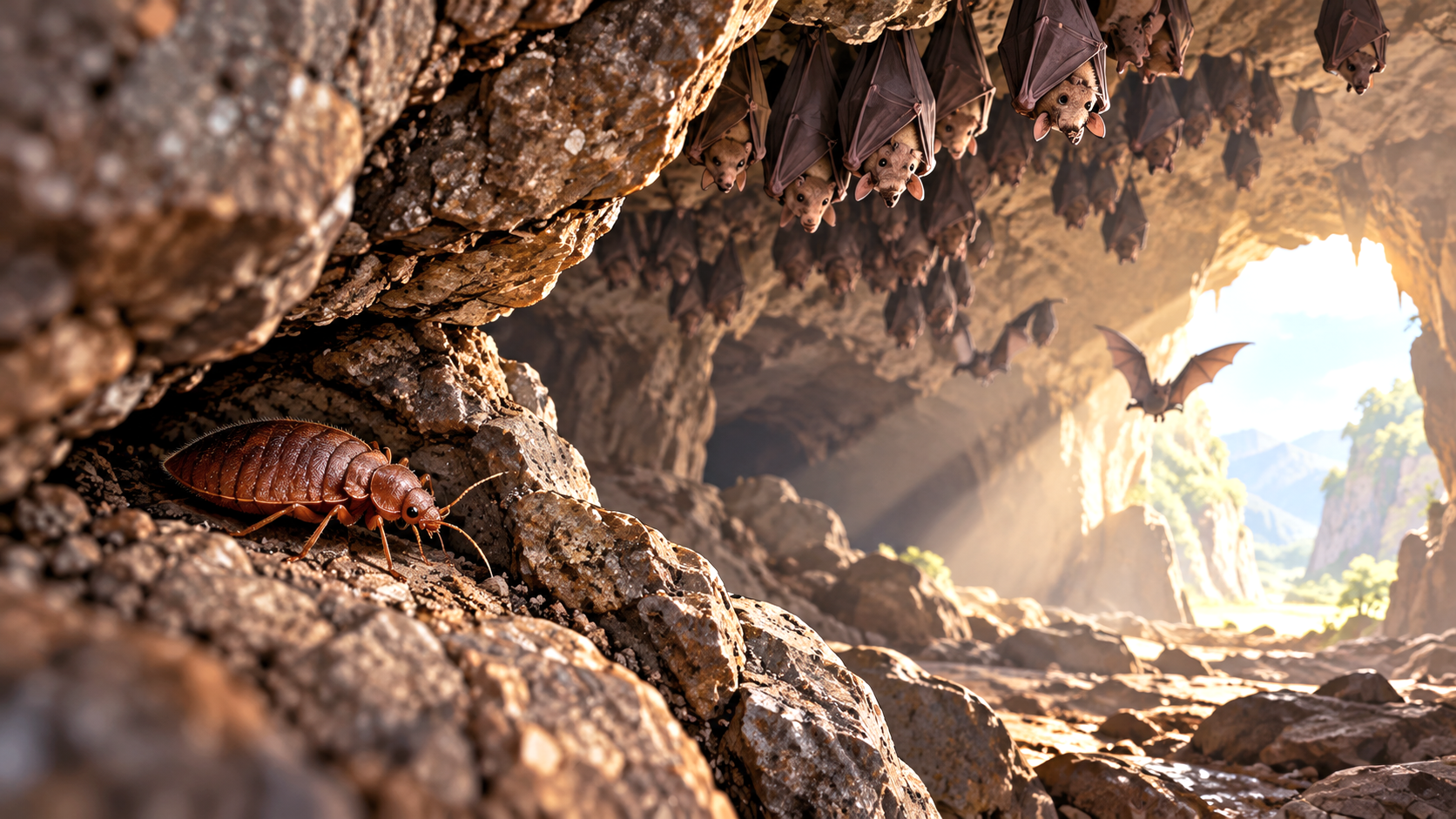
Bed bugs never evolved to depend on mattresses or bed frames. They need a blood-feeding host that remains still long enough to approach, plus a sheltered crevice nearby where they can hide between meals. Long before furniture existed, caves, animal roosts, nests, rock fissures, and human sleeping shelters could provide the same basic arrangement.
Bed Bugs Are Far Older Than Human Furniture
The evolutionary history of the bed bug family stretches enormously farther back than human beds. A fossil-calibrated molecular study of Cimicidae placed the family’s ancestry at about 115 million years ago, showing that bed bugs evolved before bats themselves appeared. The same research found that the evolutionary branches containing today’s common bed bug, Cimex lectularius, and tropical bed bug, Cimex hemipterus, separated tens of millions of years before humans could have influenced their divergence.
That evidence changes the older simplified story that bed bugs began with bats and later transferred directly to humans. Ancient cimicids were already specialized blood feeders before modern bats existed, although later lineages became strongly associated with bats and birds. The precise earliest hosts are therefore deeper in evolutionary history than the animals most people now associate with bed bug origins. The later history of where bed bugs came from involves repeated host associations rather than the invention of human sleeping furniture.
For a blood-feeding insect, a bed is biologically unimportant. The useful resource is a predictable host. Bed bugs and their relatives can feed on mammals and birds, while the familiar human-associated species became particularly successful around people. Their dependence on blood, rather than bedding material, explains what bed bugs actually eat and why they could exist in ecosystems with no human-made furniture at all.
Caves and Roosts Already Supplied the Bed Bug’s Basic Living Arrangement
A cave occupied repeatedly by bats creates almost everything a cimicid needs: animals resting in predictable positions, darkness, stable hiding sites, and cracks where insects can remain protected when their hosts leave. Modern bed bug behavior still follows that design. EPA notes that bed bugs normally remain inside small cracks and crevices close to a feeding host and travel out from those harborages when they need blood.
Common bed bugs also retain a close evolutionary connection with bats. Genetic studies have identified separate human-associated and bat-associated populations of Cimex lectularius, with substantial genetic differentiation between the two host groups. Later work likewise found that host association strongly structures bed bug populations and that modern bat and human lineages show little ongoing gene flow between them. Researchers have proposed that contact between bats and humans sharing caves provided opportunities for ancestral populations to exploit people, although the evolutionary history of the wider bed bug family predates that relationship. Genetic evidence from modern populations supports a long-standing separation between bed bugs associated with humans and those associated with bats.
Archaeology shows how naturally cimicids fit cave environments. Remains of several Cimex species recovered from Oregon’s Paisley Caves date from approximately 5,100 to almost 11,000 years ago. Those specimens were species associated primarily with bats rather than the modern human bed bug, but they demonstrate that cimicids were occupying caves used by people thousands of years before beds resembled anything found in a modern bedroom.
Early Human Sleeping Places Did Not Need to Look Like Beds
Once some bed bug populations became associated with humans, the insects needed only regular access to sleeping people and somewhere nearby to conceal themselves. Humans slept on ground surfaces, plant material, hides, mats, platforms, and other temporary or permanent sleeping arrangements long before the modern bed developed. A crack in a cave wall, gap between stones, wooden shelter, woven material, or accumulated sleeping material could serve the same ecological role that mattress seams and bed-frame joints serve today.
The insects’ body shape makes that possible. Bed bugs are extremely flat when unfed and can occupy very narrow crevices. They also do not need to remain physically attached to a host like lice. They hide away, emerge to feed, and retreat. Their tendency to become active around a resting host is part of the behavior behind bed bugs being primarily nocturnal, although hungry insects can feed at other times when a host is available.
Periods when a host disappeared were survivable as well. CDC notes that bed bugs can live for months without taking another blood meal, and EPA describes them as capable of surviving several months to as long as a year under some conditions. That ability would have been useful in animal roosts and temporary human shelters where occupants were not continuously present. The capacity of bed bugs to survive extended periods without feeding is therefore older and more fundamental than their association with bedrooms.
Permanent Human Settlements Made Bed Bugs Much More Successful
Beds were not required for bed bugs to survive, but increasingly permanent human settlements gave human-associated populations a much more reliable environment. People began spending repeated nights in the same shelters, living in larger groups and moving possessions between communities. Those conditions created abundant feeding opportunities and allowed wingless insects to spread by being carried with people and their belongings.
Recent whole-genome research found that the human-associated lineage of Cimex lectularius may have been connected with people for hundreds of thousands of years, while its population underwent a major expansion beginning roughly 13,000 years ago alongside changes in human settlement. That timing falls around the transition toward increasingly sedentary societies, well before modern beds existed. Stable dwellings, stored belongings, repeated sleeping sites, and growing settlements could support bed bug populations far more consistently than temporary camps.
By ancient historical times, the relationship was unmistakable. Archaeologists recovered Cimex lectularius from the workers’ village at Tell el-Amarna in Egypt, showing that bed bugs were living with humans at least 3,550 years ago. Furniture styles changed afterward, but the insect’s requirements remained remarkably simple.
Modern mattresses merely concentrate those requirements into an especially convenient location. CDC notes that infestations cluster near places where people sleep because bed bugs hide close to a predictable resting host. Their eggs, nymphs, and adults can complete the entire bed bug life cycle anywhere that recurring blood meals and protected harborages remain available.
A cave crack beside a sleeping mammal, a crevice in an early shelter beside a resting human, and a seam in a modern mattress all solve the same biological problem. The bed came much later; the host-and-harborage strategy did not.