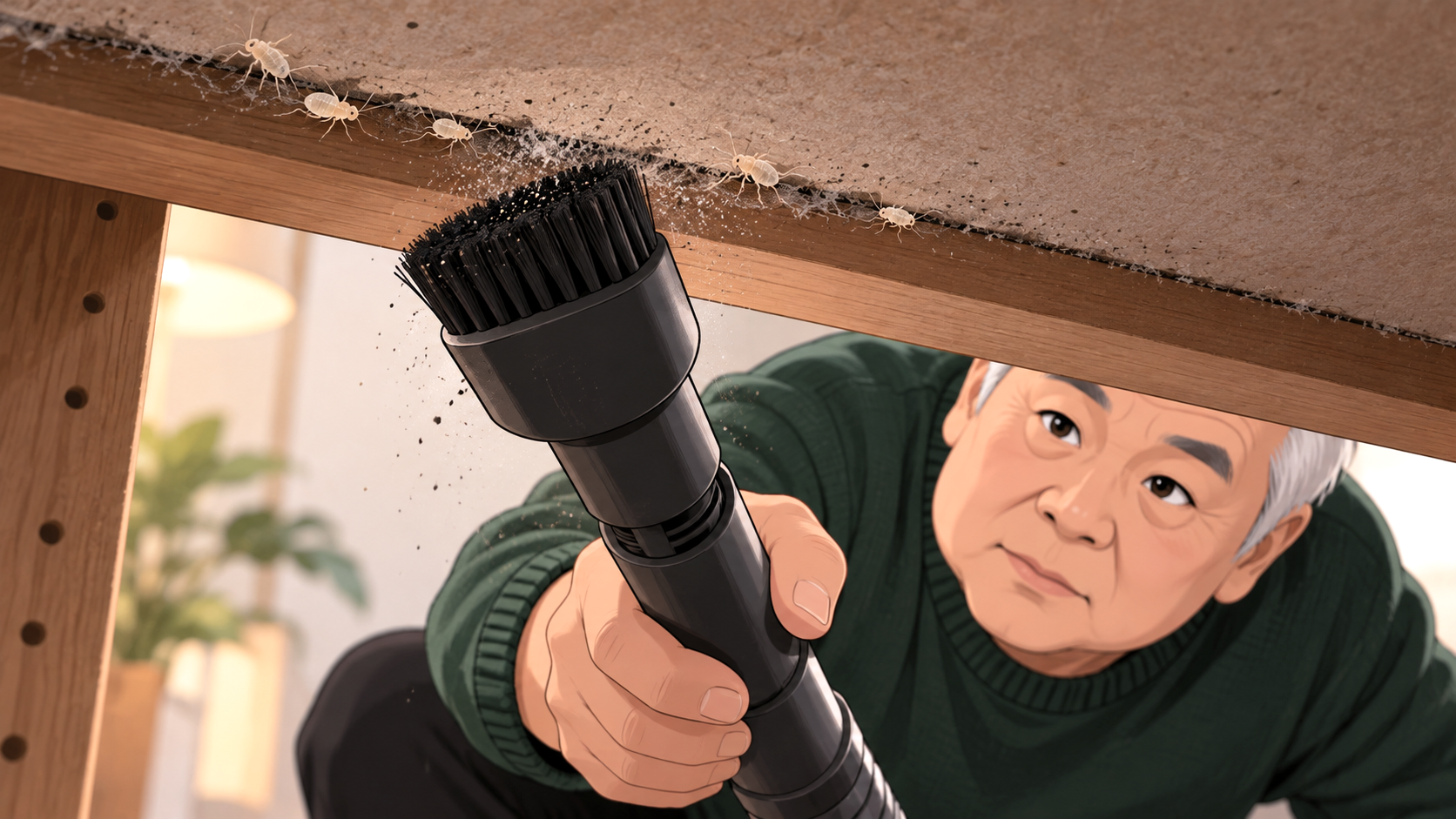
You can vacuum booklice, and for small numbers it is one of the simplest ways to remove them immediately without applying pesticide. Vacuuming is most useful for insects already exposed on shelves, floors, windowsills, baseboards, and similar surfaces. It does not reach every concealed booklouse or correct the damp conditions supporting a reproducing population.
Vacuuming Works Best When the Insects Are Already Exposed
Booklice are only about 1 to 2 mm long and have lightweight, soft bodies, so a household vacuum can readily collect individuals crawling across accessible surfaces. Physical removal, including vacuuming, is specifically recommended for small household populations of psocids. Conservation pest-management guidance likewise treats vacuuming as more effective than sweeping or mopping for physically removing many pests.
A narrow crevice attachment is useful along baseboards, shelf joints, window frames, cabinet edges, floor-wall junctions, and other places where tiny insects collect. Vacuum slowly enough for suction to pull insects from surface irregularities rather than making quick passes over the center of the room. Because booklice are easy to overlook at their normal size, concentrating on the places where activity has actually been observed is more efficient than repeatedly vacuuming every surface.
Vacuuming a Hotspot Can Reduce the Population Quickly
When dozens of booklice are moving across one shelf, windowsill, or section of flooring, vacuuming can remove a large share of the exposed population in minutes. It also collects dust, dead insects, loose fungal debris, and other surface material at the same time. Integrated pest-management guidance for collections specifically includes physical removal of insects and debris by vacuum, making it useful where unnecessary liquid treatments could damage sensitive materials.
Removing a visible concentration also makes later monitoring easier. If the surface is cleared and numerous booklice reappear from the same edge or crack, the new activity is stronger evidence that the insects are emerging from a nearby breeding site rather than simply remaining from the original group. Location and recurrence are useful parts of recognizing an established booklice infestation.
Suction Cannot Reach Every Booklouse Hidden Inside the Material
A vacuum only removes what airflow can reach. Booklice can occupy gaps behind trim, cabinet joints, tightly stacked papers, cardboard corrugations, wall cavities, and other protected spaces. Vacuuming the exposed edge of a shelf does not create meaningful suction deep inside a wall, and passing a nozzle across the outside of a cardboard box does not empty every fold within it.
Indoor booklice also occur in damp, protected environments associated with mold and fungi. Canadian grain guidance records psocids in households, warehouses, stored commodities, and other humid environments, while conservation guidance associates them with mouldy and damp paper-based objects. Vacuuming removes insects from those materials only where the nozzle can safely access them.
Eggs May Remain After the Adults Have Been Vacuumed
Clearing every moving insect you can see does not prove that the population has been removed. Booklice females deposit extremely small eggs on suitable substrates, and eggs concealed in narrow gaps may remain beyond the reach of ordinary vacuum suction. Newly hatched nymphs can then appear after the original adults have been collected.
The appearance of booklice eggs also makes them far harder to locate than moving adults. Searching a wall or bookshelf for individual eggs is rarely a productive control strategy. Vacuuming works better as population reduction while the environment is being made unsuitable for any remaining life stages.
A HEPA Vacuum Is Useful but Not Required Just to Collect Booklice
Ordinary household suction is sufficient to pick up visible booklice. A HEPA-filtered vacuum becomes more attractive when the affected area also contains substantial dust, mold debris, deteriorated materials, or other fine particles that should not be blown back into the room. Conservation guidance recommends HEPA vacuuming when insects and contaminated dust need to be physically removed.
The filter does not kill booklice or make the vacuum uniquely insecticidal. Its benefit is particle containment. A clean, properly maintained vacuum with suitable attachments is more important than buying specialized pest-control equipment merely for a few booklice.
Be Gentle When Vacuuming Books and Paper
Do not press a full-size vacuum nozzle directly against pages, bindings, photographs, fragile paper, or loose decorative material. Strong suction can tear weak paper, pull loose fragments away, or damage delicate bindings. If booklice are visible around a book collection, vacuum the surrounding shelf and accessible crevices first.
Conservation guidance for paper emphasizes careful preventive handling because booklice occur around paper collections kept under humid conditions that support fungal growth. Valuable or fragile books should not be aggressively vacuumed simply to chase individual insects into the spine.
For ordinary sturdy shelving, a narrow attachment held slightly above the material can collect insects without dragging the nozzle across vulnerable surfaces. The connection between booklice and books also means storage humidity deserves attention whenever insects repeatedly appear throughout a collection.
Empty the Vacuum After Removing a Large Number
After collecting a substantial concentration of booklice, remove the accumulated debris rather than leaving it in the vacuum indefinitely. With a bagged vacuum, follow the manufacturer’s procedure for replacing and disposing of the bag. With a bagless model, empty the collection chamber promptly and clean it according to its instructions, preferably without releasing fine dust back into the affected room.
There is no need to treat the vacuum itself with insecticide. The aim is simply to remove the captured material from circulation and maintain the appliance normally. Booklice depend on suitable moisture and food, so a clean, dry vacuum is not equivalent to the damp harborage from which they were collected.
Repeated Vacuuming Without Drying Can Become an Endless Cycle
Vacuuming works immediately on exposed insects but has no effect on a leaking pipe, condensation behind a cabinet, damp cardboard, or excessive room humidity. If those conditions remain, new booklice can continue developing and replacing the ones removed.
Household psocids generally fail to persist once relative humidity remains around 45% to 50% or lower. Their dependence on moisture is explained by why booklice need humidity to survive, and damp environments can simultaneously support the molds and fungi they commonly feed on.
A vacuum can therefore provide immediate cleanup while moisture correction removes the source of continuing reproduction. The broader non-chemical approach to booklice control combines physical removal with drying rather than relying on suction alone.
Recurrence After Vacuuming Can Help Locate the Source
Vacuuming can double as a simple diagnostic step. Clear one affected surface thoroughly, note the date and location, and watch where insects appear next. If they repeatedly emerge along one cabinet seam while neighboring surfaces remain clear, that pattern points toward a localized source. If they reappear throughout an entire humid basement, a room-wide environmental condition becomes more plausible.
This is often more informative than continuously spraying every visible insect. Booklice are principally associated with damp, warm, undisturbed locations where fungi grow, so a reappearance pattern can help direct the search toward moisture.
Once the source has been corrected, occasional vacuuming can remove remaining wanderers while the population declines. The complete household process for getting rid of booklice should not require perpetual vacuuming if the environment no longer supports them.
Questions About Vacuuming Booklice
Will vacuuming kill booklice?
Some may be injured or killed during collection, but vacuuming should primarily be viewed as physical removal rather than a guaranteed killing method. Once collected debris is disposed of appropriately, the insects are no longer on the treated surface.
Can booklice crawl back out of a vacuum?
Do not depend on the vacuum as long-term pest containment. Empty or replace the collection container after a substantial cleanup instead of storing captured insects and debris inside the machine.
Should you vacuum booklice every day?
Daily vacuuming can be useful temporarily when many insects are emerging, but repeated heavy activity means the breeding conditions remain somewhere nearby. More frequent vacuuming cannot substitute for locating dampness.
Can you vacuum booklice off a mattress?
Exposed insects can be vacuumed from a mattress surface with an appropriate upholstery attachment. Booklice found around a bed should also prompt inspection of the bed frame, underside of the mattress, adjacent wall, and room humidity rather than assuming the mattress itself is the source.
Can vacuuming remove booklice from carpet?
It can remove insects moving on or near the carpet surface. Continued activity may originate beneath the carpet, along the perimeter, or from another damp location that suction from above cannot reach.
Should you spray insecticide inside the vacuum after collecting booklice?
No. There is no need to add pesticide to the machine unless its manufacturer and a pesticide label specifically permit such use. Empty and maintain the vacuum normally.
Will one thorough vacuuming get rid of a small booklice problem?
It can be enough when only a few incidental insects are present and no suitable breeding habitat exists. If adults or tiny booklice nymphs keep appearing afterward, another source is still active.
Is vacuuming better than sweeping booklice?
Usually yes. Suction captures extremely small insects and debris rather than pushing them across the surface, and conservation pest-management guidance specifically rates vacuuming above sweeping and mopping for physical pest removal.