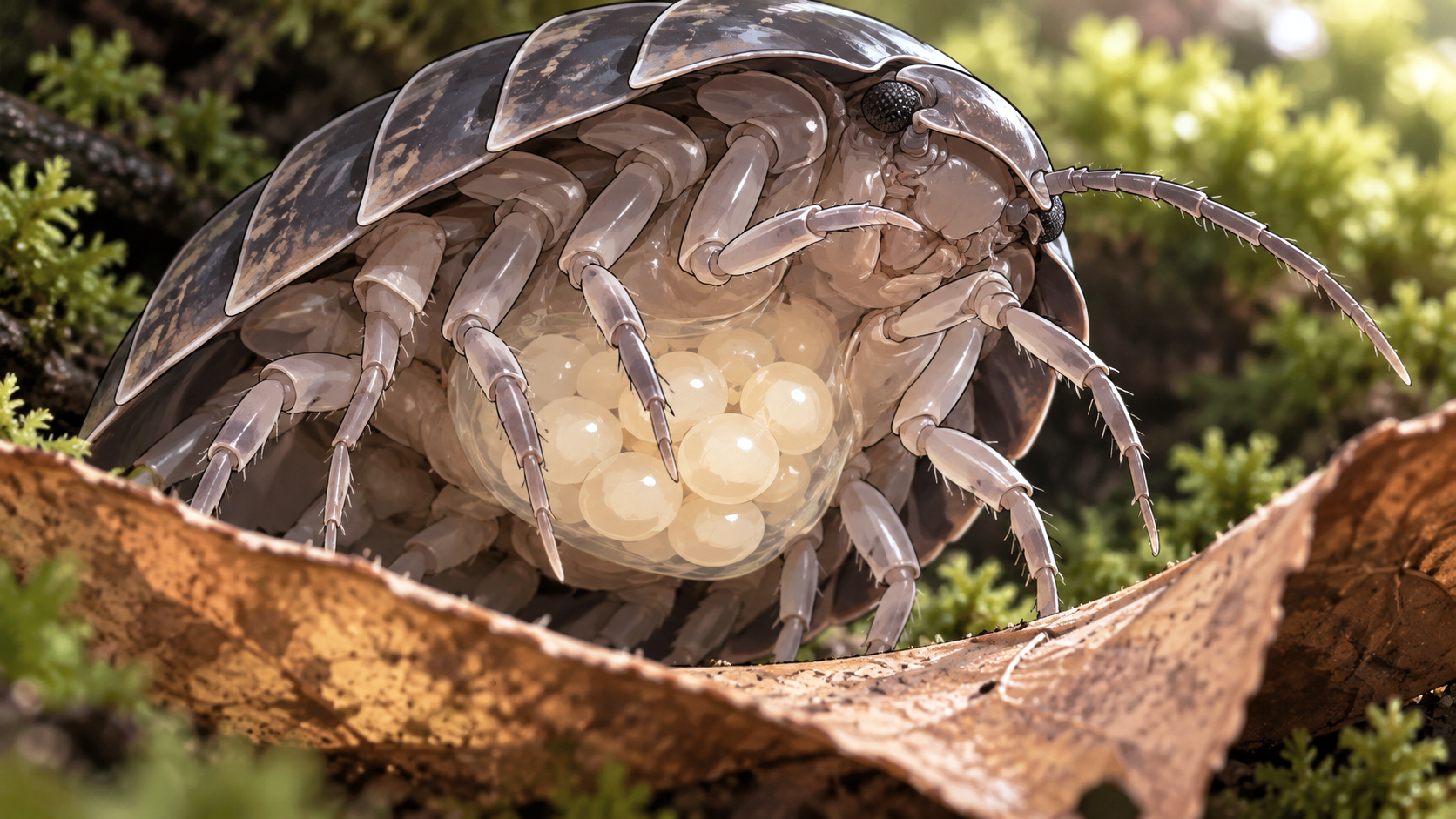
Roly-poly eggs are tiny, pale eggs carried inside a fluid-filled brood pouch on the underside of the female. They are not normally scattered under rocks or buried individually in soil. Depending on species and development, individual eggs may look round, oval, or slightly angular because many are packed tightly together inside the pouch.
You Usually Cannot See Roly-Poly Eggs Lying Around
Roly-polies are terrestrial isopods, not insects, and their reproductive biology reflects their crustacean ancestry. A female develops a specialized brood pouch called a marsupium beneath her body and retains the fertilized eggs there while they develop. The University of Florida’s profile of Armadillidium vulgare, one of the best-known pillbugs, states that the eggs remain inside this ventral brood pouch and can reach about 0.7 mm in diameter. UC IPM similarly notes that eggs or developing young may be visible through the brood pouch on the underside of a pregnant female.
That arrangement means a group of small white balls discovered freely scattered in potting soil, mulch, or beneath a stone should not automatically be identified as roly-poly eggs. Other soil arthropods reproduce very differently, and the distinction between springtails and terrestrial isopods is especially relevant when tiny organisms or eggs appear in the same damp environments.
The Eggs Are Smaller Than a Millimeter
Egg dimensions vary between terrestrial isopod species. Research on the common rough woodlouse Porcellio scaber found fertilized eggs measuring roughly 0.4 to 0.6 mm across, with the tightly packed eggs ranging from oval to somewhat angular in shape. The researchers also described transparent yolk containing granules that could appear greenish, yellowish, or brownish under magnification. The eggs are surrounded by thin protective membranes rather than the rigid, easily recognized shells associated with many insect eggs. Microscopic observations of Porcellio scaber embryos show how dramatically the internal appearance changes as development proceeds.
For the common pillbug Armadillidium vulgare, eggs may approach 0.7 mm in diameter. Animal Diversity Web describes them as thin-walled, yolk-containing eggs retained within a fluid-filled marsupium. At that scale, individual eggs would be extremely difficult to identify confidently without magnification even if they were removed from the mother.
Their color should therefore not be reduced to a single universal shade such as pure white. Species, developmental stage, yolk, lighting, and the transparent egg coverings can all influence what is visible.
A Pregnant Female Can Look Pale Underneath
The eggs are carried beneath the thorax, where overlapping plates help form the brood pouch. With a sufficiently developed brood, the underside of the female can appear swollen or unusually pale because the eggs or developing young are visible through the pouch. Colorado State University describes females carrying roughly two dozen eggs in the abdominal marsupium, while brood size varies substantially by species and female size.
Numbers should not be used as an identification rule. Utah State University reports that sowbugs and pillbugs can carry up to about 200 eggs in the pouch, whereas studies of other terrestrial isopods report much smaller broods. A larger female generally has room for more developing offspring.
The pouch is easier to recognize than the individual eggs. Turning a female over carefully may reveal a pale, bulging area beneath the body, but repeatedly handling or disturbing a brooding animal is unnecessary if the goal is simply identification.
The Eggs Hatch Before the Young Leave Their Mother
Roly-poly eggs do not hatch onto the ground. Development continues inside the maternal pouch. UF/IFAS reports that A. vulgare eggs typically hatch after roughly three to four weeks, after which the tiny juveniles remain protected inside for another one to two weeks. Other species and environmental conditions can alter the timing.
The newly hatched stage is called a manca. It already resembles a miniature pale isopod rather than a worm or grub. UC IPM describes newly emerged young as pale yellow to whitish and roughly 1/12 inch long. They initially have six pairs of walking legs instead of the adult seven pairs, with the final pair developing after later molting.
Seeing a cluster of tiny white roly-polies close to an adult therefore does not mean you are looking at eggs. They may already have hatched and emerged from the brood pouch.
Loose White Objects in Soil Are Usually Something Else
Because roly-poly eggs remain with the female, loose pearl-like objects in damp soil deserve a different identification. Snail or slug eggs, springtail eggs, fungal structures, fertilizer beads, and other small soil material can all look superficially similar when viewed without magnification.
The Missouri Botanical Garden describes pillbugs and sowbugs as carrying their eggs in a pouch beneath the body, making location one of the simplest identification checks. Eggs found attached to leaves, enclosed in a gelatinous mass, buried independently in soil, or scattered freely through a pot do not match the normal reproductive pattern of a roly-poly.
A true roly-poly brood is essentially carried around by the mother until the offspring are already recognizable as miniature isopods. That makes the female’s underside, rather than the surrounding soil, the place where genuine roly-poly eggs are normally found.