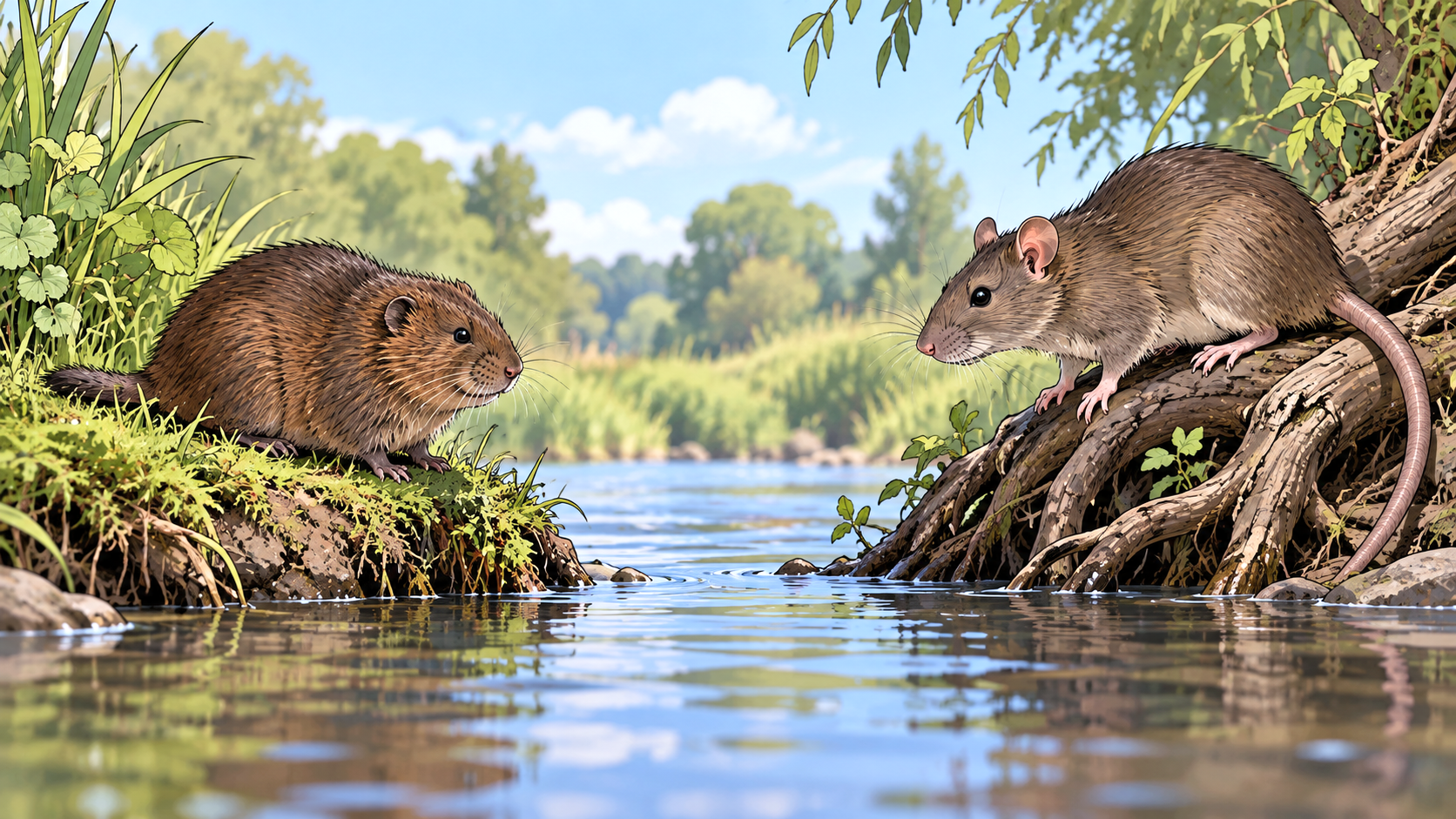
Water voles have rounded faces, blunt noses, small ears partly hidden by fur, and relatively short, furry tails. Brown rats have more pointed snouts, prominent ears, and longer, mostly hairless, scaly tails. When swimming, a water vole often keeps much of its back visible above the surface, while a brown rat typically swims with most of its body submerged.
These differences are especially useful when identifying the Eurasian water vole (Arvicola amphibius) and the brown rat (Rattus norvegicus) along British and European waterways. North America has a different species, Microtus richardsoni, also called the water vole, so identification advice developed for European water voles should not automatically be applied to animals found in Canada or the United States.
Water Voles and Brown Rats Look Different Up Close
A water vole’s face is one of its most recognizable features. The muzzle is short and rounded, creating a relatively blunt profile. Its ears are small, rounded, and often difficult to distinguish from the surrounding fur. The eyes are dark and relatively small, giving the face a compact appearance.
Brown rats have more elongated heads, with noses that narrow toward the tip. Their ears are larger and more exposed, frequently showing pinkish skin that contrasts with the fur. The differences in head shape, ear size, and tail appearance become especially apparent when both animals are observed in profile.
The tail provides another useful clue. A Eurasian water vole’s tail is relatively short and covered with fine hairs, usually measuring around half to two-thirds of its head-and-body length. A brown rat has a longer, sparsely haired tail with prominent scales. Its tail commonly approaches the length of its head and body combined.
Fur color is less dependable. Water voles frequently have rich chestnut-brown coats, while brown rats are often grayish brown with lighter undersides. However, water voles can also have very dark or nearly black coats, particularly in some Scottish populations.
Young rats create additional identification difficulties because their smaller size can overlap with that of adult water voles. An animal should not be identified exclusively by its apparent size or coloring.
| Feature | Eurasian water vole | Brown rat |
|---|---|---|
| Face | Rounded, blunt muzzle | Longer, more pointed muzzle |
| Ears | Small, often concealed by fur | Larger and visibly protruding |
| Eyes | Small, dark | Relatively more prominent |
| Tail | Shorter, finely furred | Longer, scaly, sparsely haired |
| Typical coat | Rich brown, sometimes very dark | Usually grayish brown |
| Feet | Often appear furred | More exposed, frequently pinkish |
| Overall proportions | Compact, rounded | More elongated and muscular |
The general anatomy of voles helps explain their compact proportions, but the Eurasian water vole is considerably larger than many familiar grassland vole species.
Swimming Posture Is Often the Best Clue From a Distance
A brown animal moving across a canal may reveal little of its face or tail. In those circumstances, the amount of its body visible above the water can be particularly informative.
Water voles frequently swim with their head and a noticeable portion of their back above the surface. Brown rats generally move through water with their bodies sitting lower, sometimes leaving little more than the head exposed. The different swimming silhouettes of water voles and rats are often recognizable even when the animals are too far away for close examination.
Water voles also produce a characteristic plopping sound when they enter the water suddenly. A startled animal may dive directly from a bank and disappear beneath the surface, sometimes reaching a submerged burrow entrance.
Brown rats are capable swimmers and can dive as well. A sudden splash therefore does not conclusively establish the animal’s identity, particularly when the observer never sees its head or tail.
Swimming behavior should be interpreted alongside appearance. A clear view of a rounded muzzle and compact, furred tail is stronger evidence than the height of the animal’s back above the water.
The swimming abilities of different vole species also vary, making it important not to treat every swimming vole as an Eurasian water vole.
Waterside Feeding Signs Can Help Identify Water Voles
Water voles commonly feed on grasses, sedges, reeds, and other vegetation growing along waterways. They often carry pieces of plants to favored feeding places, leaving neat piles of cut stems.
The discarded vegetation frequently has angled ends, sometimes described as being cut at approximately 45 degrees. Individual pieces may be several centimeters long and accumulate on small platforms beside the water.
These characteristic piles of neatly cut waterside vegetation are useful because they combine evidence of feeding with a location consistent with water vole activity.
Brown rats have a much broader diet. They consume seeds, grains, vegetation, insects, animal material, and discarded human food. Their feeding sites may therefore contain a different mixture of remains.
However, a pile of chopped vegetation does not prove water vole occupation. Other animals can damage or move plant material, and a single cut stem is not enough to establish the species responsible.
Repeated feeding stations beside suitable bankside habitat provide stronger evidence, especially when accompanied by distinctive droppings or a clear sighting.
Water Vole Droppings and Rat Droppings Are Not Identical
Eurasian water vole droppings are generally cylindrical, relatively uniform in shape, and rounded at both ends. They commonly measure approximately 9–15 millimeters long and 3–5 millimeters wide, with color ranging from greenish to dark brown or black.
A distinctive behavior is the use of latrines. Water voles deposit droppings in concentrated locations along their territories, sometimes trampling the material while scent-marking.
These rounded droppings arranged in identifiable latrines provide valuable evidence during water vole surveys.
Brown rat droppings are often more elongated, with one or both ends appearing tapered. They can reach approximately 17 millimeters in length, although measurements overlap with those of water voles.
The appearance of brown rat droppings and footprints can help distinguish rat activity when several types of evidence are available. However, individual pellets vary in shape, and environmental exposure can alter their appearance.
Droppings should not be picked up, crushed, or handled to determine their texture. A photograph showing their arrangement and surrounding habitat is more useful than close physical examination.
The identification problem differs from the comparison between ordinary vole droppings and mouse droppings, because Eurasian water voles are substantially larger than many familiar North American voles.
Burrows Along the Bank Can Belong to Either Animal
Both Eurasian water voles and brown rats excavate burrows, and both can occupy riverbanks, pond margins, and drainage channels.
Water vole burrows often occur immediately beside the water, with entrances above, at, or occasionally below the waterline. They may have nearby patches of closely grazed vegetation, producing a small lawn-like area around an opening.
Rats also excavate waterside burrows, especially where banks provide shelter close to accessible food. Consequently, an isolated hole cannot identify its occupant.
Water voles may leave closely cropped vegetation surrounding active bank entrances, whereas rat activity may be associated with different feeding remains and more exposed travel routes. Nevertheless, neither feature is exclusive.
The strongest evidence involves several consistent observations at the same location. An identifiable water vole sighting, rounded latrine droppings, and neatly cut vegetation provide a much stronger case than the presence of a bank opening alone.
Old burrows can also persist after their occupants disappear. Current activity should not be inferred merely because an opening remains intact.
The Animals’ Behavior Around People Can Differ
Eurasian water voles are often observed feeding beside water during daylight hours. They may sit upright on their hind feet, holding plant stems with their front paws while eating.
The feeding posture and characteristic alarm dive of water voles can provide recognizable field observations when the animal is undisturbed.
Brown rats are frequently associated with human settlements, although they also inhabit rural waterways. They may forage around rubbish, stored food, buildings, and other areas that supply accessible food.
These tendencies are not definitive identification tests. Brown rats can be active during daylight, particularly where food is abundant or human disturbance is limited. Water voles can also move outside the periods when people most often observe them.
An animal seen at noon is not automatically a water vole, and one emerging after sunset is not necessarily a rat. Body proportions and consistent field evidence are more dependable than the time of observation.
North American Water Voles Are a Different Species
The name water vole creates a geographical complication because Europe and North America have different animals commonly called by that name.
The Eurasian water vole, Arvicola amphibius, occurs across parts of Europe and northern Asia. Its appearance, swimming behavior, and bankside signs form the basis of most British water-vole-versus-rat identification advice.
The North American water vole, Microtus richardsoni, belongs to a different genus. It occurs in mountainous portions of western Canada and the northwestern United States, including areas of British Columbia, Alberta, and the Rocky Mountains.
Its distribution is concentrated around alpine and subalpine freshwater habitats, where it occupies stream margins, wet meadows, and other suitably moist environments.
The two species share certain ecological characteristics, including an association with water, but they are not interchangeable. North American water voles should not be identified using an unmodified checklist developed for Arvicola amphibius.
Genetic investigations also confirm that the North American water vole belongs within Microtus, rather than the Eurasian genus Arvicola.
A large brown rodent seen swimming in an ordinary North American city pond is consequently not automatically a water vole. Rats, muskrats, and other aquatic or semiaquatic mammals may be more plausible depending on the location.
The differences between voles and rats generally should be considered separately from this specific comparison between Eurasian water voles and brown rats.
What If You Cannot Tell Which Animal You Have Seen?
A brief glimpse of a brown animal disappearing into water may not provide enough information for reliable identification.
If the animal is still visible, observe it from a distance rather than approaching the bank. A photograph or short video that captures the complete body, particularly the nose, ears, and tail, may allow a more accurate assessment.
Where the animal has disappeared, surrounding field evidence may help, but avoid disturbing burrows or digging into the bank. Eurasian water voles are protected in Great Britain, and their burrows and resting places have legal protections.
Misidentification has practical consequences. An animal assumed to be a common brown rat may instead belong to a protected water vole population, making casual disturbance inappropriate.
For uncertain sightings, the combination of a rounded face, small concealed ears, a short furry tail, and water-vole feeding signs offers the strongest identification. A long, exposed scaly tail and pointed muzzle favor a brown rat, particularly when those features are clearly visible rather than inferred from a fleeting movement.