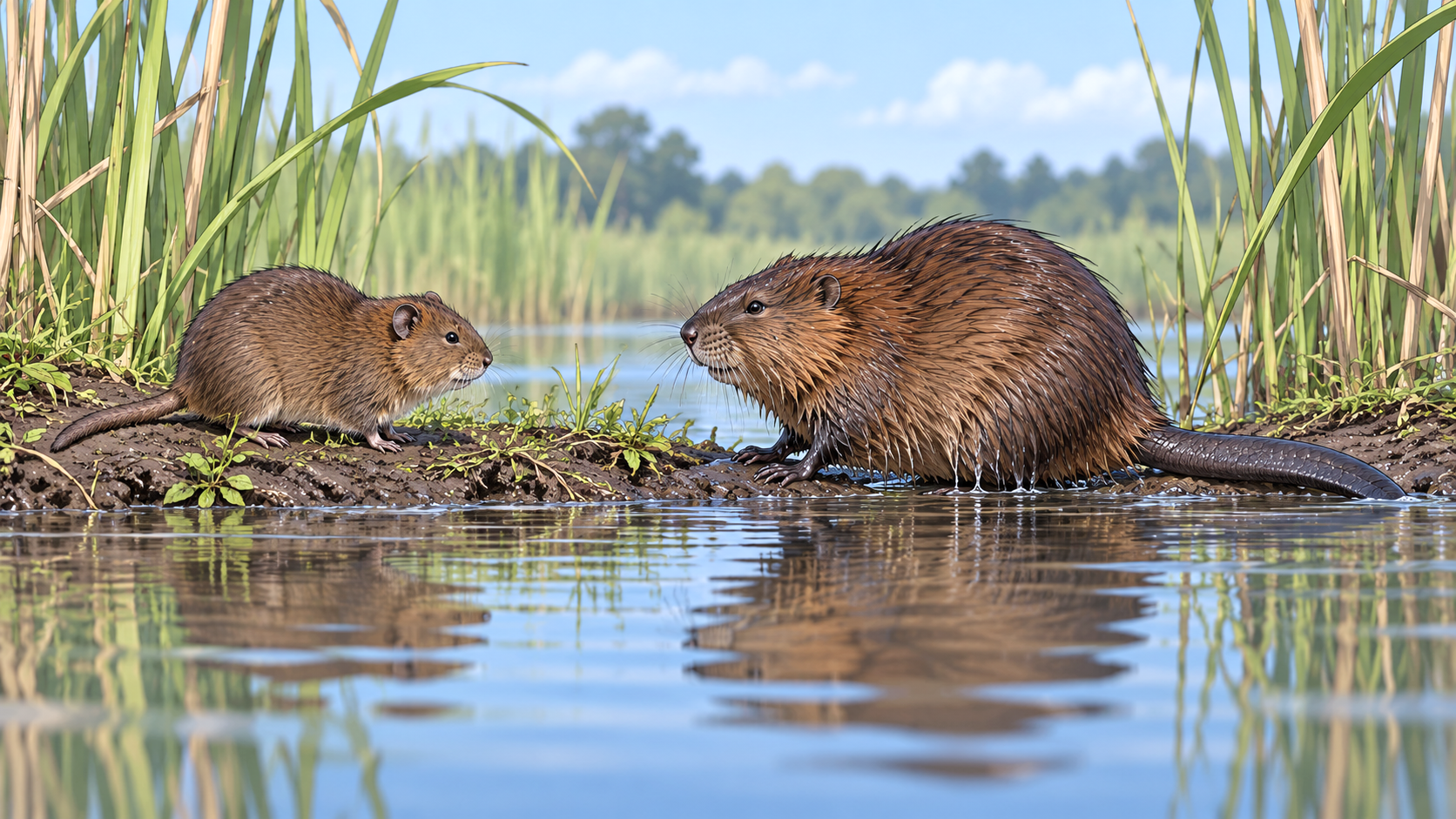
A muskrat is much larger and heavier than a water vole, with a long, nearly hairless, vertically flattened tail that distinguishes it from the shorter, fur-covered tail of a water vole. Both are brown, semiaquatic rodents with rounded bodies and small ears, so a brief sighting in water can be confusing. Tail shape, overall proportions, and the surrounding habitat provide the strongest identification clues.
There are two different animals commonly called water voles: the Eurasian water vole (Arvicola amphibius) and the North American water vole (Microtus richardsoni). Both are substantially smaller than the muskrat (Ondatra zibethicus), but their measurements, geographical distributions, and habitat preferences differ. Identifying which water vole occurs in your region is necessary before comparing it with a muskrat.
The Size Difference Is Usually Noticeable
Adult muskrats are robust aquatic rodents that commonly weigh several times as much as either water vole species. Their bodies are deeper and heavier, with relatively large hind feet that help propel them through water.
Eurasian water voles generally weigh approximately 150–300 grams, while adult muskrats commonly weigh around 680–1,800 grams. The body measurements of Eurasian water voles and the substantially larger size range of muskrats make adult animals relatively easy to separate when the entire body is visible.
North American water voles are smaller still. Their total length is generally around 20–26 centimeters, including the tail, although measurements and body mass vary by population and sex.
| Feature | Eurasian water vole | North American water vole | Muskrat |
|---|---|---|---|
| Scientific name | Arvicola amphibius | Microtus richardsoni | Ondatra zibethicus |
| Typical body length, excluding tail | 14–22 cm | Approximately 11–19 cm | 20–35 cm |
| Tail length | 9.5–14 cm | Approximately 7–9 cm | Approximately 18–28 cm |
| Adult weight | Usually 150–300 g | Often about 100–180 g, with variation | Commonly 680–1,800 g |
| Tail appearance | Shorter, furry, rounded | Furry, relatively long for a Microtus vole | Long, scaly, flattened from side to side |
| Body shape | Rounded and compact | Compact, with relatively large hind feet | Heavier, deeper-bodied, strongly aquatic |
| Geographic range | Europe and parts of northern Asia | Western North America | Native to North America; introduced elsewhere |
These measurements are approximate species ranges rather than strict boundaries. Large water voles, young muskrats, and animals seen at an unfavorable angle can appear closer in size than adults photographed side by side.
The North American water vole’s measurements and unusually large hind feet are especially useful in distinguishing it from other North American voles. Muskrats remain considerably bulkier when fully grown.
The Tail Is the Most Distinctive Feature
A muskrat’s tail is long, dark, sparsely haired, and covered with visible scales. Most importantly, it is flattened from side to side rather than from top to bottom. This shape helps the animal maintain direction while swimming, with its hind feet providing much of the propulsion.
The laterally flattened muskrat tail can appear narrow when viewed from directly above but broader when viewed from the side. It is not a wide, paddle-shaped beaver tail, and describing it simply as flat can be misleading without specifying its orientation.
Water vole tails have a different construction. The Eurasian water vole’s tail is cylindrical, covered with fine hairs, and considerably less conspicuous than a muskrat’s. The North American water vole also has a furry tail, typically darker above and paler underneath.
Although tail proportions vary among vole species, neither of these water voles possesses the distinctive elongated, scaly tail of an adult muskrat.
Tail visibility can be limited when the animal is swimming. A muskrat may trail its tail beneath the surface, making it appear unexpectedly short. An incomplete view should not be treated as proof that the animal is a water vole.
Their Faces Look Similar Until You Examine the Proportions
All three animals have small eyes, rounded ears that may be partly concealed by fur, and relatively blunt muzzles. These features are useful when distinguishing water voles from certain rats, but less useful when separating them from muskrats.
An adult muskrat typically has a large head proportional to its heavy body, with a comparatively broad muzzle and dense fur around the face. Its ears are small and may be difficult to see, especially when wet.
Eurasian water voles have particularly rounded faces, short noses, and small dark eyes. Their ears are nearly hidden by the surrounding fur, giving the head a compact, soft outline.
North American water voles also have blunt faces but are generally less massive. Their dense, water-resistant fur and enlarged hind feet reflect adaptations to life along mountain streams.
The general appearance of voles therefore provides only part of the identification. A small rounded face might favor a water vole, but a juvenile muskrat can share similar facial proportions.
A photograph that includes the complete body and tail is substantially more informative than a close-up of the animal’s head.
Swimming Behavior Offers Supporting Clues
Muskrats are accomplished swimmers that use their large hind feet for propulsion. Their toes are bordered by stiff swimming hairs, and the feet have adaptations that increase their effectiveness in water.
A muskrat commonly travels with its head and upper back visible, sometimes producing a noticeable wake. It can also dive and remain submerged while moving between feeding areas and shelter.
Eurasian water voles frequently swim with their heads and a substantial portion of their backs exposed. They may dive suddenly when disturbed, often producing a distinctive splash before disappearing beneath the surface.
The swimming posture of Eurasian water voles is a recognizable field characteristic, but it is not exclusive to that species. Muskrats can show much of their backs while swimming as well.
North American water voles are also capable swimmers, aided by their relatively large hind feet. Their movements are closely associated with streams, marshes, and other freshwater environments.
The ability of voles to swim should not be confused with the more extensive aquatic specialization of muskrats. A swimming vole does not necessarily spend as much time in open water or possess comparable diving adaptations.
An animal repeatedly swimming across a broad pond, disappearing beneath the surface, and emerging near an aquatic vegetation lodge is more suggestive of a muskrat than an ordinary small vole. The behavior becomes convincing only when supported by size and physical features.
Habitat Can Narrow the Identification
Muskrats occupy marshes, ponds, lakes, swamps, and slow-moving waterways across much of North America. They are strongly associated with aquatic vegetation, particularly cattails and bulrushes, and frequently establish themselves where water remains available throughout the year.
Their preferred wetland environments often include substantial areas of standing water and emergent vegetation. Muskrats also occur in drainage channels, canals, and other human-modified waterways.
Eurasian water voles use riverbanks, ditches, streams, ponds, marshes, and reedbeds across their native range. They often occupy vegetated banks bordering relatively calm water, including narrow channels that may be too small or shallow to support a typical muskrat lodge.
North American water voles have a more specialized geographical distribution. They inhabit wet subalpine and alpine meadows in the Rocky and Cascade mountains, commonly near mountain streams, creeks, and marshy openings.
This geographic limitation is particularly useful. A swimming rodent in a lowland pond in eastern Canada is not likely to be Microtus richardsoni, whereas muskrats are widespread across the region.
The habitat preferences of different vole species should be considered alongside the actual location of the sighting. Similar-looking animals do not necessarily occupy the same environments.
Muskrat Lodges Are Different From Water Vole Burrows
A large mound of cattails or other aquatic vegetation rising above shallow water is strong evidence of muskrat activity. Muskrats construct conspicuous lodges in suitable wetlands, although they also excavate burrows into banks.
These muskrat lodges can contain an internal chamber reached through an underwater entrance. Their construction involves substantial quantities of marsh vegetation, producing structures much larger than the small nesting chambers typically associated with water voles.
Eurasian water voles generally shelter in burrow systems excavated into banks. Their entrances may occur just above or below the waterline, sometimes surrounded by closely cropped grass. They also leave evidence of feeding where stems have been cut and consumed beside the water.
The bankside burrows and feeding stations of Eurasian water voles are therefore quite different from a prominent muskrat lodge, although an isolated bank opening may belong to either animal.
North American water voles can also use underground refuges near streams. They do not characteristically build the large emergent vegetation lodges associated with muskrats.
A lodge is strong supporting evidence for muskrats, but the absence of a lodge does not exclude them. Muskrats living in banks may leave no conspicuous structure above the water.
Feeding Remains Can Help, but Both Eat Aquatic Plants
Both water voles and muskrats consume vegetation, so finding clipped stems beside a wetland does not automatically identify either animal.
Eurasian water voles commonly leave tidy piles of cut grasses and sedges at established feeding locations. Individual stems may show angled cuts made by the incisors. Such piles often occur on small platforms or sheltered patches along the bank.
Muskrats feed heavily on cattails, bulrushes, aquatic roots, and other marsh plants. Their feeding can leave floating vegetation fragments, partially consumed stems, or larger piles of plant material near regular feeding sites.
The overlap is substantial because both animals can consume grasses and waterside plants. Feeding remains are most useful when their size, location, and surrounding evidence fit one species consistently.
An area containing a large cattail lodge, extensive aquatic feeding debris, and sightings of a heavy-bodied animal with a long scaly tail is strongly suggestive of muskrats. A narrow streambank with small burrows, carefully cut grass stems, and sightings of a compact furry-tailed animal is more consistent with a water vole.
The nesting habits of voles also differ from the large structures built by muskrats, but a hidden nest should never be excavated solely to resolve an uncertain identification.
Could a Young Muskrat Be Mistaken for a Water Vole?
Young muskrats are a genuine source of confusion because their size can overlap with that of adult water voles. Their tails also change during development, and very young animals do not necessarily display the fully developed flattened tail of an adult muskrat.
An older juvenile muskrat may already show relatively large hind feet, a heavier build, and the elongated tail characteristic of its species. However, a brief swimming observation may conceal these features.
The surrounding evidence becomes more useful when the animal’s size falls within an overlapping range. A juvenile repeatedly appearing near an occupied muskrat lodge is more plausibly a young muskrat than a water vole, particularly outside the geographical range of the local water vole species.
Conversely, an apparently small animal in an alpine stream should not automatically be classified as a juvenile muskrat. The North American water vole’s distribution and physical characteristics may make it a credible alternative in suitable western mountain habitat.
Adult measurements should not be used to exclude juveniles without accounting for their developmental stage.
Geographic Location May Settle the Question Before Appearance Does
Eurasian water voles are native to parts of Europe and northern Asia, while muskrats are native to North America and have been introduced into parts of Europe and Asia.
In Britain, the most plausible comparison is generally between the Eurasian water vole and a brown rat, because muskrats are not an established widespread wild species there. The differences between Eurasian water voles and brown rats are consequently more relevant to many British sightings.
In western North America, muskrats and Microtus richardsoni can occur within the same broader geographical regions, but the water vole’s association with suitable mountain habitats narrows the likely locations considerably.
A large brown rodent swimming in a marsh at low elevation is more likely to be a muskrat when the site falls outside the known range of the North American water vole. A smaller rodent beside a cold mountain stream warrants closer examination.
Before identifying a suspected water vole, establish the country, region, elevation, and type of waterway. These details often eliminate implausible species more effectively than trying to judge subtle color differences through binoculars.
For an uncertain sighting, a photograph showing the complete body, tail, and surrounding habitat offers the strongest practical evidence. The muskrat’s much greater adult mass and long, laterally flattened tail remain the most useful physical features for separating it from either water vole species.