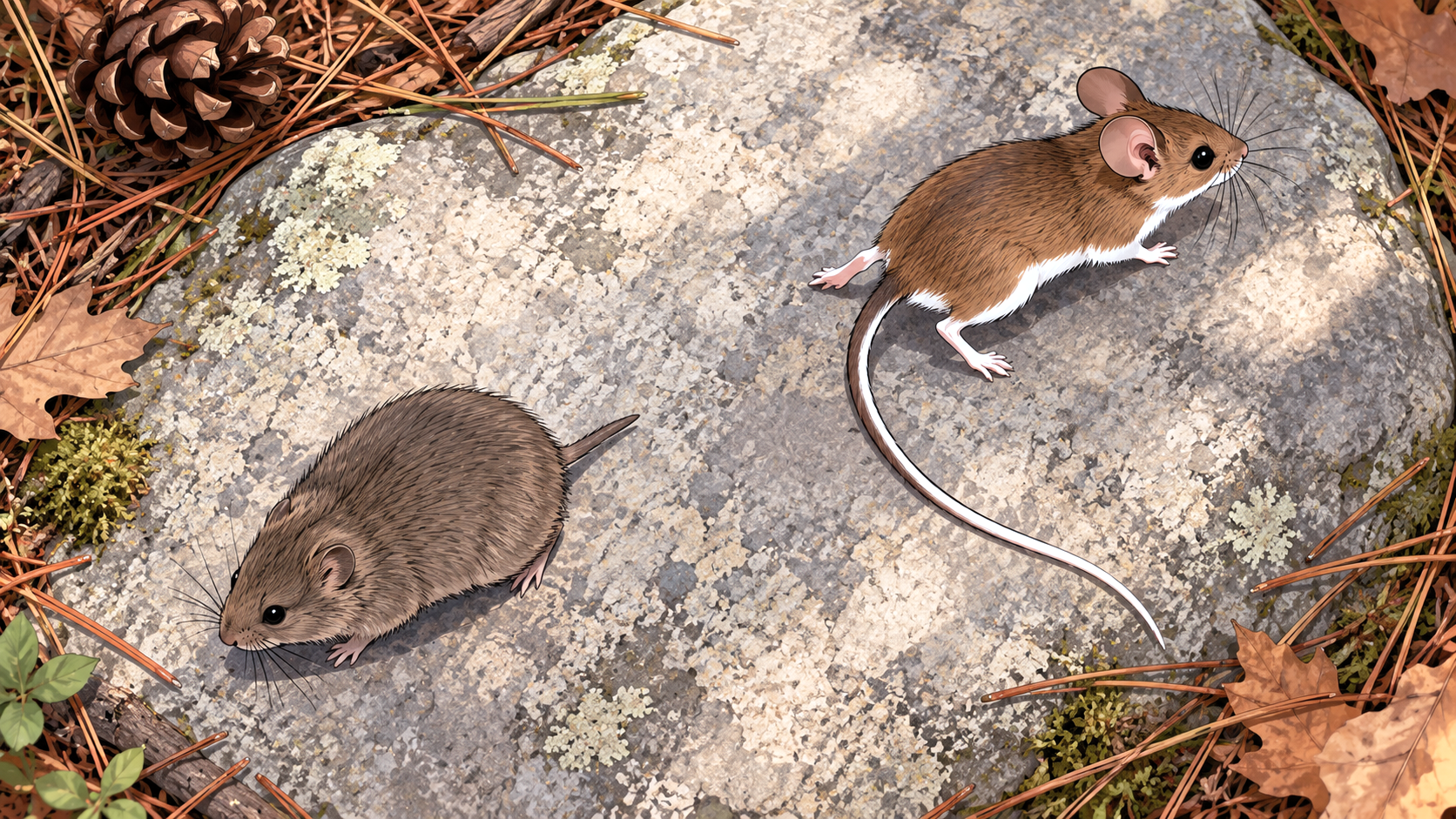
A deer mouse has a pointed muzzle, large dark eyes, prominent ears, and a relatively long tail that is usually dark above and white underneath. A vole has a rounder, heavier-looking body, a blunt snout, smaller ears partly hidden in fur, and a shorter tail. The easiest way to distinguish a vole from a deer mouse is to examine the face and tail together, rather than relying on body size or brown fur.
The comparison is particularly relevant in North America, where deer mice and several vole species occupy overlapping habitats. However, vole describes many species, while deer mouse commonly refers to the North American deer mouse, traditionally identified as Peromyscus maniculatus. Its taxonomy has undergone revisions, so an animal identified broadly as a deer mouse in older references may belong to a more narrowly recognized species.
The Deer Mouse Has a More Distinctive Face
The eyes are often the first feature that separates these rodents. Deer mice have large, dark, prominent eyes set within comparatively slender faces. Their ears stand well above the surrounding fur, and their muzzles taper toward pointed noses. These features give the animal a more delicate appearance than the compact, rounded face of a typical vole.
The large eyes, exposed ears, and pointed muzzle of deer mice are characteristic of the genus Peromyscus. Their whiskers are also relatively long and noticeable, especially in side-view photographs.
Meadow voles and prairie voles have smaller eyes and ears, with blunt noses and broader faces. Their ears may be partly concealed by the fur even when viewed from the side. Woodland voles often have particularly inconspicuous eyes and ears because they spend much of their time underground.
These differences in vole head shape and proportions make the face especially informative when the tail is hidden. An animal with a noticeably pointed nose and large, exposed ears is more suggestive of a deer mouse, while a blunt-faced animal with small ears favors a vole.
The distinction becomes less reliable with young animals or photographs taken from directly above. A vole’s ears may look larger when its fur is flattened, and a frightened deer mouse may crouch so tightly that its body appears unusually rounded.
A Two-Toned Tail Strongly Favors a Deer Mouse
Deer mice generally have slender tails with sharply contrasting colors: darker brown or gray on top and white underneath. The tail is covered with fine hairs and can approach the length of the animal’s head and body, although its proportions vary among populations.
The sharply bicolored tail of the North American deer mouse is one of its most recognizable identification features. Depending on the population, the tail may be relatively short or particularly long, so its coloring is often more useful than an assumed minimum length.
Voles typically have thicker-looking, shorter tails relative to their bodies. Meadow voles possess moderately short, sparsely furred tails, while woodland voles have exceptionally short ones. Prairie voles also appear compact from behind because their tails project comparatively little beyond their bodies.
The short tails and stocky proportions characteristic of voles distinguish them from deer mice, but tail length alone is insufficient because vole species vary considerably.
A long tail with a clear dark upper surface and white lower surface strongly supports a deer mouse identification. A short tail that appears uniformly dark or only weakly two-toned is more consistent with many familiar vole species.
Coloration is not absolute. Some voles have lighter tail undersides, while deer mice from different habitats can exhibit substantial variation in tail length.
Their Body Shapes Differ More Than Their Overall Sizes
Deer mice are relatively slender rodents with longer-looking hind limbs and a body that often appears slightly arched when moving. Voles have shorter-looking legs and broader bodies, giving them a heavier appearance even when their actual weights are similar.
Both can fit within the same general size range. The average deer mouse weighs approximately 15–30 grams, although populations vary. Meadow voles frequently weigh more, but small adults and juveniles can overlap substantially with deer mice.
The measurements of deer mice across North American populations illustrate this variation, with total lengths ranging approximately from 12 to 22.5 centimeters, including the tail. That range cannot be compared directly with a vole’s head-and-body length unless both measurements include the same anatomical parts.
The variation in adult vole sizes also means that an unusually small vole should not automatically be classified as a mouse.
| Feature | Deer mouse | Typical meadow or prairie vole |
|---|---|---|
| Muzzle | Narrower and pointed | Broader and blunt |
| Eyes | Large and prominent | Small and less prominent |
| Ears | Large, exposed above fur | Smaller, partly hidden |
| Body | Relatively slender | Stocky and rounded |
| Legs | More visible, especially hind legs | Shorter-looking |
| Tail | Relatively long, often sharply two-toned | Shorter relative to body |
| Belly | Usually distinctly white | Commonly gray, cream, or buff |
| Feet | Usually white | Variable, often darker or less contrasting |
These differences are most useful when comparing a deer mouse with a familiar grassland vole. Other vole species may have somewhat different proportions, and no single row should be treated as a universal identification test.
White Feet and a Bright Belly Are Additional Deer Mouse Clues
Deer mice often have a clear color boundary between the brown or grayish-brown upper body and the white underside. Their feet are typically white, sometimes creating the impression of small white socks against darker legs.
The white feet, pale underside, and distinctly contrasting upper coat of deer mice provide useful supporting features when the animal is photographed in natural light.
Voles also have lighter undersides, but the contrast is often less pronounced. Meadow voles usually have grayish or silvery bellies, while prairie voles frequently show buff or yellowish tones. Their upper coats tend to look more evenly mottled than the strongly divided coloration of many deer mice.
The natural colors found among vole species can overlap with those of deer mice, especially when the animal is wet, young, or photographed under artificial lighting.
A white belly is therefore supporting evidence, not proof. Several other North American mice also have contrasting white undersides, including the white-footed mouse (Peromyscus leucopus), which can resemble a deer mouse closely.
A Mouse-Like Animal in a Field Is Not Necessarily a Vole
The habitats of deer mice and voles overlap extensively. Both may be encountered in grassy fields, agricultural margins, woodland edges, and rural yards.
Deer mice occupy a wide variety of North American environments, including forests, prairie, shrubland, farmland, and rocky areas. Their habitat preferences vary considerably between woodland and grassland populations, making the location of an individual sighting a weak identification clue by itself.
Voles are frequently associated with dense vegetation, particularly grasslands and sheltered ground cover. Meadow voles maintain well-used routes through grass, while certain woodland voles spend much of their time below the soil surface.
Finding an animal moving along narrow runways through dense grass is consistent with vole activity, but deer mice can also travel through covered vegetation and use existing pathways.
The surrounding terrain may help establish which animals are plausible locally, yet a deer mouse can occupy a field just as readily as an animal belonging to a grassland vole species. Physical characteristics remain more dependable than the word field in a habitat description.
Watch How the Animal Moves, but Don’t Rely on Speed Alone
Deer mice often move with quick running movements and may make noticeable jumps when disturbed. Their relatively long hind legs contribute to this agile appearance. They are also capable climbers, particularly in habitats containing shrubs, trees, and other elevated structures.
The jumping and climbing abilities of deer mice can make them appear quite different from a stocky rodent traveling through grass.
Voles commonly run close to the ground, particularly along sheltered vegetation routes. Their short legs and rounded bodies produce a compact silhouette. However, some voles can jump, climb low obstacles, and move quickly when startled.
The ability of voles to jump prevents movement style from serving as a definitive identification test.
An animal making several long bounds may favor a deer mouse identification, especially when accompanied by prominent ears and a two-toned tail. A low-running animal with a blunt face and short tail favors a vole. Either observation becomes considerably less reliable when the animal is seen for only a moment.
Why Deer Mouse Identification Depends on Geography
The name deer mouse has historically been applied to a broad group of closely related North American populations. Genetic and taxonomic research has separated several of these into distinct species, complicating older range maps that identify nearly all of them as Peromyscus maniculatus.
Under a narrower modern classification, the eastern deer mouse, Peromyscus maniculatus, occupies portions of eastern and central North America. Populations formerly included within that species have been reassigned to other taxa, including Peromyscus sonoriensis and Peromyscus gambelii.
These changes do not eliminate the familiar deer mouse appearance. Many members of the broader group retain large eyes, exposed ears, white feet, and distinctly two-toned coats or tails.
They do affect how precisely an animal can be named. A deer-mouse-like rodent seen in western North America should not automatically be assigned the scientific name P. maniculatus without considering the taxonomy and species recognized for that region.
The relationships within the deer mouse species group are complex enough that external appearance may not separate every closely related species reliably.
For the purpose of distinguishing a vole from a deer mouse, genus-level features are generally more useful than assuming a particular deer mouse species occurs everywhere in North America.
What If You Only Have a Photograph?
A useful identification photograph should show the animal’s entire side, including its muzzle, ears, feet, and tail. A second image taken from behind may reveal whether the tail has sharply contrasting upper and lower colors.
A photograph showing only brown fur or a rounded body provides little useful information. Both deer mice and voles have substantial variation in coat color, and body shape can change with posture.
Start with the most visible features. Large exposed ears, prominent eyes, a pointed muzzle, white feet, and a relatively long two-toned tail together make a strong case for a deer mouse. A blunt muzzle, inconspicuous ears, smaller eyes, compact body, and comparatively short tail favor a vole.
When the evidence remains incomplete, identification as a small rodent or probable vole is more defensible than assigning a precise species. Visual appearance also cannot determine whether an animal carries an infectious organism. The risk of hantavirus associated with particular rodents must not be inferred from the size, color, or apparent health of an individual animal.