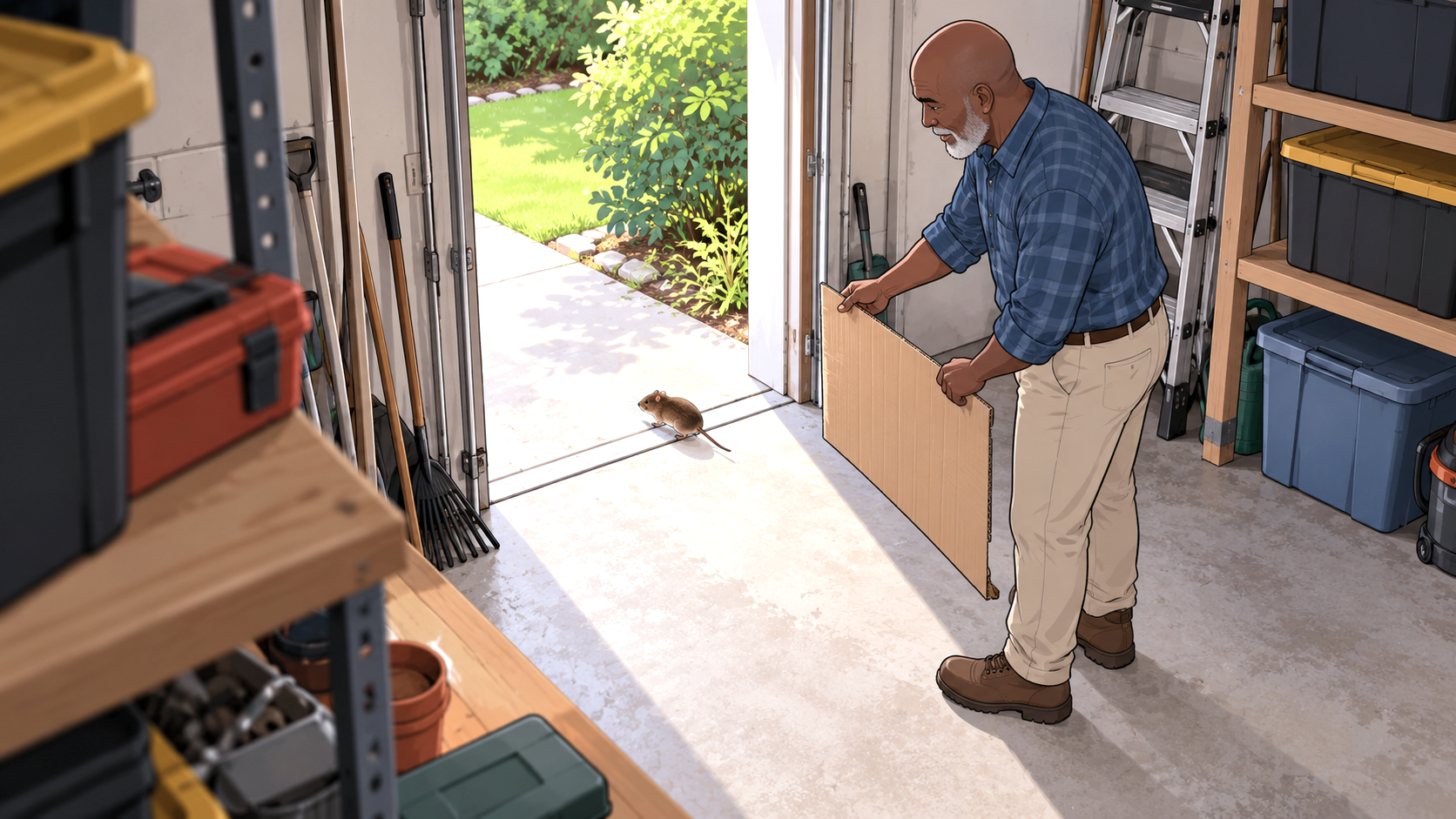
To get a vole out of your house or garage, isolate it in one area, keep children and pets away, and guide it toward a safe outdoor exit or contain it without direct handling. A small, ventilated box or an appropriately sized live-capture trap may be suitable, depending on the animal’s location and local wildlife rules. Once the vole is outside, inspect the building for the opening it used and seal the gap after confirming no animals remain inside.
Voles are primarily outdoor rodents and rarely establish themselves inside homes. A single animal discovered on a garage floor may have wandered through an open door, while repeated signs of rodents in walls or an attic warrant closer identification before any removal method is chosen.
First, Make Sure the Animal Is Actually a Vole
A vole can resemble a mouse when it darts behind furniture, but its proportions are different. Most commonly encountered voles have rounded bodies, relatively blunt faces, small ears partly concealed by fur, and short tails. House mice generally have more prominent ears, slimmer bodies, and longer tails.
The physical differences between voles and mice are particularly useful when evaluating photographs taken indoors. Try to capture the entire animal, including its tail, without cornering it or attempting to pick it up.
Location provides additional context. Voles spend much of their time among vegetation, shallow burrows, and sheltered ground-level routes. Their usual association with outdoor ground cover makes an occasional garage encounter more plausible than a persistent infestation in an upper-story ceiling.
Droppings alone may not resolve the identification. Small pellets from voles and mice can overlap considerably in appearance, so vole droppings and mouse droppings should be interpreted alongside sightings, entry points, and other evidence.
If you have only heard scratching or movement inside the attic, do not identify the animal as a vole. Mice, squirrels, and other animals can occupy roof spaces, and the appropriate removal method depends on which animal is actually present.
Getting a Vole Out of a Room Without Catching It
When a vole is visible in a room with a direct exterior doorway, allowing it to leave voluntarily may be the simplest option.
Close interior doors to prevent movement into other rooms, block accessible gaps beneath those doors with rolled towels, and remove pets from the area. Open an exterior door only if it leads directly to a safe outdoor location and can be monitored without compromising household security.
A vole may remain hidden rather than immediately moving toward an opening. Reduce noise and movement, step back, and give it an opportunity to leave. Avoid chasing it with a broom or repeatedly moving furniture, which can cause the animal to retreat into less accessible spaces.
If it remains exposed on an open floor, a large rigid container can sometimes be lowered gently over it. Slide a firm piece of cardboard underneath, keeping the container level and avoiding contact with the animal’s body or tail. Wear protective gloves and make sure the container cannot tip or open unexpectedly.
Small wild rodents can bite when frightened. The possibility of a defensive vole bite is a reason to use a container rather than bare hands.
This approach is appropriate only when the animal can be contained without force or excessive pursuit. A vole wedged behind appliances, inside machinery, or beneath heavy furniture is better left undisturbed while a suitable removal method is arranged.
Removing a Vole From a Garage
Garages present different challenges because they often contain stored materials, shelving, vehicles, and equipment that provide numerous hiding places. A vole may be visible one moment and disappear beneath a cabinet or woodpile the next.
Begin by closing the door connecting the garage to the house. Keep pets out, and avoid operating vehicles, power tools, or equipment near the animal’s suspected hiding place.
If the vole entered through an open garage door and remains near the floor, a clear route back outdoors may be sufficient. Remove obvious obstacles from that route without dismantling the entire storage area. There is no need to expose every corner of the garage when the animal can leave through an accessible exit.
Where direct removal is impractical, small live traps can be used for occasional voles inside buildings. Choose a trap intended for small rodents, place it along the area where the animal has actually been seen, and follow its instructions. Keep the trap away from children, pets, direct sunlight, freezing conditions, and vehicle traffic.
Live capture does not eliminate the animal’s need for prompt attention. Small rodents confined in traps can experience considerable stress, particularly when left without suitable conditions. Check the trap frequently and arrange lawful, prompt release or qualified assistance. Do not leave it unattended overnight merely for convenience.
Before releasing a captured vole, confirm the applicable wildlife rules. Release near the original capture location in suitable sheltered habitat when permitted and safe. Transporting a vole to a distant field is not automatically legal or humane, and an unfamiliar location may leave it exposed to predators or unsuitable conditions.
What If the Vole Is Inside a Wall or Attic?
An inaccessible animal requires more caution than one moving across a floor. Do not cut into walls, pull apart insulation, or seal suspected exits while there is evidence that something remains inside.
First establish whether the animal is a vole. Persistent attic noises are not characteristic evidence of vole activity, and a high entry point may suggest another rodent or wildlife species. Even a genuine vole sighting at ground level does not prove that additional animals in the roof are voles.
Inspect accessible spaces for signs of recent activity without disturbing suspected nesting material. A clear photograph or brief observation of the animal is more informative than guessing from scratching sounds. If identification remains uncertain, a qualified wildlife or pest-control professional can assess accessible entry routes and determine an appropriate removal method.
Avoid placing unapproved poisons or fumigants inside wall cavities. They can expose occupants or pets to hazardous substances, and an animal that dies in an inaccessible location creates additional problems. Indoor rodent removal should be accompanied by inspection of entry points, rather than relying on treatment inside concealed spaces.
Professional assistance is particularly appropriate when an animal may be trapped, when young may be present, or when access requires disturbing electrical equipment, insulation, or building materials.
Finding and Sealing the Entry Point
A successful capture does not establish that the building is secure. Inspect the area where the vole was first seen, especially doors, foundations, utility penetrations, and the junction between the garage floor and exterior walls.
Rodents can exploit surprisingly small openings. House mice can pass through a gap approximately 1/4 inch wide, making that measurement a useful precaution when inspecting a building for small-rodent access. It is not a scientifically established minimum opening size for every vole species.
Common locations worth examining include damaged door sweeps, gaps around pipes, deteriorated weatherstripping, loose utility penetrations, and openings beneath garage doors. Search outdoors as well as indoors, since a gap may be hidden behind vegetation or stored materials.
Small openings can often be repaired with appropriately secured metal mesh and compatible sealant. Larger defects may require hardware cloth, metal flashing, cement, or another durable building material. Expanding foam alone is not a dependable rodent-resistant barrier because animals may chew through it.
Before sealing a suspected active entrance, make sure the animal has left and no dependent young or other wildlife remain inside. An opening should not be closed merely because it is temporarily quiet.
Vegetation growing against the foundation can conceal gaps and provide sheltered approaches. The yard conditions that attract voles may therefore make a ground-level opening more accessible, even though they do not establish that voles will enter the building.
How to Tell Whether Another Vole Is Still Inside
After removal, inspect the same room or garage for fresh signs of rodent movement. Check sheltered edges, the location of the original sighting, and any suspected access points that have not yet been repaired.
Fresh droppings, repeated sightings, newly disturbed stored material, or additional movement may indicate that another animal remains. Old evidence cannot establish current occupancy, and the disappearance of one captured vole does not prove that every concealed space is empty.
Monitor the area before declaring the problem resolved. If signs continue despite closing accessible gaps, arrange a more thorough inspection rather than repeatedly capturing animals without determining how they enter.
The differences between voles and other household rodents remain important when new activity appears. A single outdoor vole entering a garage and an established indoor mouse problem are not equivalent situations.
What to Do With an Injured Vole Found Indoors
An injured, unusually weak, or unresponsive vole should not simply be released outdoors. Its condition may prevent it from escaping predators or reaching shelter.
Avoid attempting to feed it, force water into its mouth, or treat visible wounds. If safe containment is possible, keep the animal in a ventilated container in a quiet location away from pets while contacting a qualified wildlife rehabilitator.
The appropriate response to an injured or dependent vole depends on its condition, and animals found trapped in machinery or enclosed spaces may require professional assessment even when injuries are not obvious.
Any droppings or nesting material discovered during removal should be treated as potentially contaminated. Avoid dry sweeping or vacuuming, and use wet disinfection and safe removal of rodent waste before restoring the area to normal use.