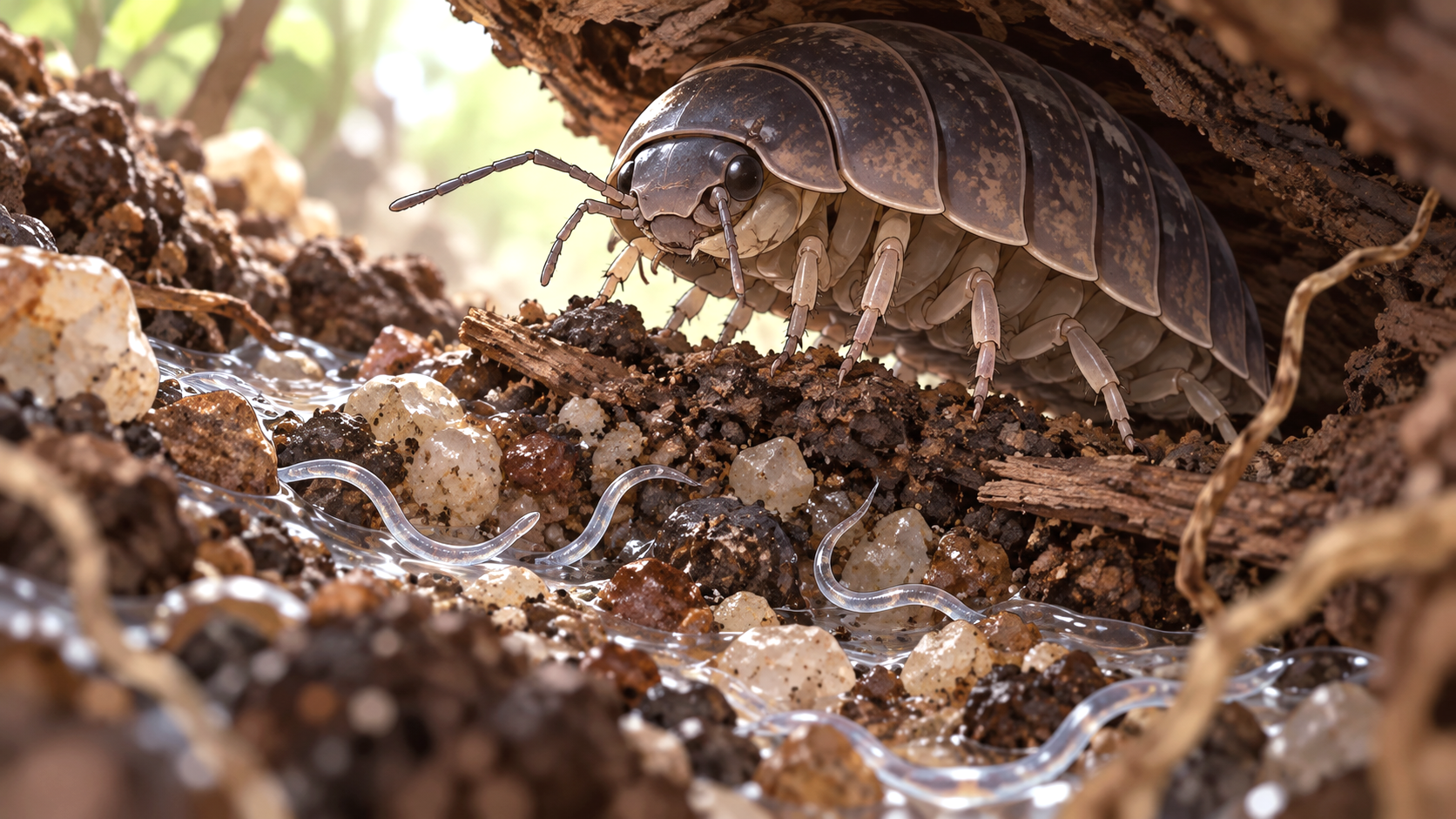
Some nematodes can infect and kill roly-polies, but commercial beneficial nematodes are not a reliable treatment for the common pill bug (Armadillidium vulgare). Laboratory experiments have demonstrated infections in several terrestrial isopod species, including sowbugs. However, susceptibility differs considerably between species, and a major comparative study found that common pill bugs survived exposure to three widely used insect-parasitic nematodes. There is no established nematode treatment that consistently controls roly-poly populations in ordinary gardens.
This makes the answer more complicated than the familiar advice to use beneficial nematodes against soil pests. Their ability to kill certain insects does not establish that they will control a crustacean living in the same soil.
What Research Shows About Nematodes Killing Roly-Polies
An early laboratory investigation published in 1985 demonstrated that nematodes now known as Steinernema carpocapsae could infect common pill bugs. The same experiments found that sowbugs belonging to the genus Porcellio were more susceptible. Researchers observed nematodes entering and developing within the animals’ body cavities, establishing that terrestrial crustaceans were possible hosts under experimental conditions. The laboratory infection study also examined nematodes from the genus Heterorhabditis.
A broader experiment published in 2008 compared three entomopathogenic nematodes against eight terrestrial isopod species. Steinernema carpocapsae and Heterorhabditis bacteriophora reduced survival in six species, while Steinernema feltiae affected two. Crucially, neither Armadillidium vulgare nor Armadillo officinalis showed reduced survival under the tested treatments. The comparative study of nematode-bacterium complexes demonstrated that responses vary substantially between closely related crustaceans.
The earlier infection results and later survival findings measure different outcomes under different experimental conditions. Establishing that a nematode can enter an individual pill bug does not prove that a garden application will kill enough animals to control a population. The later study also found that infected isopods were reproductive dead ends for the tested nematodes, which failed to produce offspring emerging from those hosts.
For homeowners considering a purchase, the evidence does not support treating commercial nematodes as a dependable roly-poly killer.
Why Nematodes Work Against Some Soil Pests but Not Pill Bugs
Beneficial nematodes sold for pest control are microscopic roundworms that infect susceptible arthropods. The commercially important genera Steinernema and Heterorhabditis carry symbiotic bacteria that contribute to killing their hosts. Once a suitable host is infected, the nematodes can develop and reproduce within its body.
Their effectiveness depends heavily on the target species. Steinernema carpocapsae is used against certain insects active near the soil surface, including cutworms and some billbugs. Heterorhabditis bacteriophora actively searches deeper in the soil and can control susceptible beetle grubs. The biological control characteristics of Steinernema carpocapsae and the target range of Heterorhabditis bacteriophora illustrate how treatment choices depend on the particular pest being attacked.
The common pill bug belongs to the crustaceans rather than the insects. Its physiology and defenses differ from those of the insect larvae that commercial nematodes are commonly used to control. Even within terrestrial isopods, experimental susceptibility varies enough that results obtained from sowbugs cannot be applied automatically to Armadillidium vulgare.
A package advertising control of numerous soil-dwelling insects therefore provides no reliable basis for expecting control of pill bugs.
Can Naturally Occurring Parasitic Nematodes Infect Roly-Polies?
Commercial insect-parasitic nematodes are only part of the wider group. Other nematodes naturally infect terrestrial isopods, including members of the family Mermithidae.
A study published in 2023 documented Agamermis nematodes parasitizing Armadillidium vulgare in Argentina. The infected animals were discovered during an investigation involving entomopathogenic nematodes. The research identifying Agamermis infection confirmed the parasite through morphological examination and genetic analysis.
A separate investigation of a natural population in Japan examined 1,553 common pill bugs and found an overall mermithid infection prevalence of 4.2%. Infection levels reached 10% to 28% during certain sampling periods. The population study of naturally infected pill bugs also examined the potential effects of parasitism on reproduction and population dynamics.
These observations establish that nematode parasitism occurs in wild roly-poly populations. They do not establish a practical biological control method. Naturally occurring mermithid parasites are different from the beneficial nematode products commonly sold for garden insect control.
Should You Apply Beneficial Nematodes to Control Roly-Polies?
We would not recommend purchasing beneficial nematodes solely to eliminate roly-polies. Their performance against the common pill bug lacks dependable field evidence, and maintaining the conditions necessary for nematodes to survive may work against efforts to discourage pill bugs.
Commercial beneficial nematodes require moisture to move through soil and locate suitable hosts. Application guidance commonly calls for moist soil, protection from intense sunlight, and irrigation after treatment. The University of California’s insect-parasitic nematode guidance explains these environmental requirements and identifies insect pests for which the organisms have established uses.
Roly-polies also favor damp soil and sheltered organic material. Keeping a planting bed consistently moist to support a nematode application may preserve the conditions attracting pill bugs, without producing dependable control. The comparison below summarizes the practical implications of using the three commonly marketed nematode species against them.
| Beneficial nematode | Established insect targets | Evidence involving terrestrial isopods | Recommendation for common roly-polies |
|---|---|---|---|
| Steinernema carpocapsae | Certain cutworms, billbugs, and other susceptible insects | Laboratory infections demonstrated; variable survival effects between isopod species | Not recommended as a dependable control |
| Steinernema feltiae | Fungus gnat larvae and certain other fly larvae | Reduced survival in two of eight tested isopod species | Not recommended |
| Heterorhabditis bacteriophora | Susceptible white grubs and root-feeding beetle larvae | Reduced survival in several isopod species, but not common pill bugs in the comparative study | Not recommended |
The comparison uses observed host susceptibility rather than assumptions based on the products’ general pest-control claims. Even where nematodes successfully infect another isopod species, the findings do not establish an effective application rate or control program for common garden roly-polies.
Beneficial nematodes can still be useful when a garden has a separate, correctly identified insect problem. For example, springtails in potted plants can occur alongside fungus gnat larvae, but their presence does not establish that a fungus gnat treatment is necessary. Nematode selection must correspond to the pest actually causing damage.
What Works Better Than Nematodes for Roly-Polies?
Where pill bugs are damaging seedlings or vegetables touching damp soil, changing the immediate growing conditions is better supported than applying nematodes. Reducing unnecessary irrigation, removing excessive decaying debris, and separating vulnerable produce from wet ground can limit feeding opportunities.
The University of California’s pill bug management recommendations favor these cultural controls, including drip irrigation, suitable planting containers, and reducing organic material directly around vulnerable plants. Watering adjustments must remain compatible with healthy plant growth.
Gardens contain other arthropods capable of damaging seedlings, including earwigs that feed on garden plants. Pill bugs should be observed feeding on the affected tissue before assigning responsibility. If the animals are merely present beneath a plant, eliminating them may have no effect on the actual damage.
For indoor roly-poly problems, beneficial nematodes are especially unsuitable. They are not designed to function as household perimeter barriers, and the moisture required to keep them active is undesirable in a basement or crawlspace. Correcting entry points and damp conditions addresses the circumstances that allow pill bugs to appear indoors.
The University of Maryland’s pill bug management guidance recommends moisture reduction, removing shelter near foundations, and sealing openings around doors and windows. These measures also help address conditions associated with springtails entering houses.
Where beneficial nematodes are being purchased for another pest, follow the supplier’s instructions for that identified target. There is no reason to increase application rates or repeatedly treat soil in the hope of improving their performance against pill bugs.
Roly-polies are useful decomposers in ordinary garden habitats. Leaving harmless populations undisturbed avoids spending money on a treatment without established effectiveness and preserves their contribution to organic matter breakdown.
This post reflects our own research and isn’t a substitute for advice from a licensed pest control professional. Always follow the product label. See our full disclaimer for more.