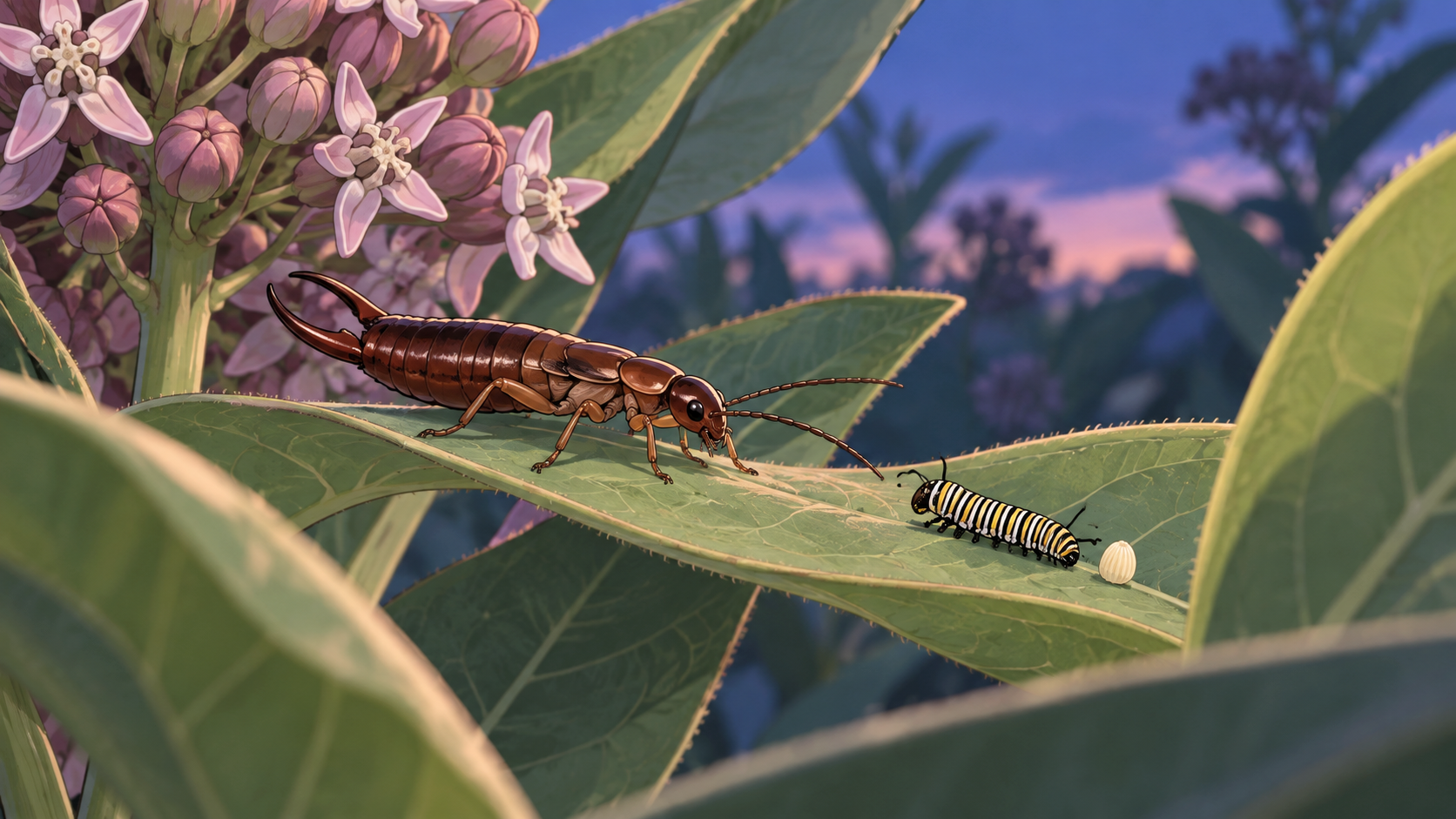
Earwigs can eat monarch caterpillars, particularly newly hatched larvae. They also prey on monarch eggs. Scientific research has confirmed that European earwigs (Forficula auricularia) consume both life stages, including observations of predation on milkweed plants. However, an earwig found near a missing caterpillar is not proof that it was responsible.
The risk is greatest for eggs and very young caterpillars, which are small enough for a variety of predatory insects to consume. Larger monarch caterpillars face other threats, and the available evidence does not establish earwigs as major predators of late-stage larvae.
What Research Shows About Earwigs Eating Monarchs
A 2019 study published in Scientific Reports investigated insects and other arthropods associated with milkweed to determine which could consume monarch eggs and newly hatched caterpillars. Researchers tested 75 arthropod groups in laboratory feeding trials and supplemented the experiments with observations of predation outdoors.
European earwigs were among the predators that consistently consumed monarch eggs and newly hatched larvae in the laboratory trials. Independent field observations also confirmed earwig predation on immature monarchs. The research identifying previously unrecognized monarch predators therefore provides direct evidence rather than relying solely on earwigs’ general reputation as omnivores.
There are important limits to these findings. The laboratory experiments used no-choice conditions, meaning the tested predator was presented with monarch eggs or larvae without the range of alternative foods available outdoors. Such experiments establish the ability and willingness to feed, but they cannot determine how frequently an earwig chooses monarchs in a natural milkweed patch.
The study also focused on eggs and newly hatched larvae. Its results should not be used to claim that earwigs regularly kill large, nearly mature monarch caterpillars. The actual contribution of earwig predation to monarch mortality varies with the local predator community and remains difficult to quantify across habitats.
Why Monarch Eggs and Newly Hatched Caterpillars Are Vulnerable
A monarch egg is small and attached directly to a milkweed leaf. Newly emerged caterpillars are also tiny and initially remain close to the place where they hatched. Both stages can encounter predators searching the same plant for food.
Researchers observed European earwigs resting among newly developing milkweed leaves, where young monarch caterpillars may also be found. This creates opportunities for contact even when the earwig has not specifically traveled to the plant to hunt monarchs.
Monarch caterpillars obtain defensive chemicals called cardenolides from milkweed. These compounds make monarchs unpalatable or toxic to many predators, but the protection is incomplete. Monarch chemical defenses and natural enemies show that numerous invertebrates can successfully prey on eggs and larvae despite their association with toxic milkweed.
The earliest stages of development are particularly vulnerable because even one encounter can result in the complete loss of an egg or newly hatched larva. A larger caterpillar has more developed defenses and different physical characteristics, although it remains susceptible to certain predators and parasites.
The earwig’s ability to consume other insects is part of its role in garden food webs. Its predatory behavior can be beneficial when directed toward crop pests, but it can also affect insects that gardeners are trying to conserve.
How to Tell Whether Earwigs Are Eating Your Monarchs
A disappearing caterpillar creates uncertainty because several events can produce the same observation. It may have been eaten, moved to another part of the plant, died from disease, or left the milkweed to pupate.
The most convincing evidence is direct observation of an earwig attacking or consuming a monarch egg or caterpillar. Finding an earwig on the same milkweed plant provides considerably weaker evidence, particularly when ants, spiders, wasps, and other predators are also present.
A practical investigation begins with identifying the monarch’s developmental stage. Eggs and newly hatched larvae that disappear are more consistent with possible predation than a large, mature caterpillar that vanishes shortly before pupation. Fully grown monarch caterpillars commonly leave milkweed to find a pupation site, so their disappearance does not automatically indicate that something ate them.
For a milkweed plant where young monarchs repeatedly disappear, photograph the eggs or caterpillars and record their approximate positions. Return after dark with a flashlight and inspect the same leaves, particularly the undersides and newly developing foliage. Earwigs are predominantly active at night, making evening observations useful when investigating possible feeding.
Do not shake the plant or repeatedly handle the caterpillars during inspection. Such disturbance can dislodge small larvae and make the original disappearance harder to interpret. Observe from a short distance before moving leaves.
If you witness predation, photograph the interaction when possible. A clear record showing both the predator and monarch is more informative than separate photographs taken at different times.
Other Predators That Can Be Mistaken for Earwigs
Monarch eggs and caterpillars are attacked by a diverse collection of organisms. Earwigs are only one possible predator among many insects and spiders associated with milkweed.
| Predator | Relevant threat to monarchs |
|---|---|
| Earwigs | Confirmed consumption of monarch eggs and newly hatched larvae |
| Ants | Some species attack eggs and caterpillars |
| Lacewing larvae | Can consume monarch eggs and young larvae |
| Lady beetles | Certain species consume monarch eggs and small caterpillars |
| Spiders | Some capture monarch caterpillars or consume eggs |
| Predatory stink bugs | Certain species attack monarch larvae |
| Paper wasps | May capture caterpillars to feed their developing young |
The diversity of natural monarch predators means that removing one earwig cannot establish whether other predators remain active.
Ants are particularly easy to overlook because some species travel repeatedly over milkweed stems while tending aphids. Their presence is not automatic evidence of monarch predation, but certain ants do consume monarch eggs and larvae.
Lacewing larvae and lady beetles are commonly considered beneficial because they eat aphids. Some also consume immature monarchs. Consequently, an insect that is useful elsewhere in the garden can still pose a risk to monarchs under particular circumstances.
Parasites and diseases add further uncertainty. Tachinid flies can parasitize monarch caterpillars, with their larvae eventually killing the host. A caterpillar that becomes sick or dies without an observed attack may therefore have experienced a problem unrelated to earwigs. Monarch diseases and parasitoids require a different interpretation from an insect being visibly consumed.
Should You Remove Earwigs From Milkweed?
Finding earwigs on milkweed does not justify eliminating every individual. Predation is a natural part of monarch ecology, and earwigs also consume insects that can damage garden plants.
If an earwig is actively attacking an egg or young caterpillar, carefully removing that particular insect is a reasonable way to protect the monarch without treating the entire plant. Use a small container and a piece of stiff paper rather than grabbing the insect or disturbing the caterpillar. Relocate the earwig away from the milkweed.
An earwig resting beneath a leaf without evidence of predation presents a different situation. Removing every insect from milkweed can disturb other wildlife without necessarily improving monarch survival. Monarch conservation guidance discourages killing suspected predators because predation is part of the natural ecosystem and the responsible species is frequently uncertain.
Avoid removing the surrounding vegetation indiscriminately. Milkweed patches and native flowering plants support numerous organisms, including those involved in pollination and biological pest control. The conservation of monarch habitat depends on maintaining suitable host plants and nectar resources rather than creating an insect-free garden.
The immediate presence of a predator is also not proof that monarch mortality is unusually high at that location. In the wild, many monarch eggs never survive to adulthood, and predation is one of several contributing factors.
How to Protect Monarch Eggs and Caterpillars Without Spraying Milkweed
Pesticide applications around milkweed present a serious risk because the plant is the monarch caterpillar’s food source. An insecticide intended to kill earwigs may also kill monarch larvae directly or contaminate the foliage they consume.
Even treatments marketed as natural or suitable for gardens can harm caterpillars. The effects of insecticides on milkweed-associated wildlife include direct toxicity to monarchs and other beneficial insects. Systemic products are particularly concerning because their active ingredients can move into plant tissues and remain available to feeding organisms.
Avoid applying broad-spectrum insecticides, insecticidal soaps, botanical sprays, or homemade pest-killing mixtures to milkweed containing monarch eggs or caterpillars. A substance does not become selective for earwigs simply because it is plant-derived.
Targeted protection can begin with regular observation and manual removal of a confirmed predator. Where a particularly vulnerable egg or young caterpillar is being monitored, an appropriately ventilated protective mesh sleeve may offer temporary protection if it is designed and positioned so that it does not trap predators inside, injure the plant, or interfere with the monarch’s development. Such protection requires continued inspection and should not be treated as a guaranteed way to improve survival.
Large-scale captive rearing is also not a substitute for protecting habitat. Confined monarchs can experience disease transmission and other problems, and large-scale captive rearing is not recommended as a conservation strategy. Supporting healthy milkweed habitat generally provides greater long-term value than attempting to raise every caterpillar indoors.
Where possible, plant additional milkweed species native to the region. Providing more suitable host plants increases opportunities for monarch females to lay eggs and for developing caterpillars to find foliage. Protect these plants from unnecessary pesticide applications and avoid removing occupied stems during routine gardening.
What to Do When Monarch Caterpillars Keep Disappearing
Repeated disappearances deserve observation before intervention. Mark the position of newly found eggs and young caterpillars with photographs, without placing anything directly on the insects. Check them at consistent intervals and record whether they remain present, develop normally, or disappear.
Separate observations of actual predators from assumptions based on nearby insects. An earwig feeding on a monarch is confirmed evidence. An earwig sitting inside a rolled leaf several hours after a caterpillar vanished establishes only that both occupied the plant.
Nighttime monitoring may be especially informative because some monarch predators are active after dark. Research on predation of monarch eggs and larvae has identified nocturnal feeding events involving earwigs and several other arthropods. Daytime inspections alone can therefore miss important interactions.
Do not interpret every disappearance as predation. Older caterpillars may leave the host plant before pupation, while younger larvae can move to nearby foliage and become difficult to relocate. Disease, weather, and accidental dislodging also affect survival.
If direct observations repeatedly identify earwigs as the predator, remove the individuals responsible when practical and continue monitoring the affected milkweed. If no attacks are observed, concentrate on maintaining healthy, pesticide-free habitat rather than treating the entire patch for a suspected culprit.