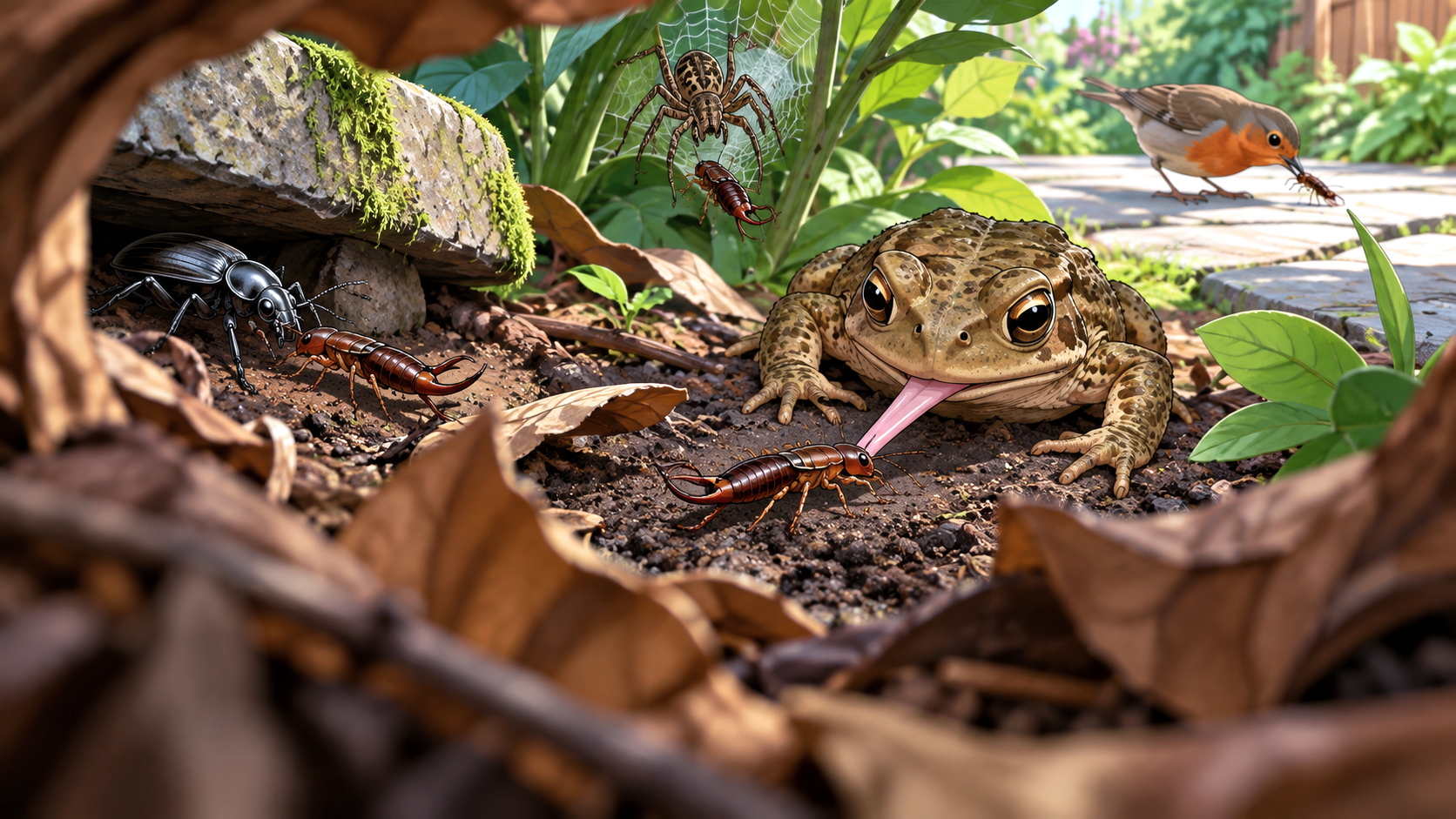
An earwig spends much of the day doing something that makes perfect sense for an insect with plenty of enemies: hiding. Beneath mulch, boards, leaves and other cover, it is harder for a hungry bird or toad to find. Once darkness arrives and the earwig comes out to feed, that protection changes.
Earwigs are eaten by several natural predators, including toads, songbirds, chickens, ducks and turkeys. European earwigs are also attacked by parasitic tachinid flies. Their foul-smelling defensive secretion can discourage some predators, but it certainly does not make them predator-proof.
The interesting part is that earwigs sit on both sides of the food web. They hunt smaller creatures themselves, yet they also become food for larger animals and parasites.
Birds Are Among the Best-Documented Earwig Predators
For an insect that spends daylight hours tucked into narrow shelters, birds might seem like an odd enemy. Yet birds are among the natural predators specifically documented feeding on European earwigs.
Songbirds will eat earwigs, and researchers have even observed birds feeding on earwigs collected in cardboard traps. That observation is useful because it shows how an earwig’s hiding behavior can work against it. A shelter protects the insect while it remains concealed, but once that shelter is disturbed or exposes a concentrated group, a predator has an opportunity.
Domestic birds can be even more conspicuous earwig eaters. Chickens, ducks and turkeys all consume them, while chickens and ducks can eat substantial numbers of earwigs.
That does not make poultry a precision earwig-control system. Chickens and ducks forage for many different things rather than targeting one pest on command. Still, in a garden where the birds already belong, earwigs can become another item on the menu.
Toads Hunt in the Same World Earwigs Use at Night
Toads and earwigs have an important overlap: both can be active around gardens after daylight fades.
European earwigs are nocturnal and emerge at night to feed. Their daytime shelters include dark, tight and moist spaces, which is why turning over garden objects can suddenly reveal them. Our guide to when earwigs are active looks more closely at that daily pattern.
Toads are specifically listed among the animals that eat earwigs, and natural enemies such as toads and birds can play a role in gardens. Unlike a bird searching from above, a toad can encounter insects moving across the soil surface at night.
We think this overlap is more useful than simply memorizing a predator list. A predator has to encounter its prey before it can eat it. Earwigs leaving their daytime shelters after dark become exposed in a way that concealed earwigs are not.
The Strangest Earwig Enemy Is a Fly
Not everything that kills an earwig simply catches it and swallows it.
European earwigs can also be attacked by tachinid flies, a large family of parasitoid flies. UC’s natural-enemy database specifically lists tachinid flies as natural enemies of earwigs. These flies belong to a very different category from birds or toads because their immature stages develop using another arthropod as a host.
Tachinid flies have even been deliberately used against European earwigs. Several species were released in North America in attempts to suppress European earwig populations.
That history makes the fly more than an obscure addition to a list of things that happen to eat earwigs. It represents an attempt to turn one of the earwig’s natural enemies into biological control.
There is also an important vocabulary difference here. A songbird is a predator because it kills and consumes prey. A tachinid attacking an earwig is functioning as a parasitoid, with its immature stage developing in association with a host that it ultimately kills. Both are natural enemies, but they do not attack earwigs in the same way.
Earwigs Are Not Easy Prey Without Defenses
Being small and edible does not mean an earwig waits helplessly for something to eat it. Its body comes with defenses that help explain some of its most recognizable features.
The obvious defense is the pair of forceps at the end of the abdomen. Earwigs use these rear pincers as protective weapons, although the forceps have other functions as well. The exaggerated pincers of some males can make an earwig look much more formidable than its size would otherwise suggest. We cover their different uses in our guide to what earwig pincers are actually for.
The less visible defense is chemical. European earwigs can emit a foul-smelling substance that is distasteful to many predators. This is the same defensive chemistry behind the unpleasant odor people sometimes notice after disturbing or crushing one, which we explain separately in why earwigs smell when you kill them.
Yet neither defense makes the insect untouchable. Toads and several kinds of birds still eat earwigs. In evolutionary terms, a defense does not have to stop every predator to be useful. Making an attacker hesitate, reject the insect or choose easier prey can still benefit the earwig.
Earwigs Are Predators Too
The food web becomes more interesting when we turn the earwig around and ask what it eats.
European earwigs are omnivores. Their diet can include plants, fungi, decaying organic material and small invertebrates. They also prey on aphids, scales, caterpillars, maggots and mites. In some situations, that predatory behavior makes them useful rather than harmful.
This creates an unusual garden relationship. An earwig can spend one part of the night hunting a smaller plant pest, then become prey itself for a bird or toad. That is why labeling earwigs simply as garden villains misses part of their ecological role.
Their plant feeding can certainly cause problems, especially when populations damage seedlings, flowers, fruit or crops. However, low populations can also contribute to the suppression of other pests. Our article on whether earwigs are good or bad for the garden deals with that tradeoff in detail, while what earwigs eat in a garden covers the other side of this predator-prey relationship.
Natural Predators Help, but They Do Not Guarantee Earwig Control
Seeing birds or toads in your yard does not mean earwigs will disappear. Natural enemies are one influence on an earwig population, not an automatic extermination service.
That distinction matters if earwigs are damaging plants or repeatedly entering your home. Waiting for predators to solve a substantial problem gives you little control over the outcome. Instead, look at the conditions allowing large numbers of earwigs to remain around the property.
Earwigs favor protected daytime hiding places and can become more abundant in highly irrigated or mulched areas. Therefore, reducing unnecessary shelter and correcting excess moisture can address the habitat supporting them. Our guide to what attracts earwigs explains why those conditions matter.
At the same time, there is little reason to treat every outdoor earwig as something that must be eliminated. They are part of a larger food web, and low populations can themselves prey on other pests. When earwigs are not causing unacceptable plant damage or creating a nuisance indoors, their predators and the rest of the garden ecosystem can simply continue doing what they do.
Other Questions About Animals That Eat Earwigs
Do chickens eat earwigs?
Yes. Chickens consume earwigs while foraging and are among the documented bird predators of European earwigs. However, chickens eat many kinds of invertebrates and other food, so their presence should not be interpreted as a guarantee that an earwig population will disappear.
Do ducks eat earwigs?
Yes. Ducks are also documented earwig predators. Where ducks already forage outdoors, earwigs can be among the insects they consume.
Do turkeys eat earwigs?
Yes. Turkeys are included among the birds documented feeding on European earwigs. Like chickens and ducks, they are general foragers rather than animals that specialize exclusively in hunting earwigs.
Do earwigs have many natural enemies?
European earwigs have several documented natural enemies, but their defensive chemistry can make them distasteful to potential predators. Their habit of hiding in protected places during daylight also reduces how exposed they are for much of the day.
Can natural predators get rid of an earwig infestation?
Predators can contribute to natural population control, but their presence does not guarantee that an earwig problem will end. When earwig numbers are causing unacceptable plant damage or repeated indoor problems, habitat management, trapping and other appropriate control measures give you more direct ways to respond. Our guide to getting rid of earwigs covers those options separately.