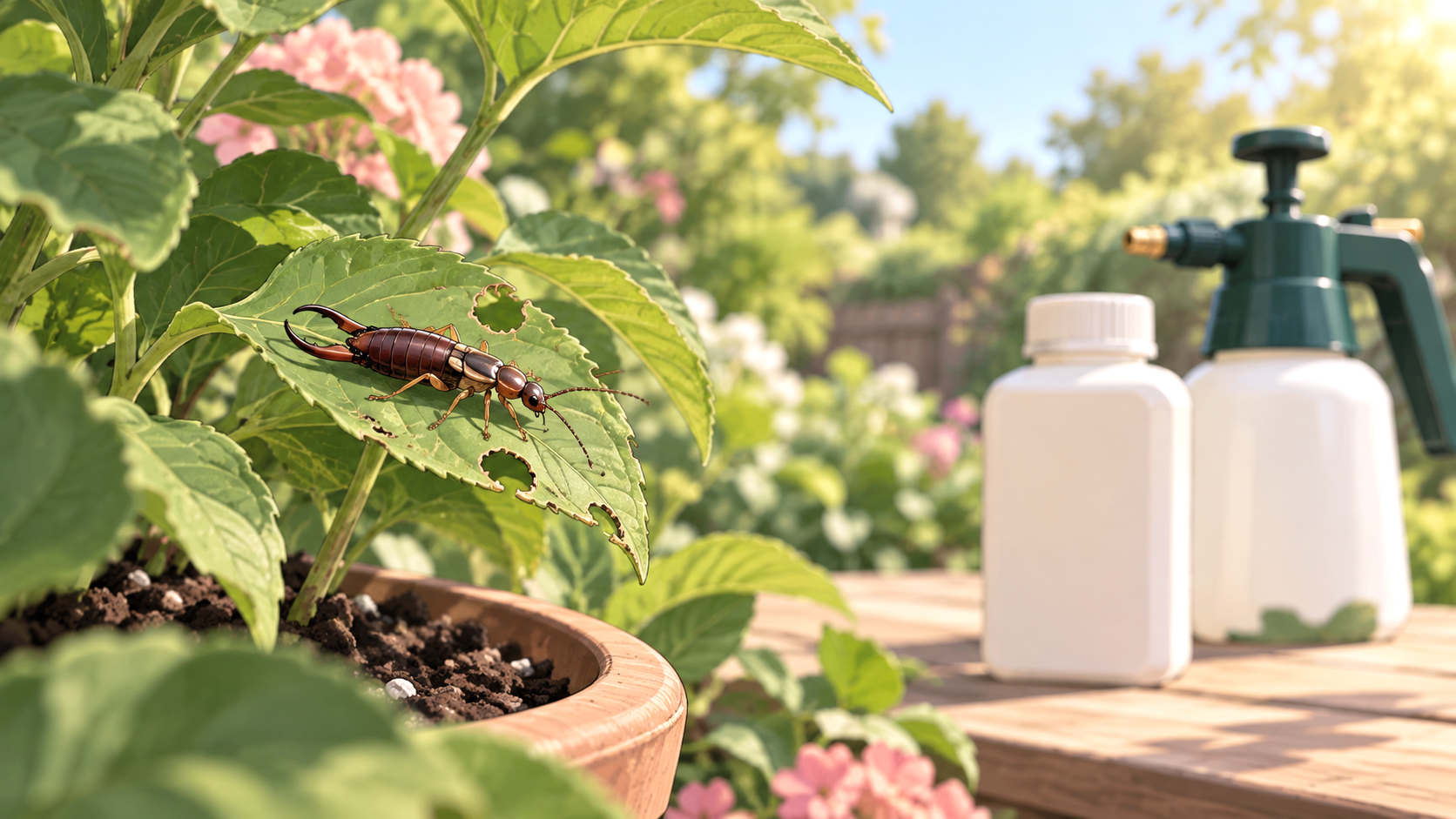
Spinosad kills earwigs, and research confirms its effectiveness against the European earwig (Forficula auricularia). It works when susceptible insects ingest or contact sufficient amounts of the insecticide. Spinosad-based baits and certain garden sprays are used for earwig control, but the formulation determines how exposure occurs and whether the product is legally approved for that purpose.
Spinosad is particularly relevant when earwigs are damaging susceptible plants. It is less useful as a general indoor treatment or as a precaution against insects that are present outdoors without causing problems. Products containing spinosad should be selected according to their actual earwig-control claims, not simply because they share the same active ingredient.
How Strong Is the Evidence That Spinosad Works Against Earwigs?
Spinosad has been evaluated specifically against European earwigs, including in controlled laboratory experiments and agricultural field trials. The evidence goes beyond general claims that the ingredient kills insects.
A study published in the Journal of Economic Entomology in April 2026 investigated spinosad and another insecticide delivered through experimental hydrogel baits. Researchers conducted laboratory trials with field-collected earwigs and tested the treatments in California citrus orchards. Earwig mortality increased following exposure to insecticide-infused hydrogel, while treated orchard trees had significantly fewer earwigs than untreated controls at six and fourteen days.
In the laboratory experiments, mortality increased over the observation period, and a later test reported mortality ranging from 83.1% to 100% across the insecticide treatments at 144 hours. These findings support the effectiveness of spinosad-containing experimental baits, but the mortality range covers more than one insecticide and treatment condition. It should not be presented as a guaranteed kill rate for commercially available spinosad products.
The study also tested specially prepared hydrogel baits rather than ordinary retail sprays or granules. Its results establish that the active ingredient can contribute to earwig control under the tested conditions without proving that every consumer formulation performs identically.
Established earwig management recommendations identify spinosad sprays and baits as useful insecticidal options where treatment is warranted. Their effectiveness still depends on the insects encountering the formulation in a location where it is permitted.
How Spinosad Kills Earwigs
Spinosad consists primarily of two related compounds, spinosyn A and spinosyn D, produced through fermentation involving the soil bacterium Saccharopolyspora spinosa. It acts on the insect nervous system, causing abnormal muscle contractions that progress to paralysis and death.
The toxicological properties of spinosad include activity through both ingestion and contact. These exposure routes are not equally important in every product. A bait is designed to encourage feeding, while a spray may expose an insect through direct application or contact with treated plant surfaces.
Sufficient exposure generally produces mortality over hours to days rather than guaranteeing instantaneous death. An earwig can remain mobile for some time after encountering the insecticide, and dead individuals may not remain visible at the application site.
Spinosad belongs to Insecticide Resistance Action Committee Group 5, a classification based on its action at insect nicotinic acetylcholine receptors. This distinguishes its mechanism from pyrethroid insecticides and other pesticide groups. The classification is relevant when resistance-management programs require rotation among different modes of action, although an occasional household earwig sighting does not justify creating a pesticide rotation schedule.
Spinosad Baits and Sprays Do Not Work the Same Way
The method used to deliver spinosad influences whether earwigs encounter a lethal dose. A granular bait must attract feeding insects, whereas a spray must reach the insects or surfaces they contact.
| Formulation | How earwigs encounter spinosad | Main limitation |
|---|---|---|
| Granular insecticidal bait | Earwigs consume bait containing spinosad | Competing food and poor placement can reduce feeding |
| Garden spray | Direct contact or exposure to treated plant surfaces | Concealed insects may escape exposure |
| Experimental hydrogel bait | Earwigs feed on insecticide-infused material | Research results cannot automatically be applied to retail products |
A commercially registered example is Seduce Insect Bait, containing 0.07% spinosad. Its manufacturer’s registered product information explicitly includes earwigs among the target insects. The granular formulation is intended for specified soil applications around agricultural crops and other labeled locations.
Another example is Sluggo Plus formulated for earwig control, which combines spinosad with iron phosphate. The two products share an insecticidal ingredient but have separate labels, intended uses, and application requirements.
Sprays require closer examination because many spinosad garden products are marketed primarily for caterpillars, thrips, leafminers, and beetles. A product containing spinosad is not automatically labeled for earwigs. The registered pest lists for individual spinosad products can differ substantially, even when the active ingredient is identical.
Do not assume that a spinosad spray can be used against earwigs simply because spinosad itself is effective. The selected product must authorize the pest and intended application site.
Why Spinosad Baits Sometimes Produce Disappointing Results
Bait performance depends on feeding behavior. Earwigs are omnivorous and may encounter numerous alternative foods, including decaying plant material and other small organisms. A bait placed among competing food sources may receive less attention than expected.
The limitations of spinosad bait treatments become particularly important after earwigs have already moved into susceptible plants or ripening fruit. Bait distributed on the surrounding soil may not reach insects feeding within dense foliage or fruit clusters.
Timing also influences exposure. Earwigs commonly forage after dark, so a bait intended for them must remain available where they travel. However, their nocturnal activity does not guarantee they will discover or consume nearby granules.
A bait can be effective against insects that feed on it while leaving others unaffected. Low consumption should not automatically be interpreted as resistance to spinosad.
Concealed activity creates a different limitation for sprays. Earwigs beneath tightly fitted objects, inside overlapping vegetation, or within inaccessible spaces may never contact the insecticide. Their ability to remain active despite previous treatment can result from incomplete exposure rather than unusual chemical tolerance.
Where Can Spinosad Be Applied for Earwig Control?
There is no single application rate or permitted location for spinosad as an ingredient. Registered products differ in concentration, formulation, intended crops, retreatment intervals, and environmental restrictions.
For example, Seduce Insect Bait is a soil-applied product used in specified agricultural and ornamental settings. Its directions describe distributing granules around or near plants requiring protection rather than spraying the foliage. The label also contains restrictions governing crop use, application frequency, and entry into treated areas.
A spinosad spray may be authorized for particular fruits, vegetables, or ornamental plants without listing earwigs among the target pests. Crop approval and pest approval are separate considerations. The exact combination must be permitted by the product’s registered labeling.
This becomes important where earwigs are suspected of feeding on garden plants. Irregular holes alone are not definitive evidence, and identifying actual earwig feeding damage prevents unnecessary application against the wrong insect.
Spinosad formulations intended for agricultural or outdoor garden use must not be repurposed for carpets, indoor cabinets, bedding, or other household surfaces unless the product specifically authorizes those uses.
For edible plants, follow the applicable preharvest interval and any restricted-entry requirements. These values can differ substantially among products and crops, so one spinosad label cannot be used to determine the waiting period for another formulation.
How Safe Is Spinosad for Bees and Other Beneficial Insects?
Spinosad is derived from a naturally occurring microorganism, and some formulations are permitted in organic production. Neither characteristic makes it harmless to non-target organisms.
The ingredient is highly toxic to bees during certain exposure conditions, particularly when spray deposits are wet. Research into spinosad exposure and pollinator risk has found substantially lower acute risks from appropriately dried residues under particular test conditions. Those findings do not override restrictions on individual product labels.
Applications should avoid exposing actively foraging bees and other pollinators. Evening application may reduce some exposure opportunities where the label permits it, but timing alone does not guarantee safety. Residues, treated flowers, and the formulation’s permitted uses must also be considered.
Milkweed requires additional caution. Earwigs can prey on monarch eggs and newly hatched caterpillars, but spinosad can harm susceptible insects beyond the intended target. Using an insecticide to protect monarchs from one predator can introduce another hazard to the same habitat.
Spinosad also presents risks to certain aquatic invertebrates. Prevent application drift and runoff into ponds, streams, and drainage systems, and follow all environmental restrictions printed on the container.
Human and pet exposure precautions remain necessary. Spinosad has comparatively low acute mammalian toxicity, but products can cause irritation or other effects. Wear the protective equipment specified by the label, keep children and pets away as directed, and store the pesticide in its original container.
When Spinosad Is a Reasonable Choice for Earwigs
Spinosad is most appropriate when earwig activity is causing identifiable, unacceptable damage and a registered formulation is suitable for the location. It is less compelling when the insects are merely present in a garden without causing harm.
Earwigs can also consume aphids and other plant pests. Applying a broad treatment against low populations may reduce useful predators while exposing other beneficial insects. The integrated pest management approach favors assessing the problem and choosing interventions according to actual need.
After an authorized application, evaluate whether new feeding damage and live earwig activity decrease. A lack of visible insect carcasses is not sufficient evidence of failure, particularly with ingestible baits. Conversely, reduced activity after treatment does not prove that every earwig in the surrounding area has been eliminated.
Where continued treatment is being considered, follow the product’s prescribed intervals and maximum application limits rather than increasing the dose. A persistently high number of earwigs may indicate that the selected formulation is not reaching them or that conditions continue to support substantial activity.
Spinosad has credible scientific support as an earwig-control ingredient, including recent experimental evidence. The useful decision for a gardener is whether a particular registered bait or spray can safely expose the earwigs causing the problem, without creating unnecessary risks for surrounding plants, pollinators, and wildlife.